 |
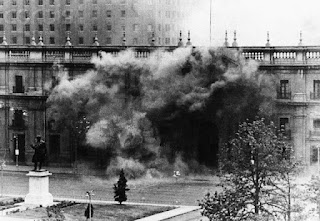
| September 11, 1973: The Bombing of the Moneda, Santiago, Chile (Corbis) |
It's a strange irony that before 2001, the date September 11th was already etched into the history of infamy by another act of brutal violence. For on that date in 1973, working in collusion with the U.S. government, the Chilean military overthrew the elected Popular Unity (UP, or Unidad Popular) government of President Salvador Allende, bombing the presidential palace, murdering Allende himself, and beginning a dark chapter of repression resulting in the murder of thousands of Popular Unity supporters, leftists, trade unionists, and regular working people.
 |
| ¡Crear Poder Popular! Create Popular Power! |
Allende, a socialist, had risen to power not through a revolution but through an election. With broad popular support from the Chilean left and the Chilean working class, he attempted the socialist transformation of Chilean society without first overthrowing the capitalist state. It's easy in retrospect to criticize Allende, and important in many ways to do so. Indeed, in my opinion he and the leftist parties that backed him committed serious errors that paved the way for their own destruction. But at the same time the Chilean experiment in a new road to socialism is filled with important lessons for people seeking a path to a new world. Some of these lessons were brutal and hard, but others inspiring. In the end I think history marks Allende as a hero, even if a tragic one. He fell in combat for a better world.
Chile in the early 1970s became a kind of crucible where the struggle between the classes became super-heated. As working people took to the streets, the upper classes responded in kind, playing havoc with the Chilean economy. While thousands of students and middle-class people joined the workers and the leftists parties in the struggle for economic transformation, thousands more formed outright fascist organizations to combat the restive working class. As working people occupied farms and factories to support the socialist and communist dominated government, other working people challenged its rule. Indeed some leftist parties distanced themselves from the Allende government.
New forms of workers autonomy, and workers and community control sprung up everywhere.
"Create Peoples' Power!" became the watchword of the people out in the street. Despite some conciliatory efforts toward the propertied classes by the Allende government, the workers' movement in Chile became a speeding train, clearly approaching a collision with state power. To see how the Chilean population radicalized and politicized in the course of revolutionary events is awe-inspiring. Regular people understood the importance of acting together: it became obvious how they themselves had the power to change Chilean society: how politics seeped into the daily acts of living. The workers were miles ahead of Allende himself.
While Allende was freely elected, he was never able to achieve a majority for UP in the Chilean parliament, and always forced to make allowances with professedly progressive factions of the bourgeoisie and their military. And this, of course was his undoing.
The Popular Unity made much of a nonviolent path to socialism, but this proved to be a pipedream. Violence, or the threat of violence, is the underpinning of class society. Marx and Engels made this clear long ago in
The Communist Manifesto, and the events in Chile were a like a blank slate waiting for the violence to fill itself in. Fatally, Allende and Unidad Popular failed to disarm the military, the instrument of potential violence of the ruling class, and failed to arm the people and create workers militias, the force necessary to meet the (unwanted) violence everybody could see coming. The propertied classes and their allies would defend the capitalist state to the death against those who sought to dismantle it. It was not necessary for the Chilean revolution to advocate violence, merely to soberly prepare itself against the building threat.
Allende thought he had split the allegiance of the military: Pinochet, the man who became Chile's military dictator, was among the supposedly "loyal" officers who Allende rallied to defeat an earlier coup attempt in mid-1973. But the military was just biding its time, all the time plotting and colluding with the CIA and the US government. The Chilean ruling class wasn't sitting idly by waiting for Allende or the workers to expropriate them: they were organizing and building their own counterrevolution just as surely as the people were building their revolution. But in the crucial moment the ruling classes had the jets and the bombs and the tanks and the machine guns.
And they held the stadium that was turned into a giant concentration camp into which leftists were herded and murdered: there perished the legendary musician
Victor Jara, proud supporter of the UP, who had his hands smashed and broken by military torturers before they made him play one last song before they killed him.
It's no accident that after the success of the coup, when all the manifestations of people's power were smashed, Chile became an economic labratory for American economists of the ilk of Milton Friedman and his cothinkers, the forerunners to the trickle-down theorists so beloved by American conservatives. They wanted a Chile with a docile, pacified population, with subdued or eliminated trade unions, and a disappeared political opposition. Thousands were murdered, and the blood of those martyrs is on the hands of the U.S. government and all those civilian economic vultures as surely as it on the hands of the fascist elements in Chilean society.
 |
| Salvador Allende's distinctive glasses, recovered from the rubble, preserved in a museum in Chile |
|
Allende
took to the radio from the Moneda Palace while it was under attack by those jets and tanks:
"Other men will overcome this dark and bitter moment when treason
seeks to prevail. Go forward knowing that, sooner rather than later, the great avenues
will open again where free men will walk to build a better society." Within a few hours he was dead, and the Chilean experiment was crushed by a U.S.-backed fascist jackboot. While today the military dictatorship is a thing of the past, the struggle for
poder popular continues in Chile, and for people around the world who dream of that better world.
Strongly recommended: "La Batalla de Chile: La lucha de un pueblo sin armas," Patricio Guzmán's extended black-and-white documentary study of the end of the Unidad Popular government. A must-see: readily available on DVD.


