Showing posts with label 911. Show all posts

Monday, September 10, 2012

The Other September 11th

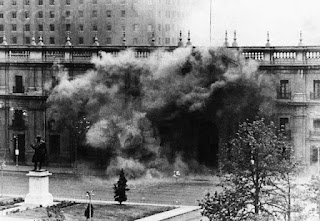
September 11, 1973: The Bombing of the Moneda, Santiago, Chile (Corbis)
It's a strange irony that before 2001, the date September 11th was already etched into the history of infamy by another act of brutal violence. For on that date in 1973, working in collusion with the U.S. government, the Chilean military overthrew the elected Popular Unity (UP, or Unidad Popular) government of President Salvador Allende, bombing the presidential palace, murdering Allende himself, and beginning a dark chapter of repression resulting in the murder of thousands of Popular Unity supporters, leftists, trade unionists, and regular working people.


¡Crear Poder Popular! Create Popular Power!

Allende, a socialist, had risen to power not through a revolution but through an election. With broad popular support from the Chilean left and the Chilean working class, he attempted the socialist transformation of Chilean society without first overthrowing the capitalist state. It's easy in retrospect to criticize Allende, and important in many ways to do so. Indeed, in my opinion he and the leftist parties that backed him committed serious errors that paved the way for their own destruction. But at the same time the Chilean experiment in a new road to socialism is filled with important lessons for people seeking a path to a new world. Some of these lessons were brutal and hard, but others inspiring. In the end I think history marks Allende as a hero, even if a tragic one. He fell in combat for a better world.

Chile in the early 1970s became a kind of crucible where the struggle between the classes became super-heated. As working people took to the streets, the upper classes responded in kind, playing havoc with the Chilean economy. While thousands of students and middle-class people joined the workers and the leftists parties in the struggle for economic transformation, thousands more formed outright fascist organizations to combat the restive working class. As working people occupied farms and factories to support the socialist and communist dominated government, other working people challenged its rule. Indeed some leftist parties distanced themselves from the Allende government.

New forms of workers autonomy, and workers and community control sprung up everywhere. "Create Peoples' Power!" became the watchword of the people out in the street. Despite some conciliatory efforts toward the propertied classes by the Allende government, the workers' movement in Chile became a speeding train, clearly approaching a collision with state power. To see how the Chilean population radicalized and politicized in the course of revolutionary events is awe-inspiring. Regular people understood the importance of acting together: it became obvious how they themselves had the power to change Chilean society: how politics seeped into the daily acts of living. The workers were miles ahead of Allende himself.

While Allende was freely elected, he was never able to achieve a majority for UP in the Chilean parliament, and always forced to make allowances with professedly progressive factions of the bourgeoisie and their military. And this, of course was his undoing.

The Popular Unity made much of a nonviolent path to socialism, but this proved to be a pipedream. Violence, or the threat of violence, is the underpinning of class society. Marx and Engels made this clear long ago in The Communist Manifesto, and the events in Chile were a like a blank slate waiting for the violence to fill itself in. Fatally, Allende and Unidad Popular failed to disarm the military, the instrument of potential violence of the ruling class, and failed to arm the people and create workers militias, the force necessary to meet the (unwanted) violence everybody could see coming. The propertied classes and their allies would defend the capitalist state to the death against those who sought to dismantle it. It was not necessary for the Chilean revolution to advocate violence, merely to soberly prepare itself against the building threat.

Allende thought he had split the allegiance of the military: Pinochet, the man who became Chile's military dictator, was among the supposedly "loyal" officers who Allende rallied to defeat an earlier coup attempt in mid-1973. But the military was just biding its time, all the time plotting and colluding with the CIA and the US government. The Chilean ruling class wasn't sitting idly by waiting for Allende or the workers to expropriate them: they were organizing and building their own counterrevolution just as surely as the people were building their revolution. But in the crucial moment the ruling classes had the jets and the bombs and the tanks and the machine guns.

And they held the stadium that was turned into a giant concentration camp into which leftists were herded and murdered: there perished the legendary musician Victor Jara, proud supporter of the UP, who had his hands smashed and broken by military torturers before they made him play one last song before they killed him.

It's no accident that after the success of the coup, when all the manifestations of people's power were smashed, Chile became an economic labratory for American economists of the ilk of Milton Friedman and his cothinkers, the forerunners to the trickle-down theorists so beloved by American conservatives. They wanted a Chile with a docile, pacified population, with subdued or eliminated trade unions, and a disappeared political opposition. Thousands were murdered, and the blood of those martyrs is on the hands of the U.S. government and all those civilian economic vultures as surely as it on the hands of the fascist elements in Chilean society.


Salvador Allende's distinctive glasses, recovered from the rubble, preserved in a museum in Chile
Allende took to the radio from the Moneda Palace while it was under attack by those jets and tanks: "Other men will overcome this dark and bitter moment when treason seeks to prevail. Go forward knowing that, sooner rather than later, the great avenues will open again where free men will walk to build a better society." Within a few hours he was dead, and the Chilean experiment was crushed by a U.S.-backed fascist jackboot. While today the military dictatorship is a thing of the past, the struggle for poder popular continues in Chile, and for people around the world who dream of that better world.

Strongly recommended: "La Batalla de Chile: La lucha de un pueblo sin armas," Patricio Guzmán's extended black-and-white documentary study of the end of the Unidad Popular government. A must-see: readily available on DVD.


Sunday, September 11, 2011

911 remembered: two images


The elegant "Towers of Light" memorial, from the site of the World Trade Center in New York City, last night. Photo by me.


The chart that says it all. From RT, via Kasama.

Echoes of a Past Life: Dies Irae

This is my 911 story, reposted from last year. I post it here as a ritual contribution to the tenth year anniversary of the tragedy; but I don't think I'll be reposting it every year. The murder of so many innocent people was horrific, but the fact that they were Americans does not make it a more horrific event than the drawn out murder of many thousands more around the world in the decade since. The innocents killed so senselessly in the decade of revenge after 2001 were priceless, multidimensional and unique human beings snuffed out as unjustly as the American officeworkers and firefighters were at the Twin Towers, and it doesn't help to know that many of those killed in the past few years were done so on the questionable claims of American leaders. Whether targets or the obscenely labelled "collateral" deaths: they're just as dead and gone, and their survivors suffer equally. It's time to move on, not from the memories of the treasured souls we lost, but from waving 911 about as though it qualifies American survivors for some kind of uniquely righteous grief. My heart goes out to those who lost relatives, lovers and friends on that day, but if people started seeing the faces of their lost loved ones in the faces of somebody else's lost loved ones taken by American militarism in distant lands, then maybe we'd be further along to preventing future senseless tragedies.


My friend Jim lived uptown, and I lived in Brooklyn. We'd meet up midway between us, often at the World Trade Center. Jim had an entirely questionable fetish for Marvin the Martian and underneath the WTC plaza, near the massive banks of escalators going down to the Path trains was a shop that sold cartoon trinkets like Marvin the Martian figurines. So stopping there was always a plus for him, before walking to Chinatown for lunch or hopping on a Path train to visit a mall in Jersey. I remember seeing a poster for the Windows on the World restaurant, thinking that it would be an awesome place to get a meal. Somehow we never made it there, until, well, it stopped being there; returned to an ethereal spot of empty sky.

On Tuesday, September 11, I walked a couple short blocks from my apartment in Brooklyn to the school where I was going to cast votes in an election primary. God what a beautiful day. Blue sky, warm but not hot. It wasn't a presidential year--that had been a disaster the previous fall--and I don't even remember who I was voting for. I got to the school when I noticed a small handful of people standing on the corner. I asked them what was going on. Prospect Heights wasn't called that for nothing; one of the highest spots in Brooklyn. They pointed and plain as day you could see the twin towers of the World Trade Center. Funny thing, there was smoke coming out of one of them. "It's on fire," someone said. If there was anything in their voice it was doubt and confusion. Such a thing was hard to fathom. How would the fire trucks spray water up so high? "Oh wow my wife works there. I hope she's ok," said a man nervously. Others muttered reassuringly. I went into the school. Turnout was light, of course. When I got out of the school the people were still on the corner. I looked up at the smoke. Strange, I thought.

As I crossed the street out of view of the Manhattan sky I heard loud gasps behind me. Two women had moved their hands to their faces. I walked on, a little more confused, but I didn't want to be late for work. I walked around the corner to the diner to pick up coffee and a roll. I could see smoke drifting in the sky, but couldn't see the towers. When I got to the diner I said to the lady who made me coffee every morning, "Hey look. The World Trade Center is on fire." "Really?" You couldn't really see it from inside. She kinda scrunched down so she could see the sky. "Oh my God, what happened?" She quickly turned on the radio.

I had two more blocks til I reached the subway. At Flatbush Avenue there was a crowd looking across to Manhattan. Hey wait, now there was smoke coming from both towers. That made no sense at all. "What happened?" I asked. "Two small planes crashed into the towers," someone told me. "Somebody must have gone crazy at Newark and got their directions wrong and sent planes into the buildings!" somebody speculated. There was a lot of smoke. You could see a thin line of fire, even at that distance. I didn't want to be late for work so I went down into the subway.

As the train rolled over the Manhattan bridge the motorman or conductor made an announcement. "The World Trade Center is on fire." There were loud cries in the car and people rushed to the windows on the left side of the train. It was a crazy sight. "What happened?" No one could figure it out. The train crossed the bridge and plunged back into the darkness underground.

At Times Square I got out. I came up that secret back stairway by the recruiting center. There was nobody on the street. It was weird. The huge jumbotrons had these strange pictures I didn't understand. It looked like smoke pouring off cascading dust and rubble like liquid. I couldn't make sense of what I was seeing. I looked downtown. I saw some smoke, high in the sky. But you could never see the towers from Times Square. I walked the two blocks to work.

I took the elevator up and somebody ran by me, crying. The floor was strangely empty, its energy electric and off-center. I found my boss and some coworkers huddled around a television in a conference room. "The first tower fell!" someone said. "People were jumping!" said another. "Did they say what happened? Somebody in Brooklyn said a flight controller had freaked out." I wanted to know. "Terrorists," somebody said. Somebody ran into the conference room. "There are more planes. Another one hit the Pentagon. They say some are heading this way. They don't know how many more there are. We have to get out of here."

We all paused; picturing the canyons of Times Square beckoning like a giant target to all comers. Even indoors I found myself wanting to look up to scour the sky for approaching danger. I wanted to duck. I went to find one of my coworkers; she was gone already or hadn't come in. My boss rushed by me saying "Oh my God the second tower fell. We have to get out of here. Come to our place." My boss lived near Union Square. It seemed like a very good suggestion. The streets were no longer empty; we met up with his partner on a corner and walked down to the apartment they shared. Although I know for days and days later I had trouble getting television and radio reception, they had cable, and we watched the unfolding story on the television unable to speak much. The towers were gone; it seemed like building after building was being consumed by a huge fire.

I realized I had to go home. The subways had been turned off. We imagined the two subway lines that passed under the towers turned to caverns of rubble. There was no choice but walking. All of Manhattan was emptying out. By the time I reached the Manhattan Bridge I was part of a long column of tired, silent people trudging home. The further south we all walked the more the air was acrid with burning. Some people had congealed smoke on their upper lips. Huge columns of smoke pulsed into the sky below us, but none of us stopped to stare at them. The people were silent but the air was filled with the screams of sirens and the whirl of flashing lights. So many sirens. At the foot of the bridge volunteers had amassed with paper cups from the Red Cross full of fresh, cool, water. When a woman handed me a cup I started to cry. I still have that cup. (The photo above is not my cup. My cup is in a paper bag with newspapers from the days that followed that I can't bear to consider looking at but can't bear to consider throwing away either. This cup photo is from somebody's flickr.) After downing that impossibly delicious liquid, I hung onto that cup across the bridge; and I didn't look back.

Somewhere in downtown Brooklyn the crowd thinned. The streets were oddly calm, no sirens, no rushing about. Somebody said that the subway under Flatbush Avenue was running again, and I went underground and rode the last way home. Once home I checked in with friends and family. Jim was okay, but two of his coworkers had been at a conference at Windows on the World and they were missing. David was okay, but he had watched the whole day from his roof in the East Village. He described roofs full of clots of people all screaming as the towers twisted and fell. I reassured my mom I was okay. Strangely (we had not actually talked in over a decade), I even got email from my father.

In the morning the air smelled of fire. You could see smoke from my tiny bathroom window. A pillar of smoke where you could previously see silver towers. Crazily I went into work. Which was a mess. My department head's brother who worked in the towers was missing. Coworkers were xeroxing flyers with his face on it and dividing up into squads to scour the hospitals. An IT's guys fiancee who worked across the street from the towers had somehow died at her desk. Nobody was working. There was a lot of crying. In the early afternoon all of us who had made the futile attempt to carry on with normality called it a day. We all realized the utter impossibility of faking it, and stayed home til the next Monday.

I remember that week through a daze of tears. What had happened? It made no sense. The papers were filled with unbelievable photos and accounts of what had happened; details burned into my memory that writers had to get off their chests that now we know are better left unspelled out. You'd look at the photos with the tiny falling people, or the ones with figures peering out from the wreckage high in the sky, trying to make out the expression on a tiny doomed face. And then of course you'd cry. I'd be trying to watch TV, the antenna positioned weirdly to get the one channel that worked. I'd start crying. Alone with my thoughts, I'd start crying. I walked over to Park Slope. At the firehouse there the sidewalk was filled with candles and flowers. The air there was so thick with spirits and grief it vibrated; it was like walking through waves. I cried, and turned back. At a local Presbyterian church there was a service, I went in just in time for its ending. I stood by the door, my lips and eyes quivering with coming tears, as a procession of black women dressed as though it were Sunday walked by me, shaking my hands with the softest palms and fingers I have ever felt, sharing a state of grace that brings me back to those tears even in memory. Few words needed to be shared. We all knew what it was about.

Out and about everywhere you went were walls of photos. Faces of the missing, the lost. People were not yet ready to believe all these faces had just vanished into smoke. I went to Union Square in Manhattan. It was filled with candles and flowers and signs and love. And unlike the belligerent voices threatening from the airwaves it was filled with calls for peace. I have never seen it so beautiful. It was such a healing place. I passed by there and paused often til one night they carted it all away. You couldn't go downtown. There was still a pillar of fire. And a terrible chemical-tainted stench. And now metal fences and bars.

I wondered where I would meet up with Jim. Ironically at some point I saw a post-911 photo of the basement of the World Trade Center. It was after the fires had been extinguished but before the ruins were demolished and the pit was cleared out. There was a photo of that underground lobby and the banks of escalators. They were still there. Dead still and empty; dust-covered. But not crushed. Not damaged; somehow the collapsing towers had missed them. They looked pretty much like Jim could have been standing there next to his favorite store window waiting for me to show up.

Months later, before he moved out of town, when meeting up with Jim in the Village, I'd find him stopping and staring into the sky with a puzzled look on his face. "I'm trying to remember," he'd say, "if I could see them from here. Now that they're gone, I can't seem to figure out where they were." And although he had seen the pillars of smoke on his trip home from work and in the days that followed, he had seen the burning towers only on TV. To him, one minute they were there in the background, and then in another, they weren't. Me, I remember details about the streets around the World Trade Center that I realize I'm not sure where they were; even today I can't really register the changed landscape downtown with the one in my memory.

In the days and weeks and months that followed gradually the posters were all taken down. After months of ritually retelling our survival stories, we eventually tired of them. The intimacy felt by strangers on the street eventually faded back into the anonymity favored by us city dwellers. While now "911" tumbles easily off the lips, for at least a year the people I knew just referred to it as The Day, or The Events. To name it seemed casually obscene. To turn what we had been through into a jingoism-tinged catchphrase was unthinkable.

There are those who curl their lips when recalling that day, snarling out vengeance. "Never forget. Never forgive." It's still stencilled on firetrucks and police cars and pickup trucks. Me I don't like those words. Oh I know the terrorists who committed this horrible crime could just have easily been aiming at me. I'm well aware of God's grace and there but for where I might be going. But I'm tired of the rage of 911; tired of that day of wrath, and as tired of the hatred it has spawned as of the hatred that spawned it. I'm tired of seeing American flags pasted and painted on any possible flat space as some kind of chest-thumping passive-aggressive dare. I'm tired of the crimes committed in the name of that Day.

The people who died that day weren't special. They were just regular people going on with their lives. Some were working, some were travelling. Some were just passing by. Some were selflessly doing some very dangerous jobs. But there aren't none of us better than any of the rest. And no amount of killing other regular people thousands of miles away is gonna bring them back or make meaning out of a senseless loss. That "two wrongs don't make a right" cliche? It's actually pretty wise.

It's not my religion, but the hymn "Day of Wrath" resonates:

Worthless are my prayers and sighing,
yet, good Lord, in grace complying,
rescue me from fires undying!
While the wicked are confounded,
doomed to flames of woe unbounded
call me with thy saints surrounded.
Low I kneel, with heart submission,
see, like ashes, my contrition;
help me in my last condition.
Ah ! that day of tears and mourning !
From the dust of earth returning
man for judgment must prepare him;
Spare, O God, in mercy spare him !


It's time for a season of mercy.

Monday, May 02, 2011

Repost: War Is Over If You Want It

I originally wrote and posted the following in December of 2009. In a strange week where Obama seized control of the "birther" farce, apparently at least acquiesced in an assassination attempt against Qaddafi, and announced just moments ago the killing of Al Qaeda leader Osama Bin Laden in Pakistan, I'm haunted once more by John Lennon and Yoko Ono's powerful challenge that we are in control of our own destiny. I shed no tears for Osama, leader of a vicious right-wing fundamentalist sect; but so much water has passed under the bridge in the nine years since the awful events of 9/11 it's hard not to factor in all the lives cruelly wasted by the American quest for vengeance. The challenge, of course, in being either a pacifist or an opponent of the death penalty, is to mean it. We can have better, if only we would so choose.


"...I refuse to accept the view that mankind is so tragically bound to the starless midnight of racism and war that the bright daybreak of peace and brotherhood can never become a reality.

"I refuse to accept the cynical notion that nation after nation must spiral down a militaristic stairway into the hell of thermonuclear destruction. I believe that unarmed truth and unconditional love will have the final word in reality. This is why right temporarily defeated is stronger than evil triumphant. I believe that even amid today's mortar bursts and whining bullets, there is still hope for a brighter tomorrow. I believe that wounded justice, lying prostrate on the blood-flowing streets of our nations, can be lifted from this dust of shame to reign supreme among the children of men. I have the audacity to believe that peoples everywhere can have three meals a day for their bodies, education and culture for their minds, and dignity, equality and freedom for their spirits. I believe that what self-centered men have torn down men other-centered can build up. I still believe that one day mankind will bow before the altars of God and be crowned triumphant over war and bloodshed, and nonviolent redemptive good will proclaim the rule of the land. 'And the lion and the lamb shall lie down together and every man shall sit under his own vine and fig tree and none shall be afraid.' I still believe that We Shall overcome!"
--The Rev. Dr. Martin Luther King Jr., in his acceptance speech of the Nobel Peace Prize in 1964

"We must begin by acknowledging the hard truth that we will not eradicate violent conflict in our lifetimes. There will be times when nations - acting individually or in concert - will find the use of force not only necessary but morally justified.

"I make this statement mindful of what Martin Luther King said in this same ceremony years ago - 'Violence never brings permanent peace. It solves no social problem: it merely creates new and more complicated ones.' As someone who stands here as a direct consequence of Dr. King's life's work, I am living testimony to the moral force of non-violence. I know there is nothing weak, nothing naïve - in the creed and lives of Gandhi and King.

"But as a head of state sworn to protect and defend my nation, I cannot be guided by their examples alone. I face the world as it is, and cannot stand idle in the face of threats to the American people. For make no mistake: evil does exist in the world. A non-violent movement could not have halted Hitler's armies. Negotiations cannot convince al Qaeda's leaders to lay down their arms. To say that force is sometimes necessary is not a call to cynicism - it is a recognition of history; the imperfections of man and the limits of reason.

"I raise this point because in many countries there is a deep ambivalence about military action today, no matter the cause. At times, this is joined by a reflexive suspicion of America, the world's sole military superpower."


--President Barack Obama in his acceptance speech of the Nobel Peace Prize today

"War, huh
What is it good for?
Absolutely nothing
Listen to me

"War, it ain't nothin' but a heartbreaker
War, friend only to the undertaker, oh

"Peace, love and understanding, tell me
Is there no place for them today?
They say we must fight to keep our own freedom
But Lord knows there's gotta be a better way"

--Edwin Starr/Norman Whitfield/Barrett Strong song lyrics, 1970

I give credit to President Obama for an attempt to reconcile his respect for the civil rights tradition while trying to justify his role as commander in chief of the largest military machine the world has ever known: he presented a thoughtful argument for the idea of a just war, for well-behaved war, for nice war with rules and fairness. His speech today has provoked me to read some other speeches, and to assess what I believe. I'd certainly rather hear Obama's reasoned argument than those base and empty appeals to "freedom" a la Reagan or Bush. If I wanted to hear that war is peace or freedom is slavery I know which bookshelf to find Orwell on. Obama is a good speaker if not, here, a fiery one, and I'm glad to be pushed to affirm my own views.

I am proud that my father and his paternal line were peaceful people who ran from war, who would uplift their lives and families and give up their homes rather than serve in the military. They did this over and over again when they fled Germany in the 1700s and when they fled Russia in the early years of the last century and when my father did it before I was born in the 1950s. But I'm also proud of my father's maternal line; that my great great grandfather donned that blue uniform to defeat the racist Confederacy.

I am deeply persuaded by Dr. King's profound notion that the long and difficult path of non-violence was the way to respond to the violence of racism in such a way as to transform and transcend a social relationship not just suppress or repress it. But I am also deeply persuaded by the righteousness of generations of anti-colonial revolutionaries who were drawn to armed struggle in their path of liberation.

These are contradictions, and I think it was courageous of Obama to acknowledge that fundamental contest of justice and violence. But here's another contradiction: I think that U.S. military intervention anywhere in the world--with the debatable exception of the Second World War--is always and fundamentally wrong. And I think it was deeply disingenous of Obama to weave so slender a thread around the real story of the misery inflicted by the U.S. on so many nations and peoples around the world in pursuit of its own self-righteous agenda.

As someone living in New York City during the events of September 11, 2001, I could easily have been one of the people the Al-Qaeda hijackers were trying to kill. I think that the religious fundamentalists behind those criminal attacks needed to be brought to justice; not because they dared threaten the American way of life but because they chose to blame and kill a bunch of innocent people. In that sense I'm not entirely unsympathetic to the American destruction of the Taliban in the aftermath of 9/11 if it's viewed as a mission to arrest criminals.

But it is the history of the crucible of those religious fundamentalists--Afghanistan--that shows the deadly chain reaction that belief in "a just war" causes. The "Just War" of the Soviets aiding the secular Afghan revolution; the "Just War" of the Mujahedeen expelling the foreign invaders; the "Just War" of the Taliban fighting the corrupt tribal Mujahedeen militias; the "Just War" of the US against the Taliban and their Al-Qaeda guests, and now, from someone else's perspective, the "Just War" of the Taliban again to expell new foreign invaders: where do these "Just Wars" end? How many regular people is it okay to kill to steer the wheels of history in a different direction?

Here's the thing. As long as people like Obama rationalize their seduction by war, all those good intentions mean nothing because in the end it comes down to parents on the wrong side of some arbitrary line on a map made to scream and weep inconsolably over the bloodied bodies of their children.

It took me many years to understand it, but John Lennon and Yoko Ono's famous Christmas Greeting is so deeply profound:

"WAR IS OVER! if you want it."

As long as the leaders of this world--both the ones in whom we've placed our aspirations for good, like Obama, and the ones we feared as pure corrupt evil, like Bush--look for the "moral justifications" in their use of bombs and tanks and drones and missiles and guns and mines and cluster bombs, then we, the regular people, will suffer. This world of violence is our choice...unless we stop wanting it; unless we're brave enough to listen to the likes of Dr. King without adding that terrible soul-corrupting word "but."

I'd like to choose peace.

Saturday, September 11, 2010

Dies Irae


My friend Jim lived uptown, and I lived in Brooklyn. We'd meet up midway between us, often at the World Trade Center. Jim had an entirely questionable fetish for Marvin the Martian and underneath the WTC plaza, near the massive banks of escalators going down to the Path trains was a shop that sold cartoon trinkets like Marvin the Martian figurines. So stopping there was always a plus for him, before walking to Chinatown for lunch or hopping on a Path train to visit a mall in Jersey. I remember seeing a poster for the Windows on the World restaurant, thinking that it would be an awesome place to get a meal. Somehow we never made it there, until, well, it stopped being there; returned to an ethereal spot of empty sky.

On Tuesday, September 11, I walked a couple short blocks from my apartment in Brooklyn to the school where I was going to cast votes in an election primary. God what a beautiful day. Blue sky, warm but not hot. It wasn't a presidential year--that had been a disaster the previous fall--and I don't even remember who I was voting for. I got to the school when I noticed a small handful of people standing on the corner. I asked them what was going on. Prospect Heights wasn't called that for nothing; one of the highest spots in Brooklyn. They pointed and plain as day you could see the twin towers of the World Trade Center. Funny thing, there was smoke coming out of one of them. "It's on fire," someone said. If there was anything in their voice it was doubt and confusion. Such a thing was hard to fathom. How would the fire trucks spray water up so high? "Oh wow my wife works there. I hope she's ok," said a man nervously. Others muttered reassuringly. I went into the school. Turnout was light, of course. When I got out of the school the people were still on the corner. I looked up at the smoke. Strange, I thought.

As I crossed the street out of view of the Manhattan sky I heard loud gasps behind me. Two women had moved their hands to their faces. I walked on, a little more confused, but I didn't want to be late for work. I walked around the corner to the diner to pick up coffee and a roll. I could see smoke drifting in the sky, but couldn't see the towers. When I got to the diner I said to the lady who made me coffee every morning, "Hey look. The World Trade Center is on fire." "Really?" You couldn't really see it from inside. She kinda scrunched down so she could see the sky. "Oh my God, what happened?" She quickly turned on the radio.

I had two more blocks til I reached the subway. At Flatbush Avenue there was a crowd looking across to Manhattan. Hey wait, now there was smoke coming from both towers. That made no sense at all. "What happened?" I asked. "Two small planes crashed into the towers," someone told me. "Somebody must have gone crazy at Newark and got their directions wrong and sent planes into the buildings!" somebody speculated. There was a lot of smoke. You could see a thin line of fire, even at that distance. I didn't want to be late for work so I went down into the subway.

As the train rolled over the Manhattan bridge the motorman or conductor made an announcement. "The World Trade Center is on fire." There were loud cries in the car and people rushed to the windows on the left side of the train. It was a crazy sight. "What happened?" No one could figure it out. The train crossed the bridge and plunged back into the darkness underground.

At Times Square I got out. I came up that secret back stairway by the recruiting center. There was nobody on the street. It was weird. The huge jumbotrons had these strange pictures I didn't understand. It looked like smoke pouring off cascading dust and rubble like liquid. I couldn't make sense of what I was seeing. I looked downtown. I saw some smoke, high in the sky. But you could never see the towers from Times Square. I walked the two blocks to work.

I took the elevator up and somebody ran by me, crying. The floor was strangely empty, its energy electric and off-center. I found my boss and some coworkers huddled around a television in a conference room. "The first tower fell!" someone said. "People were jumping!" said another. "Did they say what happened? Somebody in Brooklyn said a flight controller had freaked out." I wanted to know. "Terrorists," somebody said. Somebody ran into the conference room. "There are more planes. Another one hit the Pentagon. They say some are heading this way. They don't know how many more there are. We have to get out of here."

We all paused; picturing the canyons of Times Square beckoning like a giant target to all comers. Even indoors I found myself wanting to look up to scour the sky for approaching danger. I wanted to duck. I went to find one of my coworkers; she was gone already or hadn't come in. My boss rushed by me saying "Oh my God the second tower fell. We have to get out of here. Come to our place." My boss lived near Union Square. It seemed like a very good suggestion. The streets were no longer empty; we met up with his partner on a corner and walked down to the apartment they shared. Although I know for days and days later I had trouble getting television and radio reception, they had cable, and we watched the unfolding story on the television unable to speak much. The towers were gone; it seemed like building after building was being consumed by a huge fire.

I realized I had to go home. The subways had been turned off. We imagined the two subway lines that passed under the towers turned to caverns of rubble. There was no choice but walking. All of Manhattan was emptying out. By the time I reached the Manhattan Bridge I was part of a long column of tired, silent people trudging home. The further south we all walked the more the air was acrid with burning. Some people had congealed smoke on their upper lips. Huge columns of smoke pulsed into the sky below us, but none of us stopped to stare at them. The people were silent but the air was filled with the screams of sirens and the whirl of flashing lights. So many sirens. At the foot of the bridge volunteers had amassed with paper cups from the Red Cross full of fresh, cool, water. When a woman handed me a cup I started to cry. I still have that cup. (The photo above is not my cup. My cup is in a paper bag with newspapers from the days that followed that I can't bear to consider looking at but can't bear to consider throwing away either. This cup photo is from somebody's flickr.) After downing that impossibly delicious liquid, I hung onto that cup across the bridge; and I didn't look back.

Somewhere in downtown Brooklyn the crowd thinned. The streets were oddly calm, no sirens, no rushing about. Somebody said that the subway under Flatbush Avenue was running again, and I went underground and rode the last way home. Once home I checked in with friends and family. Jim was okay, but two of his coworkers had been at a conference at Windows on the World and they were missing. David was okay, but he had watched the whole day from his roof in the East Village. He described roofs full of clots of people all screaming as the towers twisted and fell. I reassured my mom I was okay. Strangely (we had not actually talked in over a decade), I even got email from my father.

In the morning the air smelled of fire. You could see smoke from my tiny bathroom window. A pillar of smoke where you could previously see silver towers. Crazily I went into work. Which was a mess. My department head's brother who worked in the towers was missing. Coworkers were xeroxing flyers with his face on it and dividing up into squads to scour the hospitals. An IT's guys fiancee who worked across the street from the towers had somehow died at her desk. Nobody was working. There was a lot of crying. In the early afternoon all of us who had made the futile attempt to carry on with normality called it a day. We all realized the utter impossibility of faking it, and stayed home til the next Monday.

I remember that week through a daze of tears. What had happened? It made no sense. The papers were filled with unbelievable photos and accounts of what had happened; details burned into my memory that writers had to get off their chests that now we know are better left unspelled out. You'd look at the photos with the tiny falling people, or the ones with figures peering out from the wreckage high in the sky, trying to make out the expression on a tiny doomed face. And then of course you'd cry. I'd be trying to watch TV, the antenna positioned weirdly to get the one channel that worked. I'd start crying. Alone with my thoughts, I'd start crying. I walked over to Park Slope. At the firehouse there the sidewalk was filled with candles and flowers. The air there was so thick with spirits and grief it vibrated; it was like walking through waves. I cried, and turned back. At a local Presbyterian church there was a service, I went in just in time for its ending. I stood by the door, my lips and eyes quivering with coming tears, as a procession of black women dressed as though it were Sunday walked by me, shaking my hands with the softest palms and fingers I have ever felt, sharing a state of grace that brings me back to those tears even in memory. Few words needed to be shared. We all knew what it was about.

Out and about everywhere you went were walls of photos. Faces of the missing, the lost. People were not yet ready to believe all these faces had just vanished into smoke. I went to Union Square in Manhattan. It was filled with candles and flowers and signs and love. And unlike the belligerent voices threatening from the airwaves it was filled with calls for peace. I have never seen it so beautiful. It was such a healing place. I passed by there and paused often til one night they carted it all away. You couldn't go downtown. There was still a pillar of fire. And a terrible chemical-tainted stench. And now metal fences and bars.

I wondered where I would meet up with Jim. Ironically at some point I saw a post-911 photo of the basement of the World Trade Center. It was after the fires had been extinguished but before the ruins were demolished and the pit was cleared out. There was a photo of that underground lobby and the banks of escalators. They were still there. Dead still and empty; dust-covered. But not crushed. Not damaged; somehow the collapsing towers had missed them. They looked pretty much like Jim could have been standing there next to his favorite store window waiting for me to show up.

Months later, before he moved out of town, when meeting up with Jim in the Village, I'd find him stopping and staring into the sky with a puzzled look on his face. "I'm trying to remember," he'd say, "if I could see them from here. Now that they're gone, I can't seem to figure out where they were." And although he had seen the pillars of smoke on his trip home from work and in the days that followed, he had seen the burning towers only on TV. To him, one minute they were there in the background, and then in another, they weren't. Me, I remember details about the streets around the World Trade Center that I realize I'm not sure where they were; even today I can't really register the changed landscape downtown with the one in my memory.

In the days and weeks and months that followed gradually the posters were all taken down. After months of ritually retelling our survival stories, we eventually tired of them. The intimacy felt by strangers on the street eventually faded back into the anonymity favored by us city dwellers. While now "911" tumbles easily off the lips, for at least a year the people I knew just referred to it as The Day, or The Events. To name it seemed casually obscene. To turn what we had been through into a jingoism-tinged catchphrase was unthinkable.

There are those who curl their lips when recalling that day, snarling out vengeance. "Never forget. Never forgive." It's still stencilled on firetrucks and police cars and pickup trucks. Me I don't like those words. Oh I know the terrorists who committed this horrible crime could just have easily been aiming at me. I'm well aware of God's grace and there but for where I might be going. But I'm tired of the rage of 911; tired of that day of wrath, and as tired of the hatred it has spawned as of the hatred that spawned it. I'm tired of seeing American flags pasted and painted on any possible flat space as some kind of chest-thumping passive-aggressive dare. I'm tired of the crimes committed in the name of that Day.

The people who died that day weren't special. They were just regular people going on with their lives. Some were working, some were travelling. Some were just passing by. Some were selflessly doing some very dangerous jobs. But there aren't none of us better than any of the rest. And no amount of killing other regular people thousands of miles away is gonna bring them back or make meaning out of a senseless loss. That "two wrongs don't make a right" cliche? It's actually pretty wise.

It's not my religion, but the hymn "Day of Wrath" resonates:

Worthless are my prayers and sighing,
yet, good Lord, in grace complying,
rescue me from fires undying!
While the wicked are confounded,
doomed to flames of woe unbounded
call me with thy saints surrounded.
Low I kneel, with heart submission,
see, like ashes, my contrition;
help me in my last condition.
Ah ! that day of tears and mourning !
From the dust of earth returning
man for judgment must prepare him;
Spare, O God, in mercy spare him !


It's time for a season of mercy.

Friday, September 10, 2010

What Nine Years Have Wrought


Here's a headline that puts tomorrow's ninth anniversary of September 11 in some perspective:

U.S. Soldiers Allegedly Killed Afghan Civilians, Kept Body Parts As Trophies

"A dozen U.S. soldiers are charged with organizing a secret 'kill team' which allegedly murdered Afghan civilians at random and cut fingers and other body parts from corpses as trophies. Charging documents released Wednesday shed new light on the cases against 12 soldiers who served a year in southern Afghanistan with a Stryker infantry brigade. The most serious accusations involve five soldiers -- Calvin Gibbs, Adam Winfield, Jeremy Mortlock, Andrew Holmes and Michael Wagnon II -- who are said to have slain three Afghans earlier this year. According to reports, those men would likely be charged with premeditated murder, but may face additional charges relating to obstructing justice, possessing human body parts and retaining mortar rounds for personal use..."


This is Afghanistan they're talking about. You know, the good war, the one supposed to be preventing actual terrorists (as opposed to Saddam's imaginary ones) from attacking the U.S. I wonder who's winning that war? Because it sure looks like it's become a war of terrorist vs. terrorist to me.

Speaking of terrorists, a crazed anti-gay pastor of a microchurch in Florida may or may not have cancelled his plans to burn some holy Qurans to celebrate the anniversary of 911. The crazed anti-gay inbred morons of the Westboro Baptist Church may join in. Meanwhile, Muslim houses of worship in Tennessee and New York State have been targeted by bigots and arsonists. The proposed Islamic community center in downtown Manhattan continues to be attacked by right-wing Republicans, Zionists, and the odd liberal or two. Or three. People in government are actually suggesting Muslim Americans should be deprived of their rights.

All this hate against Muslims. Go on any blog to any discussion of Muslims, mosques or Islam and you'll find commenter after commenter reciting similarly worded tirades about Muslims overrunning Europe, inflicting Sharia law on civil societies, now setting their sights on our shores. Read these comments, these blogs, these news stories. Respectable news organizations ponder American anxiety over Muslims. Change Muslims to Jews. Change Mosque to Synagogue. Change Islam to Judaism. Do you not feel a chill down your spine?

What kind of country is this one becoming? What nation is in the throes of its birth? Who are these people who believe all Muslims share in the collective guilt of September 11? Who are these people who allow that insinuation, whose silence becomes acquiescence? Among the silent are allegedly progressive politicians. They know that the leaders of the Cordoba House initiative have nothing to do with terrorists, no specific links to Al Qaeda, well, as far as they know. But in their silence, or in their weak assertion that perhaps the proposed community center is legally right but morally unwise, they reveal a corruption in their hearts. They're willing to sacrifice Muslims on an altar of intolerance. The Carl Paladinos, Rick Lazios, and Sarah Palins of this world, these are the would-be Goebbelses and Himmlers of our time just waiting for their chance. And those who remain silent while Muslims are dehumanized and demonized and presumed guilty by association, they are the Good Germans who could have said something, but didn't. Nevermind the fact that many of those killed on 911 were Muslims. Nevermind that the biggest victims of Al Qaeda worldwide have been Muslims. Nevermind that Muslims aren't one monolithic mass. Nevermind that most of the tens (hundreds?) of thousands of people killed in the American wars of this new millennium have been Muslims.

"I just have to commit one act and the Americans will destroy themselves..." --Osama bin Laden

Who is winning this war that began on that beautiful and sad morning nine years ago? I don't think it's the good guys. It's another war that needs to end before the cancerous malignant rot at its core metastasizes. So who is profaning the memory of all those innocent people who died on September 11, 2001? It's not the people building mosques.

Tuesday, August 24, 2010

Hallowed Ground?


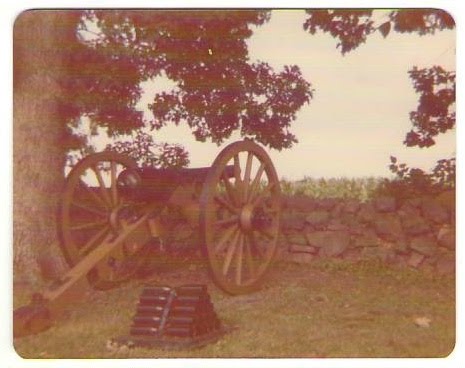
I think it was the summer before I graduated high school, which makes it 1975. My mom and I drove southward from where we lived in Connecticut to visit a dizzying chain of historical sites and memorials. I was big into history, and we, like many at the time, had a distracting light case of bicentennial fever as we tried not to look too hard at the utter idiot then occupying the White House. We went to all sorts of Revolutionary War and Civil War sites: battlefields, museums, you name it. I think this snapshot was taken at Gettysburg. I haven't been back there in the 35 years since, but I remember an endless expanse of fields, hot and humid and buzzing with insects, punctuated with stone walls and corn. There was a huge indoor mural and a scale model of the battlefield, and cannons were set up at various spots, as though the soldiers manning them had just that moment wandered away from their posts.

It really brought Gettysburg home to me; to picture the humanity rushing at each other with lethal intent; the bullets and cannonballs and limbs and blood flying, and on such a vast scale. They don't fight wars like that anymore. As much as I hate war, and hate the culture that excuses it as some kind of ugly necessity, I have to say of all the murderous exercises in wasting life that I have studied, the American Civil War comes closest to being the exception to prove the rule. How lucky we are to live in an America where the side that won were the ones who wore blue and not gray.

I'm glad Gettysburg is still there. It's important to remember what was defended there. It's not the unity of this country that resonates emotionally to me, but the destruction of that confederate nation built on the backs of slaves. Now that was a worthy cause, and I hope they keep Gettysburg like it is as testament to the thousands and thousands of men who died fighting for that victory.

I lived in New York City in 2001. I saw what happened on that beautiful September morning. I didn't see planes crash or bodies falling, but I saw smoke and flames, and witnessed the world we live in change forever. I went downtown to peer at the smoking ruins once a week or two later when they started letting people go back down there. For weeks and weeks you could see the plume of smoke from my bathroom window where previously you could see the towers, but this was while actual standing ruins were still there and I wanted to get closer. There were barricades and fences and black-clad soldiers or police or something with machine guns everywhere...I'm not sure who the guns were meant for; I didn't see any terrorists about. My friend had brought along a coworker in from out of state. "I'm so proud of Our Military and Our President," she pronounced. I wanted to vomit. And having just spent a week crying I realized I didn't actually want to look at the ruins too closely. I felt like I was looking at something I shouldn't be seeing.

When I went back to that neighborhood for other reasons in the months and years that followed, I would avert my eyes from the pit and the fence around it. I didn't want to see what wasn't there. To my disgust I would see tourists posing for snapshots in front of the pit. A young couple, smiling, posing. Families. And you could buy bizarre souvenirs, ranging from full color atrocity porn to little snowglobes with tiny firetrucks surrounding little model burning towers, with sprinkles like ash floating around in the water inside the glass domes. And eventually I listened and watched as Bush used the occasion...to attack a country that had nothing to do with that place and the tragedy there, emotionally manipulating an entire nation and profaning that spot forever.

While this is a big city, it's not so big that we can rope it all off leave it like Gettysburg. Life goes on here. There's a really comfy movie theater a half block from the pit and the discount department store right across the street from it still has great cheap shoes. We New Yorkers we just walk by, doing what we have to do to live our lives here, averting our eyes when necessary. The subway line I take to work runs right by the site, and for years now there have always been clusters of tourists heading there on my train. To see nothing, no more smoking ruin, no crumpled bodies or piles of ash, just a big hole in the ground. They would puzzle over the subway maps and ask stupid questions like "Does this train go to 911?" I guess I'm immune to them now but for years I wanted to shout at them. "It's not there any more!" I wanted to shake each one of them and demand to know if they had voted for Bush. Go away! This is not the place for you.

I haven't been by it in some months but I understand that there are now, nine years later, visible structures rising from the pit. While I sure wouldn't ever want to work in the new World Trade Center building, I guess I'm happy that something's being done. There should be a memorial there, there was a terrible tragedy and the friends and relatives of 2,700 or so people deserve a place to mourn. And I'm glad they've dispensed with the abomination of a name "freedom tower" for the new building. The greedy real estate developers are all still trying to figure out how that pit's going to keep them rich: for them it's a money pit, not hallowed ground.

And now so many years later so many other people have died. So much about our way of life has changed and gone. I still see black clad uniformed men with machine guns in the subways. Seven stupid years of war in Iraq, and nine stupid years of war in Afghanistan; millions of innocent Iraqis and Afghans mourning just like millions of New Yorkers and just as psychically damaged; millions of Iraqis and Afghans associating "terrorist bombing" with the United States and its callously murdering contractor hordes and silent inhuman predator drones and its shock and awe and manipulative self-righteousness. And a whole lot more than 2,700 lives cut short. If you listen you can hear them shout: "Go away! This is not the place for you!"

This past Sunday, in a rain storm, the site was again profaned. Not by Muslims who want to go ahead with their lives and build a community center at the abandoned storefront a couple blocks away that they've been using for years, but by monstrous bigots protesting that center. I heard a radio report: the woman interviewed was described as waving an Israeli flag. She was, and I am careful to rarely use this word, hysterical. Practically weeping she was ranting about how horrible it was that the Muslims were coming to bring Shariah law and a terrorist recruiting center to lower Manhattan and such a hallowed place. She was so filled with hatred and fear you could hear her body shaking at the terrible lies that filled her head. I saw a video of the event: a dark-skinned Puerto Rican man wearing an apparently un-American looking hat is threatened and bullied out of the rally by a lot of menacing white people. Three women in sunglasses make sure to stay in camera shot with signs saying the Mosque Supports Hamas. These are the people who voted for Bush. These are the ones who are prostituting the memory of a tragedy for a corrupt political cause. These are the hate-filled ignorant bigots, brothers under the skin with a bunch of terrorists who flew planes into buildings.

Again, I'm remembering it all. I want to rush up to these people and say, Go Away. This place is not for you.

Saturday, August 14, 2010

The Battlelines Are Drawn Over Cordoba House


The photo above shows a rightist protester holding up a sign at New York City hearing over Cordoba House's real estate: "No 9/11 Victory Mosque." Cordoba House is the downtown NYC Islamic community center and mosque being villified as the "Ground Zero Mosque" by the right wing.

It pains me to recognize that Mayor Michael Bloomberg is eloquently on the correct side of this issue:
"We may not always agree with every one of our neighbors. That's life. And it's part of living in such a diverse and dense city. But we also recognize that part of being a New Yorker is living with your neighbors in mutual respect and tolerance. It was exactly that spirit of openness and acceptance that was attacked on 9/11, 2001....
“Let us not forget that Muslims were among those murdered on 9/11, and that our Muslim neighbors grieved with us as New Yorkers and as Americans. We would betray our values and play into our enemies' hands if we were to treat Muslims differently than anyone else. In fact, to cave to popular sentiment would be to hand a victory to the terrorists, and we should not stand for that...
"For that reason, I believe that this is an important test of the separation of church and state as we may see in our lifetimes, as important a test. And it is critically important that we get it right...
"Muslims are as much a part of our city and our country as the people of any faith. And they are as welcome to worship in lower Manhattan as any other group. In fact, they have been worshipping at the site for better, the better part of a year, as is their right. The local community board in lower Manhattan voted overwhelmingly to support the proposal. And if it moves forward, I expect the community center and mosque will add to the life and vitality of the neighborhood and the entire city...
"Political controversies come and go, but our values and our traditions endure, and there is no neighborhood in this city that is off-limits to God's love and mercy, as the religious leaders here with us can attest."


Now President Obama has forcefully also come out on the correct side of the issue: "As a citizen, and as president, I believe that Muslims have the same right to practice their religion as everyone else in this country...That includes the right to build a place of worship and a community center on private property in lower Manhattan, in accordance with local laws and ordinances. This is America, and our commitment to religious freedom must be unshakable."(full text)

Contrast this with the remarks of insane racist blogger Pamela Geller whose "Atlas Shrugs" blog is leading the charge to paint Cordoba House as a den of terrorism: "Obama came out for the Islamic supremacist mosque at the hallowed ground of 911 attack. He has, in effect, sided with the Islamic jihadists and told the ummah (at an Iftar dinner on the third night of Ramadan, of course) that he believes in and supports a triumphal mosque on the cherished site of Islamic conquest. If you had any doubt who Obama stood with on 911, there can be no doubt in our minds now. I believe he planned it all along. He waited until Ramadan. Symbolic." Geller has previously ranted on issues of Obama's citizenship. She is the force behind the outrageously hateful and inciteful signs shortly to appear on NYC buses attacking Cordoba House. Lining up behind Geller's disgusting campaign are a host of right-wing Republicans ranging from local political candidates like Rick Lazio to unemployed quitter and political parasite Sarah Palin.

Even George Bush resisted the urge to tar all muslims with the taint of 9/11 terrorism. These unleashed forces of Islamophobia are indicative of the qualitative rightward shift that has been transforming the Republican base into something quite new and dangerous.

For more discussion of the issues around Cordoba House see my previous posts on the Massacre Monument, Islamophobia, and on "Everybody Draw Muhammad Day."

Thursday, July 01, 2010

Wednesday, June 02, 2010

The Massacre Monument


When I was a boy in the 1960s, I used to linger at this statue in front of the Chicago Historical Society. It's huge--certainly in my memory--these figures are larger than life. It shows the Potawatomi Chief Black Partridge rescuing the white settler woman Margaret Helm from being killed during what is remembered as the Fort Dearborn Massacre, when Indian tribes allied with the British during the war of 1812 successfully destroyed the Chicago-area settlement of Fort Dearborn. It's an evocative statue in a sort of heroic realist style. The "hostile" warrior raises his tomahawk to strike, the "friendly" chief's hand raised to stop him; the lithe Ms. Helm writhes dramatically, indeed erotically, between them. A white baby raises his teeny hand out for aid at their feet. I don't remember the other side clearly, though I remember further mayhem: I think another Indian crouches over his fallen victim. There's a visceral quality to it all: the rippling muscles, the violent instant eternalized in bronze.

Sometime after my departure from Chicago in the 1970s this statue was removed to a warehouse, a victim of changing sensibilities, and protests from Native Americans have prevented its planned re-installation in a memorial park for Fort Dearborn. Indeed the term "Fort Dearborn Massacre" seems to be falling out of favor, replaced by the Battle of Fort Dearborn.

I'm sure the railroad robber baron who commissioned this statue in 1893--interestingly enough a few short years after the final defeat of the Sioux nation at Wounded Knee--intended it to strike fear into the hearts of little white boys and virginal white maidens. It's surely some kind of triumphant monument to the final defeat of the fearsome savages, and proof that the industrious white race deserved its victory, so recently having proved its mastery of the continent. It's a justification for everything that happened between 1812 and 1893 as the United States moved west, pushing the indigenous residents onto smaller and smaller patches of land at bayonet point.

Oh it's clear that in the battle/massacre of Fort Dearborn, the Indians killed about half of those hapless settlers, soldiers and civilian alike, about 45 of them, and the half who survived were sold to the British allies. But in the ocean of blood spilt by the new republic as it pushed into Indian lands, this massacre was but a drop.

I don't remember feeling fear when I looked at this statue as a little boy. What I remember feeling was a kind of admiration. I wanted to meet those fearsome Indians, and it didn't matter whether it was the "bad" one about to deprive Ms. Helm of her scalp, or the "good" one nobly intervening. Those weren't savages, those were people; mysterious and compelling people, but people nevertheless. When me and my little friends played settlers and Indians I knew from this statue I always wanted to be the Indian. In my own play fantasies with my little toy figures I remember that the Indians always won the battle of the bedroom floor. My poor little cowboy and pioneer figures; half the time I was content to leave them in the toybox and just play with plastic Indians. Is this the way the world works among children? Do we choose sides so early?

Today America's bugaboo is no longer wild Indians, it's Muslims and terrorists, though in the popular imagination those two words mean the same thing anyway. A community board in New York City has just given permission for the construction of an Islamic mosque and community center, Cordoba House, near the "ground zero" site of the 9/11 World Trade Center attack, and predictably there's no end to the outrage. The imam of this center, Feisal Abdul Rauf, has plainly condemned terrorism; numerous victims of the 911 attacks were Muslims, and yet somehow, in typically bigoted American fashion, because the 911 hijackers were Muslim extremists this mosque is being called an insensitive insult to the memory of the fallen. Well, to the memory of the fallen non-Muslims apparently, since they're the only ones who count. Somehow the presence of an Islamic center near the eventual 911 memorial is just too much for these people to bear.

Even on the gay blog I read frequently, Joe.My.God., this mosque has engendered a fierce debate, with numerous gay men repeating ridiculous canards against Islam, basically suggesting that all Muslims want nothing more than to behead gay men on sight.

I am struck by how the tomahawking Indian savage of past American imagination has been replaced by the bomb-throwing, sword-bearing Muslim savage of present American imagination: both are charging fearlessly toward our heads, their goal expanded from just our scalps to our entire heads. This is rich with metaphor. Americans are nothing if not consistent. I suppose we are lucky that artistic sensibilities have changed: I'm trying to picture the bronze statue showing fiendish Muslims ravaging a modern Ms. Margaret Helm.

There's just something so arrogant about American intolerance. 911 was a terrible tragedy. I witnessed it. I lived with it. I walked home across the bridge with thousands of other frightened, saddened people. Every morning for weeks after the attack I saw the pillar of fire and smoke from my bathroom window. The nearly three thousand innocent people who died that day deserve to be honored and remembered. But we have no monopoly on tragedy. Our suffering as Americans doesn't make us superior beings. How many 911s has the United States inflicted on the people of Iraq, Afghanistan and Pakistan in its almost ten-year quest for vengeance? If you're a family in the rugged borderlands of Pakistan murdered by a predator drone that's mistaken you for a band of terrorists, is your death less tragic than an investment trader doomed at his or her desk? In the ocean of blood spilt during this misbegotten war between the US and "terror," what drops reflect the innocents of 911? Are those redder drops than all the people killed by "shock and awe" and its aftermath?

Whatever monument is built at the site of 911, I hope there are directions from there to Cordoba House. The monument to those lost that day needs to humanize people not demonize them. Oh I'm not saying it needs to rehabilitate the criminals who carried out the 911 attacks, nor am I offering sympathy for the perverse fundamentalists of Al-Qaeda. But as long as Americans fail to see themselves reflected in the faces of others, it will just be a matter of time before we have to build yet another monument to another massacre.

By way of humanizing the Potowatomi nation who won the Battle of Fort Dearborn--or committed the massacre of Fort Dearborn, your choice--check out The Pokagon Times for a video of the Pokagon band of Potawatomi performing at the rededication of a park at the site of Fort Dearbon in Chicago in 2009. A detailed history of the Potawatomi nations can be found at Tolatsga.org. Also recommended is the First Nations site index.

Top postcard photo from Chuckman's Chicago Nostalgia. Bottom image of the statue at its original location on the south side of Chicago from Wikipedia.

Wednesday, September 19, 2007

Let Ahmedinejad Visit Ground Zero!

Iranian President Ahmedinejad is coming to New York City next week to speak at the UN. He requested permission to make a formal visit to the World Trade Center site to pay his respects. Not only has the city denied his request, but the Bush administration and a host of politicians have rushed to condemn Ahmedinejad, casting aspersions against Iran as though it was somehow involved in the Al-Qaeda attack.

Among the politicians taking this disgusting war-mongering distortion was none other than Hillary Clinton. She's quoted as saying "It is unacceptable for Iranian President Ahmadinejad, who refuses to renounce and end his own country's support of terrorism, to visit the site of the deadliest terrorist attack on American soil in our nation's history."

Wait a minute! Iran had nothing to do with 9/11. In fact it quickly offered its condolences to the US, and in fact collaborated with the US in hunting down several so-called Al Qaeda terrorists. Iran has long been an enemy of Al Qaeda. The right-wingers (and I include Hillary Clinton on this list) are desperately trying to tar Iran with some brush that would cover their plans to widen the war in Iraq. In the war-mongerers' sick book of racist duplicity they're hoping to demonize Iran so that when U.S. missiles fly against yet another innocent population, Americans will close their eyes to the bloodshed and lend their complicity to another war of aggression.

The accusations of Iranian terrorism are a complicated smokescreen involving Israel. Just let it be said that the Israelis and Americans have killed a lot more innocent civilians than so-called Iranian-backed terrorists.

Ahmedinejad's desire to pay his respects to the fallen of 9/11 should be seen as an olive branch. I for one, as a citizen of New York City, extend my own hand to accept it.

Tuesday, September 11, 2007

time for a war on terror

Last week a block in Baghdad was levelled. Foreign fighters called in airstrikes when they were unable to seize some local partisans opposing the terrorist occupation of their city. At least one whole family--one innocent collection of women, children, men--were struck down and killed by the air raid.

Every week the NY Times shows pictures of Iraqi families trying to live their lives when foreign fighters seize their houses for barracks or merely for the sport of looking at all their belongings and watching to see if they make a false move while eating breakfast.

Every week hundreds of innocent people are killed inIraq because of the actions of a major foreign terrorist leader who, unprovoked, attacked the country, destroyed its infrastructure, and then has dictated how its people might live.

It's September 11. Six years after a small number of deluded criminals killed almost three thousand innocent people. Sadly, this was the start of the killing. In response to the actions of these criminals the most powerful terrorist nation on earth decided that every day would be September 11. Every day in Iraq, in Afghanistan, innocent people are murdered by the actions of this mighty terrorist nation.

I remember how awful September 11 was. How the week that followed was grim and mournful, how breaking into tears was just sonmething you had to do. But now I am numb, because, yes, I live in the powerful terrorist nation that has inflicted its ignorant careless rage on the middle east. I live in the nation that has sent its fighters to smash into the homes of innocent people; to level blocks of cities, to arrest and torture thousands, to kill--or allow to be killed--hundreds of thousands, yes many many times the number of precious Americans lost six years ago. I know how awful it must be to live in Iraq and experience the pain of that beautiful September day every new day for six years.

My nation is held captive by a brutal terrorist leader whose name is George Bush. He and his accomplices--who are legion--have no shame in lying and cheating and robbing and killing under their false flag of corporate democracy. Their armies of occupation, their high-tech war machine, their airstrikes, their soldiers stomping through the houses of innocents, their web of deception and ignorance, their greedy duplicitous politicians, their clubhouse of rapacious corporations: these are the true terrorist evil threatening the world today.

It is time for a war of peace-loving decent people to end this terror. The empire must fall. Stop the war; stop the murder of innocents. U.S. out of Iraq and Afghanistan and Africa...now! No more Bush, never again.

Peace.

Monday, September 11, 2006

five years later

five years ago, a beautiful day like today. what we saw, experienced, lived through, was awful. loss, pain, horror, bravery, courage, the gamut of the best and worst of people was expressed that day and the weeks that followed.

what do I summon up now, september 11, 2006. hard to touch the grief...remember what it was like that week when we all cried for days, the memorial in union square, the faces of the lost plastered everywhere, the inner thoughts so private so painfully shared. somewhere I have saved the newspapers of that week still too painful to reread. saved is the red cross paper cup handed to me on the manhattan bridge as I walked home with the thousands. it's an unneeded reminder, a souvenir I can't bear to look at directly.

but I also summon up anger. anger at the know-nothing red-state tourists who pose and gawk at something they can't begin to understand. anger at the politicians who use this tragedy not to right wrongs but as currency in their own savage crusades. anger at the arrogance of americans, unused to such violent intercession acting like this tragedy was more painful than the thousands of tragedies inflicted by those waving our flag yesterday, today, tomorrow on people not so very different than our flesh bone blood but worlds, oceans, lifetimes away.

how many september 11ths has the u.s. inflicted on iraq. how many lost husbands, wives, sisters, brothers, children, friends...blameless victims of tragedy wielded blindly, intently, by bureaucrats with murderously steely eyes and deadened hearts.

so stupid. so wasteful. so sad.

all empires fall. people, they cry.