Showing posts with label socialist history. Show all posts

Friday, November 08, 2019

New Writing on Ethiopia


The really impressive independent communist website “Cosmonaut” commissioned an article by me on the Ethiopian Revolution. It’s framed as a discussion of internationalist solidarity. It’s based on the themes of my book manuscript, which I am currently shopping to publishers.

Here’s how it begins:

“Way back in 1848, the young Karl Marx and Friedrich Engels admonished in their Manifesto of the Communist Party, “Communists everywhere support every revolutionary movement against the existing social and political order of things.” This basic prescription for political solidarity flows obviously and organically from the understanding of global political economy that they (and their ideological heirs) spent decades investigating, defining, and fighting for on street barricades. Marx and Engels diagnosed that the vast majority of the world’s population shared a mutual interest by virtue of its exploitation and oppression at the hands of a global class system, here in corrupt decay, there in bloody infancy. They suggested a liberatory class struggle as a path of resistance that was conveniently locked inside that global political and economic system and enabled by its own contradictions. To reject, indeed to overturn, that global system of exploitation and oppression of the vast majority of humanity by a tiny controlling minority of kings, political elites, and captains of industry, Marx and Engels prescribed not only moral outrage, but an understanding they called “scientific” of how those oppressed and exploited people could employ their vast majority in numbers and their strategic social relationship to the means of production to win the class struggle, and with it a better future for humankind based on cooperation and the communal good.”

Read the full piece on Cosmonaut, and don’t forget my Ethiopian Research Project blog here.

Wednesday, April 20, 2016

“It it’s red, white & blue, it’s not real socialism”


Bernie took a drubbing in the NY state primary yesterday, despite the mobilization of much of the NYC left. I am in the strange position of thinking it's great that so many regular folks are open to some of the things Sanders is saying, while actually horrified that so many leftists have set aside their principles and historical legacy to dive in to the Democratic Party. I think long term that nothing good can come of Sanders’ redefining of socialism and revolution to mean something akin to the right wing’s corrupted definition. Anyway, hopefully this meme gets at the difference between Bernie Sanders’ professed socialism and the real socialism of someone like Eugene Debs, who was unequivocal in his opposition to capitalism itself. Nobody on the left should be waving those stars and stripes. Point that fucking bloodsoaked imperialist banner somewhere else.

Tuesday, April 19, 2016

Mao Badges


I bought my first Mao badge when I was a teenager in the early 1970s. Since then I have accumulated a collection of several hundred. I thought I'd share a few of my favorites. I'll post up more in a few days. These badges were produced for decades, starting in the 1940s before the whole of China was liberated. The heyday of Mao badges was the Cultural Revolution, 1966-1976, when millions of varieties were manufactured for mass consumption: most of these were the red and silver "bicycle reflector" type made of aluminum, none of which I'm actually showing today.

The first two photos here show photos from badges of the early period, stamped out of steel and enameled. I'm told that these early pins have been heavily counterfeited, which surprises me not one bit, so who knows if this are legit originals, I don't. Notable here is the pin above with the silhouettes of Mao and Stalin, the one below dated 1948, and the one below showing a Chinese volunteer bayonetting a red blob labelled "America," issued in solidarity with the DPRK, clearly a composition like the "take that" stamps I have featured here The Cahokian.


This final batch of badges are all plastic: the heart and two of the white pins are soft, squishy, puffy vinyl.

Saturday, March 26, 2016

A second blog!

EPRP demonstration in Ethiopia in 1976.

“What!?” you say, “He can barely keep up with this one!”

Well, it's true, I've become a very lazy blogger. While I'm extraordinarily proud of the year I wrote for this blog once a day, my contributions here have become far and few between. During the period I was writing for the Kasama Project, now ended, I hardly posted here at all. I'm finding my voice again though, so don't give up on me. Meanwhile, however, I have undertaken a new project I'm really excited about.

My new, second blog, certainly not replacing this one, is called “Abyot: The Lost Revolution” and it is documenting a research project I have undertaken on the Ethiopian revolution of the 1970s. I started this blog over a year ago and didn't really tell anybody about it; but now that I am well into the research project itself, I want to share what I'm learning, and I have begun much more regular postings.

It's a subject I have been interested in for, no lie, forty years. Here's an excerpt from my new blog's statement of intent:

In 1976 I was eighteen years old and a university student in Chicago. My brief tenure in college was marked by my increasing radicalization, as I became involved with the American revolutionary left. I became a voracious consumer of worldwide revolutionary literature along with the classics of Marxist theory. I attended protests and forums, conferences and demonstrations, and, in those long-ago days, admired the organization and fortitude of leftist students from around the world from places like Iran, Ethiopia, Eritrea and elsewhere. I went to demonstrations where police or right-wingers were menacing and threatening, and certainly saw the potential of brutality. In my years as a radical I've witnessed hundreds of arrests and atrocious acts of police violence. But my life has rarely been in direct danger as a result of my political activities....

In 1976 a revolution in Ethiopia was experiencing a crucial shift, and I watched and studied these events as they happened. Military officers were consolidating their co-optation of a mass, popular uprising. Thousands of revolutionary students my very age were out in the streets fighting for that revolution and attempting to resist the hijacking of the revolution by the military. The students, along with workers and peasants, were organized under the red banners of the Ethiopian People's Revolutionary Party (EPRP), at the time a largely clandestine Marxist-Leninist formation. Very shortly the EPRP faced a massive, genocidal government campaign of violence and extermination. Dubbed "The Red Terror" by the military government, soon thousands of student revolutionaries my age were rounded up and murdered. The commitment of these young revolutionaries was inspirational to me, and gave me great pause to consider the contrasts and contradictions.

This blog is an investigation project.

What was the EPRP at the height of its power? What were the forces it was up against? What was the dynamic of the Ethiopian Revolution? Why did the EPRP lose?

I hope to excavate, if not rehabilitate, the historical reputation of the EPRP during its Marxist-Leninist period through a process of curation, collection, research and reportage. I will post articles, artwork and photos, book excerpts, reviews, and if I find them, reminiscences, about the Ethiopian revolution, primarily in the second half of the 1970s but extending through the 1980s.

At the new blog I have also posted a more expanded series of study questions which explains some of the issues I'm trying to understand. That post is entitled “8 Study Questions on the Ethiopian Revolution.”  And I've posted — and will update, as I go — the reading list of works I'm consulting for my research. I'm posting cool artwork, photos I find, sharing bits of the research and provocative bits of the story as it unfolds, and I hope to eventually produce more substantial essays about the subject of my studies itself.

If you're interested in revolutionary history, a story that is really woefully forgotten or misunderstood, hop on over and take a look! http://abyotawi.blogspot.com/

Wednesday, March 16, 2016

A Crucial Message for Our Times

Cover of the 1920s Turkish Communist journal Aydinlik picturing Rosa Luxemburg

The excerpt below is not rare or hard to find. It's been in print for generations, and thanks to the good comrades at the Marxist Internet Archive, it is freely available on the internet. But this crucial document, Rosa Luxemburg's timely attack on Bernsteinian revisionism "Reform or Revolution?" should be required reading for today's generation of socialists, especially those who, in the process of #FeelingTheBern, think they are merely choosing one of many strategies for a better world. Youthful optimism is a beautiful thing. But sometimes it is of dire importance to look back over a hundred years ago. Truly, there's nothing new under the sun. The revolution is nothing without the wisdom of fighters, leaders, comrades, philosophers and theoreticians who have fought these battles before. Their sacrifices are supposed to make our struggle easier.

Pay attention!

Below are excerpts from Reform or Revolution, chapter 8, "Conquest of Political Power," first published in 1900 and revised in 1908. Luxemburg's entire pamphlet is available on MIA.

"[D]oes the development of democracy render superfluous or impossible a proletarian revolution, that is, the conquest of political power by the workers?

Bernstein settles the question by weighing minutely the good and bad sides of social reform and social revolution. He does it almost in the same manner in which cinnamon or pepper is weighed out in a consumers’ co-operative store. He sees the legislative course of historic development as the action of “intelligence,” while the revolutionary course of historic development is for him the action of “feeling.” Reformist activity, he recognises as a slow method of historic progress, revolution as a rapid method of progress. In legislation he sees a methodical force; in revolution, a spontaneous force.

We have known for a long time that the petty-bourgeoisie reformer finds “good” and “bad” sides in everything. He nibbles a bit at all grasses. But the real course of events is little affected by such combination. The carefully gathered little pile of the “good sides” of all things possible collapses at the first filip of history. Historically, legislative reform and the revolutionary method function in accordance with influences that are much more profound than the consideration of the advantages or inconveniences of one method or another....

Legislative reform and revolution are not different methods of historic development that can be picked out at the pleasure from the counter of history, just as one chooses hot or cold sausages. Legislative reform and revolution are different factors in the development of class society. They condition and complement each other, and are at the same time reciprocally exclusive, as are the north and south poles, the bourgeoisie and proletariat....

That is why people who pronounce themselves in favour of the method of legislative reform in place and in contradistinction to the conquest of political power and social revolution, do not really choose a more tranquil, calmer and slower road to the same goal, but a different goal. Instead of taking a stand for the establishment of a new society they take a stand for surface modifications of the old society. If we follow the political conceptions of revisionism, we arrive at the same conclusion that is reached when we follow the economic theories of revisionism. Our program becomes not the realisation of socialism, but the reform of capitalism; not the suppression of the wage labour system but the diminution of exploitation, that is, the suppression of the abuses of capitalism instead of suppression of capitalism itself....

No law obliges the proletariat to submit itself to the yoke of capitalism. Poverty, the lack of means of production, obliges the proletariat to submit itself to the yoke of capitalism. And no law in the world can give to the proletariat the means of production while it remains in the framework of bourgeois society, for not laws but economic development have torn the means of production from the producers’ possession....

In a word, democracy is indispensable not because it renders superfluous the conquest of political power by the proletariat but because it renders this conquest of power both necessary and possible. When Engels, in his preface to the Class Struggles in France, revised the tactics of the modern labour movement and urged the legal struggle as opposed to the barricades, he did not have in mind – this comes out of every line of the preface – the question of a definite conquest of political power, but the contemporary daily struggle. He did not have in mind the attitude that the proletariat must take toward the capitalist State at the time of the seizure of power but the attitude of the proletariat while in the bounds of the capitalist State. Engels was giving directions to the proletariat oppressed, and not to the proletariat victorious....

Just as all roads lead to Rome so too do we logically arrive at the conclusion that the revisionist proposal to slight the final aim of the socialist movement is really a recommendation to renounce the socialist movement itself."


Tuesday, January 28, 2014

On Pete Seeger and the Purpose of Hammers

Pete Seeger performing in the 1950s

If I had a hammer,
I'd hammer in the morning
I'd hammer in the evening,
All over this land

I'd hammer out danger,
I'd hammer out a warning,
I'd hammer out love between my brothers and my sisters,
All over this land.

...

Well I got a hammer,
And I got a bell,
And I got a song to sing, all over this land.

It's the hammer of Justice,
It's the bell of Freedom,
It's the song about Love between my brothers and my sisters,
All over this land.
—Pete Seeger, 1949

Like everybody else on my Facebook wall — people my age, older than I, and younger than I — I grew up on Pete Seeger's music, on his warm voice, and on his sunny optimism and apparent unflagging commitment to every decent cause of humanity. It is hard to imagine a world without him, for sure. 94 is an impressive age. That said, I feel compelled to raise a few questions about the meaning of Pete Seeger. With all due respect to somebody who lived his long life in an apparently principled. humble and admirable way, I don't mean to piss on his personal reputation. But something needs to be said, not about Seeger the man, but about the comfortable niche that Seeger's vision found in American society.

Somewhere between the late 1930s, the 40s and 50s, American radicalism became so infatuated with its own narrative that it cast aside the quest for actual political power. With a few heroic exceptions (and to be fair, by the 1950s in the face of extraordinary repression), American leftists began to repudiate the idea of making actual revolution, of challenging the state power of capitalism. In hoping to ride progressive but ultimately no more than liberal waves of change and avert the harsh scrutiny of cold-war anti-communism, radicals started to deny that their goals represented any kind of threat to the American system as we know it. By the time that the McCarthyite reign of terror made such disavowals legally beneficial, something was rooted out of radicalism, and that was its revolutionary spirit. While this spirit has occasionally returned for short periods of time (as in the aftermath of the 1960s student, antiwar and black-consciousness movements that birthed the New Communist Movement and a host of other mostly doomed left grouplets), an utterly reformist lack of imagination came to dominate American social movements. Political struggle would be the good fight, but it would only take place in a context of an almost mythological view of America that smoothed out all the rough edges, and assured us that good would triumph over evil if only our intentions were true and our votes wisely cast.

Pete Seeger, as witness to most of the 20th century, was profoundly a product of that process. He came up as a fellow traveler of rightward-drifting American communism. His radicalism was tamed, unthreatening, heartwarming even. The faux nativism of the folk movement, as much as it combined egalitarian notions that allowed common people to make their own music, also marked a perpetuation of the mythological narcissism that defanged the American left. Social justice activism has done a lot of great things, all to the tune of Seeger's soundtrack no doubt. But this sunny narrative of the good fight will never actually end the cause of everything that is foundationally wrong with our system. Indeed, it perpetuates the system because it waves away difficult and unpleasant questions about capitalism itself and what it might take to actually finally transform society by confronting state power. It is a harsh question to ask but at what point does Seeger's music become the lullaby that lulls us to the sleep of satisfaction with the incremental?

All these incremental struggles over the past few decades: there's much real progress there, along with the unresolved and the lost and the undone. But, and nothing has taught me this more than the experience of the Obama years, that hammer has to do more than ring out warnings. The myth that everything gets better and returns to some primal American state of fundamental justice is demonstrably a lie that in turn perpetuates capitalism. I think there's something in the culture of Pete Seeger that consciously perpetuates this liberal, reformist myth.

The love between our sisters and our brothers is a thing of beauty, for sure.
But hammers are also for smashing things that need to be smashed.

Wednesday, September 11, 2013

Forty Years Ago Today


Forty years ago today, the Chilean military, backed by the United States, overthrew the elected socialist government of Chile, and brought a bloody end to the "Chilean road to socialism," and the life of its architect, President Salvador Allende Gossens.

On that day forty years ago, neoliberalism introduced itself to the world, waving a bloody hand and pounding a mailed fist of repression, revealing the gruesome reality hidden in the pages of economic texts written by milquetoast academics in the service of capital. One day the oppressive theories and practices of neoliberalism will be heaped in a bonfire, and today's heirs to Kissinger, Friedman and Pinochet will be swept away to dim historical memory.

Last year I wrote a short analysis of Allende's Popular Unity government and its fall: Although a lot of the lessons of Chile are negative ones, nothing takes away from heroic, self-sacrificing example of Allende, who fell in combat for the people he loved. ¡Salvador Allende Presente!

Lasting vengeance will arrive with the real creation of People's Power, the creation of a just and equitable world of human liberation.


Tuesday, September 10, 2013

Liberation Time Capsule


I'm not sure how it survived four moves and thirty years apparently undisturbed, but while rummaging through a box looking for something, this week I found a plastic bag filled with metal buttons from 1983. I wish my memories were as sharp, fresh and uncorroded as the pins folded on their backs. These pins date from the Lesbian and Gay Pride March of 1983, and there's a little story attached.

I was part of a group of leftists active inside the Christopher Street Liberation Day Committee, as the official pride planning coalition was then known. This was a year or two before Heritage of Pride corporatized and institutionalized the planning of New York's annual June festivities. It was a coalition of community and political organizations, run by an odd alliance of longtime activists who longed to make it into the halls of Democratic party machine politics and representatives from the gay business world, including some rumored to have deep connections to organized crime.

Everybody had an agenda. The folks in charge were trying very hard to figure out how to turn Lesbian and Gay Pride into a profit center; I don't remember if it was this 1983 march or the year before, but they engineered the redirection of the event from a march that burst out of the Village uptown toward a rally in Central Park to a parade that assembled uptown and funneled crowds downtown into a street festival and the bars and shops of a rapidly gentrifying gayborhood. They weren't terribly concerned with the politics of the event, though they sure didn't want it to be threatening.

I was there with my organization, the Revolutionary Socialist League, and allies in Lavender Left, CRASH (the Coalition against Racism, Anti-semitism, Sexism and Heterosexism), DARE (Dykes Against Racism Everywhere, Freedom Socialist Party, and the Coalition of Lesbian and Gay Male Socialists. It was time to come up with the annual slogan. Each year, the march and rally had a theme, and the theme's slogan was emblazoned on official banners and buttons. I have no memory of what the other slogans proposed were, but I came up with a slogan that encapsulated our own more radical, political agenda: "Diversity Is Our Strength, Liberation Is Our Fight." Oh, that first half doesn't sound like so much now in today's world of diversity programs sponsored by corporate Human Resources departments, but at the time it was a broadside against the whitewashing tendencies of a middle-class gay movement striving for middle-class respectability. The second half, in an era of struggle for New York's gay rights bill, set its sights on the evocative higher goal of liberation, achieved not through influencing politicians, but through self-struggle.

We were shocked when the volunteers from all those other community organizations liked our slogan better than the one the CSLDC bigs seemed to favor. The grassroots political groups, the religious folks, the volunteers, they loved it. We were angrily opposed by the Stonewall Democrats, the mafiosi, and the other business interests. Our radical slogan swept the vote, despite an attempt to stuff a bag full of ballots. "Diversity Is Our Strength, Liberation Is Our Fight" became the official slogan of the 1983 Christopher Street March & Festival! We looked forward to seeing the graphic treatment the publicity committee would develop.

Fast forward a couple meetings. The new buttons and banner designs were in, and were about to be unveiled!

Our jaws dropped. For the first time in the 12 or 13 years of the march, the slogan was left off the buttons, replaced by an unappealing abstract design. The corrupt ringleaders of CSLDC had their corporate revenge. "But it will be mentioned in the program," they said, over our loud protestations. We were done with CSLDC. We had all learned a lesson about the gay establishment.


So we organized the "Militant Stonewall Contingent for Lesbian and Gay Liberation." I designed a logo for a button, using the pink triangle, the symbol of gay resistance in those pre-rainbow flag days. I still remember the laborious manual mechanical pasteup of these designs in those pre-desktop publishing days. "Stonewall" evoked nothing short of revolutionary turmoil for us: at the time the building that had been and now is again a bar called Stonewall was a bagel restaurant. We produced hundreds of buttons in English and Spanish. And apparently, sometime after the march was over, bagged up the leftover buttons in such a way that I wouldn't notice them again for thirty years.


Frankly my first few pride marches in New York City are a bit of a blur. I wish I could report confidently that our Militant Stonewall Contingent was a raving success. I think it was actually pretty good, drawing together many otherwise not-so-friendly organizations left of gay center, but I'm not even sure if the few march photos I have from that era were that year or another. I know we were young, happy and energetic; the worst of the decimating AIDS assault still ahead of us. The photo above is either from 1983 or the year before. I'm happy to say I can still call the guy front and center in this photo a friend.

Hey, anybody want a button?


Saturday, August 17, 2013

Egypt: Sometimes Revolutions Fail

The aftermath of the army's crackdown on the Ikhwan: A grief-stricken man among the bodies in a makeshift morgue.

‘[I]f the state is the product of the irreconcilability of class antagonisms, if it is a power standing above society and “alienating itself more and more from it,” it is clear that the liberation of the oppressed class is impossible not only without a violent revolution, but also without the destruction of the apparatus of state power which was created by the ruling class and which is the embodiment of this “alienation”.’ —V.I. Lenin, The State and Revolution, 1917


It has been two and a half years of hope, cycled with fear and disappointment. In the winter of 2011, millions of Egyptians took to the streets. In Cairo, Tahrir Square was turned into a carnival of revolution, an encampment where hundreds of thousands shook off the quiet of decades of political and military repression. In a model for the Occupy movement which followed later in the U.S. (which, it must be said, never quite reached the critical mass of the Egyptian — or Greek— squares movements), people camped out in public spaces, talking and celebrating and building a new reality 24 hours a day, defying the rules and laws of established order. There were waves of repression and violence, sectarian tension, and massive social ferment. Egyptians watched as the military, key to Egyptian state power in the most obvious ways, stood down and then consented to the overthrow of the Egyptian dictator Hosni Mubarak in February of 2011.

It's worth calling out the role of the United States during the Egyptian revolution: while cops used American-supplied teargas against protesters, the Obama government made equivocating noises until the die was cast that Mubarak would fall. As the U.S. has loudly shouted "Democracy!" it's clear what they've really meant was "Order!" It's also clear their primary concern is for the protection of Israel: Egyptian revolutionaries have over and over again called into question the peace treaty signed by Anwar Sadat, even as successive governments including Morsi's have done their part to enforce the Israeli blockade of Gaza. Jumping ahead a moment, the new military regime has been coordinating military attacks against Islamist rebels in northern Sinai with Israel and Israeli drones.

An interim government — again with the backing of the military — organized elections. After a long period of confusing debate a run-off election seemed to exclude both liberal democrats and leftists, forcing Egyptians to choose their new leadership either from a candidate tainted by association with the previous machine, or Mohammed Morsi, the candidate of the long-banned Ikhwan, or Muslim Brotherhood, an Islamist political party and social movement that sought to establish an Islamic State in a multi-sectarian nation. The Ikhwan promised to be more moderate than the far-right Salafist Islamist parties. Morsi won the election, and proceeded to use his new government to undermine democracy and give the Islamist movement permanent advantage. Leftists, liberals and Egypt's significant Coptic Christian population began to get nervous.

Fast forward to this summer, a new movement called "tamarod" ("rebellion") mobilized millions of people back into the streets. Some claimed that the ensuing demonstrations were the largest gathering of human beings ever. The military moved into action quickly, delivering an ultimatum not to the protesters, but to the Morsi government. In July, the military acted, and it deposed Morsi in a quick show of force. Millions celebrated the coup d'etat in the streets, though not the Ikhwan, who recognized that it had been backed into a corner.


A woman protester challenges a cop breaking up an Ikhwan protest encampment


The Brotherhood soon set up its own protest camps in different districts of Cairo. Demonstrations turned violent, and a confrontation seemed imminent. This week, the military acted and attacked those camps. Over just a few days, hundreds maybe thousands of people have been killed, significantly including dozens of members of security forces. A heartbreaking post from an eyewitness on Facebook conveys some of the horror of the military crackdown on the Ikhwan:

"For the first time in my life I thought I wasn't going to make it home. This is a nightmare. After Friday prayer we had the Day of Rage march spilling out of the mosque into the streets. We prayed upon the deceased, wrapped in shrouds at the front of the minbar, their loved ones crying out in pain and raising their hands to the sky. We drove to Ramses, where all of the protests around the country were funneling into a massive one. As soon as I started walking, I saw reporters scurrying here and there with their cameras trying to get into the mobs. Smoke was everywhere...for the first time I experienced tear gas. That stuff hurts. Your eyes water, your throat cracks, you can't see, and the only way to relieve it is to pour pepsi into your eyes or water with yeast and breathe into a cloth. I was walking with my family into the crowd when we saw people running back, warning us not to go, they are firing live ammunition, people are dying. Helicopters are everywhere, dropping tear gas canisters. You can distinguish the crisp shots of live ammunition as opposed to the muffled blunts of the cartouche. I look up and I can see snipers atop the buildings. All of a sudden it is chaos. Everyone is running, everyone is pushing you or pulling you along; on one side there are thugs advancing upon you with sticks, on the other side are snipers and helicopters. The only thing you can do is flatten yourself against the walls of the buildings. One man lost his temper and started screaming in the middle of the streets, almost ripping his clothes off, telling us "WHY ARE YOU SCARED. THEY ARE TEN. WE ARE TEN THOUSAND. STAND YOUR GROUND." None of the protestors were armed. No one. As we advanced ahead, more gunshots, more people with cartouche wounds in their face. Small motorcycles were operating as makeshift ambulances as they urgently puttered back and forth, each time with a different man or woman on it covered in blood, some lifeless, some screaming in pain. There aren't enough motorcycles; some people are holding others like babies and running in the streets to the mosque which is housing injured folk. Dead bodies are being transported atop floor mats. There are mini fires on every corner of the street so as to make smoke so the helicopters don't see clearly. As we turned to head home, we found the street we were on was blocked with thugs. We took a side alleyway, hoping it was safer. As I was walking in the quiet alley, passing by a guy making bean sandwiches, I heard a sharp rat-a-tat-tat and turned to my right. A man not one meter in front of me, RIGHT IN FRONT OF MY FACE, got shot in the head and plopped to the floor, lifeless. His brother was holding him when this happened and started shaking the man's bloody face. He gave one last futile kick...I swear I saw his soul go out of him...and sunk like jello. His brother screamed in anguish...the deepest anguish I've ever seen, and threw himself at my feet. Sobbing uncontrollably, pounding at the floor like an infant, wiping his face and smearing blood everywhere. People picked him up, hugged him, kissed him, consoling him for something that couldn't be consoled. The dead man was carried away, pools of viscous ruby red pouring out of his head on the floor. When I walked home I saw a tank with soldiers sitting on it, stoic expressions on their faces. One woman in hysterics asked them if they were content in their hearts, to which the soldier replied yes, yes I am very content. I don't even know anymore. You can sit behind your computer screen talking politics, talking about churches or mosques or brotherhood or the STUPID word 'islamists' all you want...go ahead. This stuff can't be unseen."Eman Haggag (August 16)


Not clear from this account is the massive division taking place in Egyptian society. It seems the military government has the support of massive numbers of Egyptians. And it's true, even as the Ikhwan is being violently repressed (again, U.S.-supplied teargas and weapons), its supporters have been attacking Christian churches as they retreat.

A statement from Tahrir-ICN, an anarchist network, nails the danger faced by the Egyptian people:

"The events of the past couple of days are the latest step in a sequence of events by which the military can consolidate its hold on power, aim towards the death of the revolution and a return to a military/police state.

The authoritarian regime of the Muslim Brotherhood had to go. But what has replaced it is the true face of the military in Egypt — no less authoritarian, no less fascist and for sure more difficult to depose.

The massacre carried out by the army against pro-Morsi supporters in Nadha Square and Raba’a has left around 500 killed and up to 3000 injured (Ministry of Health figures — the reality is likely much higher). It was a pre-orchestrated act of state terrorism. Its aim is to divide the people and push the Muslim Brotherhood to create more militia’s to revenge and protect themselves. This in turn will enable the army to label all Islamists as terrorists and produce an “internal enemy” in the country which will allow the army to keep the military regime in an ongoing state of emergency.

They go after the Muslim Brotherhood today, but they will come after anyone who dares to criticize them tomorrow. Already the army has declared a state of emergency for one month, giving the police and military exceptional powers, and a curfew has been declared in many provinces for the same amount of time from 7pm to 6am. This gives the army a free hand to crack down on dissent..." (August 15)


A cumpled poster for overthrown President Morsi

So what has happened here? How is it that a revolutionary process that seems to have birthed so much hope all over the world seemingly come to such a terrible, bloody end, with an entrenched military dictatorship stronger than ever?

Let's go back again to Lenin:

"A state arises, a special power is created, special bodies of armed men, and every revolution, by destroying the state apparatus, shows us the naked class struggle, clearly shows us how the ruling class strives to restore the special bodies of armed men which serve it, and how the oppressed class strives to create a new organization of this kind, capable of serving the exploited instead of the exploiters."

It seems this crucial bit of revolutionary understanding has been lost. Even the Ikhwan, which rightfully saw seizing the government as key to its social agenda, seems to have forgotten that the state is nothing without the naked power of the military. The working-class communist left was destroyed by the radical nationalist Nasser in the 1950s. As happened across the Middle East, repression by rightward drifting nationalist forces drove a Leninist understanding of the state underground. While Egypt has a new generation of left organizations, none of these seems to have a strong mass base. The Trotskyist Revolutionary Socialists, for instance, seems to have bravely taken part in these two years of revolution, even losing martyrs to the repression. But in the end the Revolutionary Socialists supported the election of Morsi that has led to this predictable conclusion.

In my opinion, what the tragic unfolding of events in Egypt teaches us are some of the limits of horizontalism. Who could fail to be inspired by millions of people going out in the streets? Who could fail to be inspired by the new reality created in the mass democracy of the squares? In the early days of the revolution in 2011 there was some discussion of popular and factory committees, suggesting some will toward parallel horizontal self-reorganization of society; I can't tell how widespread or continued this movement was. But it's clear that this inspiring movement of people into the streets never challenged the real source of power of the Egyptian state. Indeed, Egyptian popular reverence for the military is repeated in news accounts ad nauseum. The whole world crossed its fingers and hoped that the Egyptian people would win, would win a new reality. How could millions of people in the streets, a scale unimaginable in the United States, lose? And yet, here we are.

What seems misunderstood to me in a horizontalist, or anarchist, critique of Leninist tradition, is the notion of how revolutionaries should organize. Horizontalists deride "vanguardists" for substituting themselves for the people, for being the seed of a future organized class of self-privileged dictatorship. I agree with anarchists that this is a danger, documented by certain historical failures. But what if the role of revolutionary leadership is to preserve the memory of theoretical and historical lessons? The capitalist state seems to well understand where its power comes from. In today's world it's true that not a lot of people are listening to communists, and there are lots of reasons why this is true, many of them excellent. But communist — Leninist — theory is rich with an understanding of the power of the state, and I think that it is incumbent on communists to offer up a bit of leadership by telling the truths it has learned about how revolutions unfold.

Egypt proves that none of this is an abstraction:

“According to the Marxist theory of the state, the army is the chief component of state power. Whoever wants to seize and retain state power must have a strong army. Some people ridicule us as advocates of the "omnipotence of war". Yes, we are advocates of the omnipotence of revolutionary war; that is good, not bad, it is Marxist. The guns of the Russian Communist Party created socialism. We shall create a democratic republic. Experience in the class struggle in the era of imperialism teaches us that it is only by the power of the gun that the working class and the laboring masses can defeat the armed bourgeoisie and landlords; in this sense we may say that only with guns can the whole world be transformed.”Mao Zedong (1938)

The Egyptian revolution should remain an inspiration to all of us. It was a brilliant display of popular power, faults and all. Lenin talks about Marx's attitude toward the heroic Paris Commune, which was crushed in 1871:

"It is well known that in the autumn of 1870, a few months before the Commune, Marx warned the Paris workers that any attempt to overthrow the government would be the folly of despair. But when, in March 1871, a decisive battle was forced upon the workers and they accepted it, when the uprising had become a fact, Marx greeted the proletarian revolution with the greatest enthusiasm, in spite of unfavorable auguries.... Marx, however, was not only enthusiastic about the heroism of the Communards, who, as he expressed it, "stormed heaven". Although the mass revolutionary movement did not achieve its aim, he regarded it as a historic experience of enormous importance, as a certain advance of the world proletarian revolution, as a practical step that was more important than hundreds of programmes and arguments. Marx endeavored to analyze this experiment, to draw tactical lessons from it and re-examine his theory in the light of it." 

So many popular movements have been successful in the past few decades, even though they may have not been socially transformative or socialist revolutions, it's hard to see this one apparently collapse. And sadly it probably won't be the last time the people are defeated as blood runs in the streets. We remember the 1960s as the decade when the Vietnamese were waging their ultimately victorious struggle against US imperialism, but we forget that was also the decade when half a million Indonesian communists were killed in a counterrevolution. So this is an opportunity to learn, and prepare ourselves for the next time.

What if the Occupy movement had been stronger? We saw how much the state felt threatened, how repression, albeit non-lethal repression, was quickly (and ultimately successfully) wielded to crush occupations across the country. What were the limits of our own radically rebellious horizontalism? While I think it would have been silly to suggest getting guns and running off to the woods to practice armed struggle, for equal reasons I think it would also be wrong, as some leftists are suggesting to the post-Occupy milieu, to channel all that rebellious energy to fielding electoral candidates. We must create and build popular power, but never forget the enemy we are up against. When there are millions and millions of Americans out in the street— and I believe this will happen one day — we will need to be there to share the lessons of history, and "The people united will never be defeated" is inspirational but incomplete.


(Crossposted to the Kasama Project).

Wednesday, July 31, 2013

Bertolt Brecht: In Praise of Communism


This has been making the rounds on Facebook, worth reposting here. It's by German leftist writer Bertolt Brecht, and apparently appears in his 1932 work, "The Mother." It cuts away nicely at all the crap flung against the idea of communism by a system that is actually in mortal fear of communism.


It's sensible,
anyone can understand it.
It's easy.
You're not an exploiter,
so you can grasp it.
It's a good thing for you,
find out more about it.
The stupid call it stupid
and the squalid call it squalid.
It is against squalor and
against stupidity.
the exploiters call it a crime
But we know:
It is the end of crime.
It is not madness, but
The end of madness.
It is not the riddle
But the solution.
It is the simple thing
So hard to achieve.

Saturday, June 01, 2013

Imperialism in a Bell Jar?


I wrote this polemic as part of an ongoing discussion about the attitude of revolutionaries toward imperialism and toward the military conflicts that have arisen out of the "Arab Spring." It's crossposted from Kasama, "A Reply to Pham Binh and Clay Claiborne: Imperialism in a Bell Jar?"  It's a response to an article by Claiborne and Binh on an episode late in World War 2 where the revolutionary anti-colonialists of the Viet Minh led by Ho Chi Minh and Vo Nguyen Giap briefly cooperated with the OSS, the predecessor of the American CIA. I've discussed many of these themes before but they remain central.

Ever since they decided to back US/NATO intervention in Libya (and later to argue for the US to arm or otherwise support the rebel forces in Syria), Clay Claiborne, Pham Binh and other folks associated with the North Star trend like Louis Proyect, have been repeatedly touting this story of US-Viet Minh cooperation. They fall back on this story as though it's some kind of stunning death-ray evidence that annihilates any argument against their position. They argue that it bolsters their case, somehow transforming their support of their own imperialist power into an act of revolutionary internationalism.

There are many problems with the attempt to enlist this historical episode as an argument for their position. Let's dismiss outright Binh's ridiculous assertion that this is just about historical "fact." We all know why he posted this article. But let's tackle a few of the problems with Claiborne and Binh's assertions.

So what actually happened in Vietnam? It's instructive to read Ho Chi Minh's 1952 article "Imperialist Aggressors Can Never Enslave The Heroic Vietnamese People," up on Marxists.org. Unlike the recipients of US armed beneficence in Libya, Ho is absolutely clear what the role of the United States was in Indochina. He rightfully called the American interventionists "masters" of French colonialism: "The U.S. interventionists have nurtured the French aggressors and the Vietnamese puppets, but the Vietnamese people do not let anybody delude and enslave them."
There was a brief historical moment when the strategy of Ho and the Viet Minh was to exploit the contradictions among imperialists. In the declaration of independence that Ho wrote, he says "The whole Vietnamese people, animated by a common purpose, are determined to fight to the bitter end against any attempt by the French colonialists to reconquer their country. We are convinced that the Allied nations which at Tehran and San Francisco have acknowledged the principles of self-determination and equality of nations, will not refuse to acknowledge the independence of Vietnam."

But there is simply no comparison, historical or otherwise, between the situation in Indochina in 1945 and North Africa and the Middle East in the 2010s. There is simply no contradiction to exploit. And while I think many debates are possible about the nature of the war between Japan and the US, the US was aiding an actual anti-colonial national liberation struggle, regardless of whether they were ultimately trying to hijack it. Binh has claimed that in Libya the US was aiding a "bourgeois democratic revolution." In the post-colonial age of neo-liberalism and neo-colonialism, this argument strikes me as dangerously flawed. Perhaps BInh would support waves of NATO airstrikes against the less-than-democratic regimes across Africa? What does he think of the French neocolonialist intervention in Mali?

Who in Libya or Syria today is calling out imperialism for what it is? It's not the people that the US and its close allies are assisting, and that Claiborne and Binh seem to be supporting.
One has only to look as far as Binh's North Star blog to see what the relationship of the pro-NATO Libyan forces is to US imperialism: In "Stage Two of the Libyan Revolution," a "Libyan Rebel" writes, unchecked by any North Star moderator, "Since the killing of Libya’s tyrant and official declaration of liberation, the Libyan people began calling for the next stage in their revolution which is state building....The attack on the U.S. consulate and the passing of the late Chris Stevens was the straw that broke the camel’s back. The act of attacking guests of Libya and the resulting death of a good friend of the Libyan people highlighted the fragility of the state and the danger these militias posed." The article is glowingly illustrated by a picture of Libyans carrying signs like "Sorry People of America" to atone for the attack on the Benghazi spy den.

Back to Vietnam, it's no stretch of the imagination to draw a straight line from US cooperation with the Viet Minh toward the end of WWII to the US relationship with French colonialism and their various puppets in South Vietnam after the war and the eventual defeat of the French, to the apocalyptic war of annihilation waged by the US against the NLF and the North Vietnamese in the 1960s and early 1970s. It would be interesting to know what Ho Chi Minh thought, from the benefit of historical hindsight much later before he died in 1969, whether the aid the Viet Minh received against the Japanese was balanced by the fact it allowed US imperialism a toehold in the independence struggle. Certainly the appeals to American conscience in the Vietnamese Declaration of Independence seem to have quickly given way to condemnations of American meddling.

Which brings us to another problem with Claiborne and Binh's arguments. They argue as though NATO intervention in Libya happened in a bell jar. Or now, that US arming the Free Syrian Army that they advocate would be happening in that same bell jar. Ironically they don't seem to even notice the leap from Libya to Syria. One might think such an attitude was quaintly naive, but neither Claiborne nor Binh are naifs new to the way the world works. Is it an accident that the US/NATO embrace of the Libyan manifestation of the so-called Arab spring corresponded to the US acquiescence of the smashing of Arab spring revolts in the US client state of Bahrain? Is it an accident that in the aftermath of the NATO intervention in Libya, full of the same brutal violence from the sky that NATO and the US displayed in Iraq and Afghanistan, the United States has now successfully established a drone base in neighboring Niger? Is there no connection between what imperialism wrought in Iraq and what they're up to now in the rest of the Arab world?

Imperialism was emboldened by its success in Libya. Obama's strategy — which, by the way, should be of great concern to revolutionaries — has been to employ clients and high-tech weapons systems to maximize US military success while minimizing the potential for domestic opposition; this has proved itself invaluable to imperialism's warchest. Regardless of the nature of the Gaddafi regime (in my opinion unmourned), US imperialism achieved a major victory in Libya. And Binh and Claiborne cheered that victory on.

Elsewhere Binh has argued that his call for arming Syrian and Libyan "revolutionaries" doesn't mean he supports U.S. "boots on the ground." But this is meaningless semantics. Everyone knows that the claim the US only facilitated actual military action by NATO members Britain and France in Libya is bullshit. And everyone knows that the claim that the FSA is being armed by Saudi Arabia and Qatar but not the US is equally bullshit.

Imperialism is a web of dependent connections, and the destructive, world-dominating force that is US imperialism is the monstrous spider at the center of that web. It's true that the US finds the presence of Salafist and Al-Qaeda-linked forces in the ranks of the Syrian rebels somewhat problematic. It's true that despite the militant rhetoric of the Assads over the years they have proved to be some of the best, non-actually-threatening neighbors the Zionist regime could have asked for, and that therefore the US and its Israeli allies are waiting to see which way the wind blows before making their next commitments. But the partial hesitation of US imperialism to throw its full weight behind the Syrian opposition, or to establish something like a no-fly zone (a thinly veiled declaration of war) shouldn't be seen as some kind of alibi for what Binh and Claiborne are calling for.

Let's get real: Pham BInh and Clay Clayborne are standing right next to the war criminal John McCain in calling for the US to send heavy weapons to the Syrian rebels. The John McCain who, by the way, didn't mind being photographed with sectarian kidnappers in his quick jaunt across the Syrian border.

In my opinion the Assad regime is not something communists have any business supporting. But as the leftish Lebanese resistance movement HIzbollah and some Palestinian factions enter an increasingly polarized conflict on Assad's side, will Binh and Claiborne really be cheering on the shipping of weapons to be used against, say, the PFLP?

What will be the legacy of avowed socialists supporting the military actions of "their own" imperialist power? Karl Liebknecht taught this to us a long time ago: "The main enemy is at home!"  The best way for those of us in imperialist countries to aid the oppressed peoples of the world is to do everything we can to defeat the ruling classes of our own countries. Solidarity that doesn't follow that basic lesson is no solidarity at all: and every failure of leftists like Binh and Claiborne to tell the truth to Libyan or Syrian rebels who might be listening to us further weakens the already damaged reputation of socialism.

It's not like the current conflicts aren't the first time leftists have gone soft on imperialism. In the US wars on Korea, Vietnam, Iraq and Afghanistan, segments of the left all abandoned their principle to support the actions of imperialism. It's a timeworn tradition that has happened over and over again when socialists in the homeland of imperialism lose faith in their arguments and doctrines. And the embrace of "state department socialism" is usually also marked by all sorts of other accommodations to capitalism, to imperialism. It marks a shift in roads: is this shift something the fragile and tiny US left can afford?

You wouldn't know it from reading Claiborne and Binh's writings up on North Star, but there are Syrian leftists who recognize the danger from imperialism, while also completely opposing the Assad regime. From the Syrian Leftist Coalition's statement "A Marxist Perspective on Syria: A letter from the Syrian Left Coalition to the Leftists in the Arab Countries" (definitely worth a read in its entirety):
"The media is trying to represent the people’s revolution by the forces of current political “opposition”. This media does not focus on the fighting people, but it considers an “opposition” is combating the regime. This shallow logic reflects a shallow “Marxism” that considers this opposition to represent the people, and thus approaches the revolution through the opposition... No doubt these “opposition” parties should be criticized. Parties that called for an imperialist military intervention, and published an ethnic, fundamentalist speech, in alliance with imperialists and reactionary Arab regimes, should be condemned. These parties are very harmful for the revolution as much as they delay the growth of this mass movement by posing the a speech that frightens the minorities, and also frightens the wide spectrum of people that supports resistance and defiance against imperialism and Zionism...In this situation, a Marxist should be with the people against the regime. At the same time, a Marxist should also fight against this liberal elite “opposition” and against all these fundamentalist forces that threaten a derailing of the revolution into an inter-ethnic and inter-religious struggle, and this is the exact aim the regime was trying to achieve since the beginning of the popular uprising. This can only be achieved first by improving the role of the oppressed masses in this struggle, expressing their demands in a clear program, organize the revolution, and stating a strategy for this revolution in order to overpass its spontaneity into an organized conscious movement.... We should reject any calls for imperialist military intervention, and on this basis also we should reject the intervention of Russia and Iran."
Yes, this is a harder, more difficult position to maintain. The conflict in Syria has taken thousands and thousands of innocent lives. Lives that the United States doesn't actually care about, not one bit. Communists must take the side of the Syrian people, and that means telling some truths that might be unpopular and hard to hear: that intervention of the US into the Syrian civil war, which is already happening, will not free the Syrian people. US weapons come with long strings attached.

So that story about Ho Chi Minh, the Viet Minh, and the American OSS is an interesting historical tale. But as a rationalization for abandoning everything revolutionaries know to be true about imperialism? No thanks. The first gut response of revolutionaries in the U.S should be to bristle with rage against the machinations of our imperialist ruling class.

Vietnam, Libya, Syria, different stories, different times. But the enemy remains the same.

Friday, December 07, 2012

Leila Khaled: A Hero of the Palestinian Struggle Returns to Palestine

Palestine liberation hero Leila Khaled of the PFLP at a rally this week in Gaza.

There are very few living revolutionaries I revere. History has been hard on heroes: so many have been transformed into martyrs. But one of my real heroes returned to the stage of history this week, though you might not know it from the lack of mainstream press coverage. Palestinian revolutionary Leila Khaled bravely returned to Palestine this week. In the aftermath of Israel's recent war on the tiny swath of Palestinian territory, the border between Gaza and Egypt is now more open than it has been in decades. And so Khaled was able to travel from her home as a refugee in Jordan to a part of her country long forbidden to her by the state of war and occupation between the Israeli state and the Palestinians.


Leila Khaled arriving in Gaza after crossing from Egypt at Rafah.

I read Khaled's now out-of-print autobiography "My People Shall Live" many years ago. In it she tells the story of how she came to be a revolutionary, and what lead to her role hijacking airplanes for the Palestinian cause. She describes how the view from the plane flying over Haifa was as close as she could come to returning to the place of her birth. While of course many accuse Khaled of being a terrorist, her hijackings were political statements and not instruments of random terror against innocent people. (See an earlier post here at The Cahokian for some thoughts on the politics of airplane hijacking). At a time when the Palestinians were a defeated, victimized people, considered a non-entity by so many, Khaled became a human face for the spirit of resistance.

The revolutionary Popular Front for the Liberation of Palestine celebrates its 45th birthday.
Khaled is a member of the PFLP, the Popular Front for the Liberation of Palestine, which was founded 45 years ago. The rally in Gaza was meant to celebrate the anniversary of the PFLP as well as the 25th anniversary of the first Palestinian intifada, or uprising. Speaking to the people of Gaza, Khaled clearly expressed the PFLP's point of view, quite different than the conciliatory view of the PLO majority that governs the Palestine Authority. She said:

"I am proud of you, you raise all of our heads high. The entire Palestinian people is unified behind you, united with the resistance even when split on negotiations and calm, and in the camps and diaspora we hear the echoes of your struggle and say ‘We are with you, Gaza’. During the Zionist aggression, everywhere in the camps and in diaspora our people were cheering for the resistance.... I said that I am going to Gaza, this holy land of resistance which raised all of our heads high. I am going to my family, my friends and our people there. I bring with me great love from the parents who want to return to Gaza, Haifa, Yafa, Jerusalem and Ramallah. We want to return to all of Palestine and we will definitely return to all of Palestine.... At this moment I will repeat the words of the martyr and leader Abu Ali Mustafa: I come to continue the revolution, to continue resistance, and never to compromise on the constants.... [the right of Palestinians to return] is baptized with the blood of the Palestinian people who will continue to struggle until achieving our goals and our return.”

The PFLP was the most important of the Palestinian liberation organizations formed to to the left of the nationalist Fatah movement. The PFLP of George Habash and Ghassan Kanafani came to be among the most militantly revolutionary, influenced by Maoism in the moment when the People's Republic of China seemed interested in fomenting worldwide revolution. Unlike the Islamic militant wings of today's Palestinian movement like Hamas, the PFLP was (and is) a secular movement: many of its founders were in fact largely drawn from the Palestinian Christian community, and they explicitly adopted Marxism-Leninism. The current head of the PFLP, Ahmad Saadat, is imprisoned by Israel. Ironically he had been arrested by the Palestine Authority and was later seized by the IDF.


The iconic portrait of Leila Khaled taken in the late 1960s.
Leila Khaled's image has come to be iconic of the struggle of the Palestinians. At the time of her courageous acts she was young, beautiful, and eloquent. She reflected the will and determination of a people fighting for freedom against desperate odds.

"My People Shall Live"
I am inspired by her continued courage and determination. When American or Israeli politicians try to proclaim "there is no Palestine or there are no Palestinians," Leila Khaled's visage is there to prove them wrong. And her commitment to women's liberation and vision of a radical and socially just society adds dimension to the idea of the Palestinian revolution. In revering Khaled I honor not violence but resistance, courage, selflessness, and the indomitable hope of the human spirit.

The PFLP was formed out of revolutionary necessity.

Saturday, December 01, 2012

World AIDS Day 2012: In Memory of Joe Galanti

"He Kills Me": AIDS activist art from Gran Fury. Ronald Reagan, burn in hell!

I wish I had a picture of my late friend and comrade Joe Galanti. I have a vivid if incomplete memory of a specific photograph: taken at a revolutionary counterprotest of some KKK/Nazi rally in the midwest in the late 1970s, it shows Joe and other comrades charging forward against the enemy lines. The comrades are wearing painted football helmets and bearing shields: the anti-fascist confrontations of those days were serious business. I remember the expression on Joe's face in this photo, yelling some warcry: it's like a battlefield photo, which I guess indeed it was. I don't remember if Joe was charging the fascists directly in this photo or up against their police protection. I vaguely remember this action ended in arrest, but it was taken right before I got to know Joe, and the details are lost to time.

Joe was born Joe Alongi, but in the ways of the revolutionary left of those days renamed himself Joe Galanti, picking an old family name for his nom d'guerre. The Chicago left wasn't so huge that he was a stranger to me when we finally became friends in 1978 or 1979: I had surely seen him around at demonstrations or events. His party, the Revolutionary Socialist League (RSL) was notorious for its anti-Klan/anti-Nazi work. While not quite as notorious as the Communist Workers Party who had comrades literally martyred by fascist killers down in Greensboro, North Carolina, at the end of that period, the RSL was definitely committed to building counterprotests that could literally stop the fascists in their tracks. Others on the left called them adventurists for their tactics, and remembering that photo there are certainly grains of truth in that argument. Chicago's segregated suburbs were infested with fascist vermin, of both the home-grown Klan variety and swastika-bearing, uniform dress-up German-style nazophiles. These were dangerous situations: I remember coming back from one suburban confrontation, must have been 1979 or 1980, when our car was followed from a counter-rally by a carload of Nazi sympathizers who tried ramming us off the highway: we escaped at high speed through a maze of suburban streets. The RSL had given up the football-helmeted charges by then but not the war itself.

The funny thing was that Joe was a pussycat. If he could be dynamic in action and a deft speech maker, he was soft-spoken and goofy in person. He was brilliant, with a great grasp of revolutionary politics and obviously a real commitment to fighting for his vision. Joe was also proudly out and gay, at a time when the left's relationship with the gay struggle was marked by great deals of ambivalence or even hostility.

Even though I had been warned off their adventurism, when I came out those many decades ago it was only natural that I would be forced to reevaluate the RSL since I was looking to integrate my communist politics with my newly open self-identity. I don't remember when I decided to treat Joe as something other than a raving lunatic, but at some point we began talking politics, and he really rocked my world.

He gave me a lot of space: he introduced me to another person in the RSL periphery, Michael Botkin, who would shortly become my roommate and also Joe's lover. We formed a sort of transitional organization, the boldly named Gay Revolutionary Discussion Group (GRDG, which we pronounced "Grudge"), and drew others toward the RSL from the gay activist world through this nominally independent core. Eventually I was ready to return to the hardcore left, formally joined the RSL, and GRDG folded into the League. It was smart organizing on Joe's part: and all the time we were studying the issues and organizing protests and intervening in the community. We organized protests against the movies "Cruising" and "Windows" and got involved in a fight against police repression of the Chicago gay community. I was really won to the RSL by Joe, who built a bridge between the critical Leninism of the RSL, community activism, and personal expression and identity.

Joe was fiercely charismatic: if he was intimidating at first, everyone who knew him soon fell in love with him. Having lived in New York City now for over thirty years, it's easy to forget how novel New Yorkers like Joe seemed to us quaint midwesterners back then. His New York accent and his dark Italian good looks were charming and compelling. I was happy when he and Michael became an item. We, sometimes with other comrades, would socialize frequently, going out to gay bars and discos or holding houseparties. Partying, Joe became a kind of psychedelic hippy, and warmly touchy and feely in ways enticing to those of us who grew up in Chicago's icy urbanity. He was an apostle of free love, and adored the icons of early gay counterculture.

It turned out Joe also had a personal secret dark side. He would sneak off to leather bars where he lived a whole different kind of life, one that even Michael didn't learn about til months after they had started becoming involved. This proved a bit of a challenge for Michael who didn't share the seriousness of the leather/S&M world, but he was game at least for a while. I remember sitting in our living room listening to music when Michael came out of his bedroom looking thoughtful and a little perplexed. "Hey I just fistfucked Joe." He announced before turning around and going back to his room off the kitchen in the back of the apartment. Joe seemed even happier having come out of this sort of second closet, though the intensity of Joe's sexuality became a tension on their relationship.

I was sad to leave Joe and Michael behind when I moved to New York in the late summer of 1981. I moved here to work for the League itself, and soon lived and breathed politics 24 hours a day. I stayed in touch with them, and saw them occasionally at national gatherings. But then that world just ended.

I remember several disturbing phone calls a couple years later. Calls from Joe, or Michael, or a mutual RSL friend. Joe was sick. Michael was sick. There was some weird factional trouble in the Chicago RSL. Michael left. It's confused in my memory... I remember a difficult conversation with Joe over the phone when he seemed deeply panicked...he had indeed been diagnosed with AIDS. Not a brand-new disease by then but still always a death sentence. He was discussing his plans: "If I live long enough..." the rest of this terrible pronouncement is blotted out of my memory by a rush of noise.

I saw him one more time. He came home to NYC on a sort of last pilgrimage...this was somewhere between 1985 and 1987. He seemed well, but much thinner.  He had a list of things to do. He wanted to feast on Nathan's oysters: he was shocked that they had become so expensive. Shortly thereafter I fell away from the League myself: personally terrified by AIDS and demoralized by the Reagan era, I was in political retreat and heading for hibernation. I don't even remember when the call came, or who it came from, that Joe had sickened again and succumbed to the disease. I'm guilty as hell that I was nowhere to be found. I miss him still: I miss his passion, his commitment, his courage, his ability to synthesize revolutionary politics into a compelling narrative. There's so much Joe didn't get to see. What a terrible terrible loss.

Joe loved to dance. He loved disco, and loved the adventurous new sounds that crept into the music after its r&b/funk base seemed to tire. One song I remember he loved to no end was "Pop Muzik," by M. This one's for you Joe.


I have been trying to honor my friends lost to AIDS each World AIDS day. Click here for my previous writings about them and the struggle against AIDS.

Monday, September 10, 2012

The Other September 11th

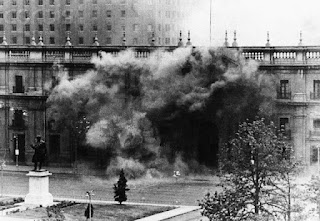
September 11, 1973: The Bombing of the Moneda, Santiago, Chile (Corbis)
It's a strange irony that before 2001, the date September 11th was already etched into the history of infamy by another act of brutal violence. For on that date in 1973, working in collusion with the U.S. government, the Chilean military overthrew the elected Popular Unity (UP, or Unidad Popular) government of President Salvador Allende, bombing the presidential palace, murdering Allende himself, and beginning a dark chapter of repression resulting in the murder of thousands of Popular Unity supporters, leftists, trade unionists, and regular working people.


¡Crear Poder Popular! Create Popular Power!

Allende, a socialist, had risen to power not through a revolution but through an election. With broad popular support from the Chilean left and the Chilean working class, he attempted the socialist transformation of Chilean society without first overthrowing the capitalist state. It's easy in retrospect to criticize Allende, and important in many ways to do so. Indeed, in my opinion he and the leftist parties that backed him committed serious errors that paved the way for their own destruction. But at the same time the Chilean experiment in a new road to socialism is filled with important lessons for people seeking a path to a new world. Some of these lessons were brutal and hard, but others inspiring. In the end I think history marks Allende as a hero, even if a tragic one. He fell in combat for a better world.

Chile in the early 1970s became a kind of crucible where the struggle between the classes became super-heated. As working people took to the streets, the upper classes responded in kind, playing havoc with the Chilean economy. While thousands of students and middle-class people joined the workers and the leftists parties in the struggle for economic transformation, thousands more formed outright fascist organizations to combat the restive working class. As working people occupied farms and factories to support the socialist and communist dominated government, other working people challenged its rule. Indeed some leftist parties distanced themselves from the Allende government.

New forms of workers autonomy, and workers and community control sprung up everywhere. "Create Peoples' Power!" became the watchword of the people out in the street. Despite some conciliatory efforts toward the propertied classes by the Allende government, the workers' movement in Chile became a speeding train, clearly approaching a collision with state power. To see how the Chilean population radicalized and politicized in the course of revolutionary events is awe-inspiring. Regular people understood the importance of acting together: it became obvious how they themselves had the power to change Chilean society: how politics seeped into the daily acts of living. The workers were miles ahead of Allende himself.

While Allende was freely elected, he was never able to achieve a majority for UP in the Chilean parliament, and always forced to make allowances with professedly progressive factions of the bourgeoisie and their military. And this, of course was his undoing.

The Popular Unity made much of a nonviolent path to socialism, but this proved to be a pipedream. Violence, or the threat of violence, is the underpinning of class society. Marx and Engels made this clear long ago in The Communist Manifesto, and the events in Chile were a like a blank slate waiting for the violence to fill itself in. Fatally, Allende and Unidad Popular failed to disarm the military, the instrument of potential violence of the ruling class, and failed to arm the people and create workers militias, the force necessary to meet the (unwanted) violence everybody could see coming. The propertied classes and their allies would defend the capitalist state to the death against those who sought to dismantle it. It was not necessary for the Chilean revolution to advocate violence, merely to soberly prepare itself against the building threat.

Allende thought he had split the allegiance of the military: Pinochet, the man who became Chile's military dictator, was among the supposedly "loyal" officers who Allende rallied to defeat an earlier coup attempt in mid-1973. But the military was just biding its time, all the time plotting and colluding with the CIA and the US government. The Chilean ruling class wasn't sitting idly by waiting for Allende or the workers to expropriate them: they were organizing and building their own counterrevolution just as surely as the people were building their revolution. But in the crucial moment the ruling classes had the jets and the bombs and the tanks and the machine guns.

And they held the stadium that was turned into a giant concentration camp into which leftists were herded and murdered: there perished the legendary musician Victor Jara, proud supporter of the UP, who had his hands smashed and broken by military torturers before they made him play one last song before they killed him.

It's no accident that after the success of the coup, when all the manifestations of people's power were smashed, Chile became an economic labratory for American economists of the ilk of Milton Friedman and his cothinkers, the forerunners to the trickle-down theorists so beloved by American conservatives. They wanted a Chile with a docile, pacified population, with subdued or eliminated trade unions, and a disappeared political opposition. Thousands were murdered, and the blood of those martyrs is on the hands of the U.S. government and all those civilian economic vultures as surely as it on the hands of the fascist elements in Chilean society.


Salvador Allende's distinctive glasses, recovered from the rubble, preserved in a museum in Chile
Allende took to the radio from the Moneda Palace while it was under attack by those jets and tanks: "Other men will overcome this dark and bitter moment when treason seeks to prevail. Go forward knowing that, sooner rather than later, the great avenues will open again where free men will walk to build a better society." Within a few hours he was dead, and the Chilean experiment was crushed by a U.S.-backed fascist jackboot. While today the military dictatorship is a thing of the past, the struggle for poder popular continues in Chile, and for people around the world who dream of that better world.

Strongly recommended: "La Batalla de Chile: La lucha de un pueblo sin armas," Patricio Guzmán's extended black-and-white documentary study of the end of the Unidad Popular government. A must-see: readily available on DVD.