Showing posts with label religion. Show all posts

Sunday, October 30, 2011

Starhawk: #OWS Renews Our Faith in the Human Spirit

The right mix of politics and spirituality is a thorny question. I am utterly devoted to the notion of separation of church and state: it's clear to me that whatever mysterious personal beliefs people have, the law must remain absolutely secular. But at the same time I believe that the desire to fight for a better world, for social justice, comes from a profoundly spiritual place, and thus ultimately the morality informing secular law risks a slippery slope easily confused when the morality of liberation becomes blurred with the controlling dogma of a particular faith. All that said, I know that while my religious beliefs and at this point very occasional religious practices have very little to do with my politics, my spirituality is quite intertwined with a liberationist perspective in politics.

Many left-wing political activists dislike/fear/hate/oppose thinking about politics in a spiritual way, and I understand where they're coming from. But for all the social conservatism of today's evangelical Christians or the right-wing nihilism of fundamentalist political Islam, there is a long history of religious people being in the vanguard of social justice movements: a key example of which is the African-American civil rights movement which had an organic relationship with the spirituality and religious faith of African-Americans.

During my period of spiritual exploration after I withdrew form political activism, one of the most inspiring writers was the Neo-Pagan priestess Starhawk, especially her seminal work "The Spiral Dance." I was excited to read that Starhawk has been visiting a number of the Occupy Together encampments on the west coast. Some of what she's written on the subject of #OWS and this amazing movement that has materialized before our eyes I find quite inspiring:

From an article published in the Washington Post's On Faith column:

"What’s going on? Pundits splutter about the movement’s lack of ‘demands’ and coherent messaging, but sound bites and 10-point programs arise from central committees and top-down hierarchies. The Occupy movement demonstrates a very different model of organizing: emergent, decentralized, without a command and control structure. ...

[The demonstrations] all share a common heart, a revulsion against an economy and a politics that increasingly say, “You don’t count, except as something to exploit. Your voice is drowned out by money, your labor is expendable, your needs must be sacrificed to the gods of profit.”

At its essence, the message of the Occupations is simply this:

'Here in the face of power we will sit and create a new society, in which you do count. Your voice carries weight, your contributions have value, whoever you may be. We care for one another, and we say that love and care are the true foundations for the society we want to live in. We’ll stand with the poor and sleep with the homeless if that’s what it takes to get justice. We’ll build a new world.'....

The Occupy movement renews my faith in the human spirit, in our creativity, our craving for justice, our determination to root our world in love. So come on down! You are important. Your voice counts. You have a unique contribution to make. We are all the 99 percent."


And so taking a stand along with #OWS has a spiritual component: awakening our long-dormant hope and aspirations. Secular political savvy and a presence in the real world with its dangerous state repression is clearly the order of the day. But go ahead, arm yourself with spirit, too.

Starhawk has also been writing at great length in her personal blog on the Occupy movement.

News of Starhawk via The Wildhunt

Wednesday, September 28, 2011

Does Mormon Presidential Candidate Mitt Romney Practice Human Sacrifice?


(Bloody human sacrifice in Ancient Mexico, that may, or may not, be just like the human sacrifices that the Mormons, may, or may not, perform; 16th-century illustration from a Codex).

"When this sign and portent was first seen, [they] were overcome with terror, weeping and shouting and crying out...These shouts and cries were accompanied by sacrifices of blood and of human beings, for this was their practice whenever they thought they were endangered by some calamity." — Not a quote from the Book of Mormon but from The Broken Spears, The Aztec Account of the Conquest of Mexico edited by Miguel Leon-Portilla

"The messengers went to the [temple]...The two captives were then sacrificed before his eyes: their breasts were torn open and the messengers were sprinkled with their blood. This was done because the messengers had completed a difficult mission: they had seen the gods...they had even conversed with the gods!" — Not a quote from Mormon Elder Brigham Young, but another from The Broken Spears

It was almost fifteen years ago that I was initiated into the religion of Santeria; it was a life-changing event, and though I am no longer really active in the religion I am ever grateful for the blessings and changes it brought to my life. As most everybody knows, Santeria is notorious for including the widely misunderstood practice of animal sacrifice. In truth, animal sacrifice is a somewhat disguised component of most of today's religions including the big three Abrahamic faiths, but it's usually considered something prettier and less controversial, like Easter dinner or Passover. Without going into it at great length, the offering of animals in Santeria is most definitely not an exercise in macabre animal cruelty, it's a respectful ritual act that connects worshippers with the mysteries of the life force in a graphic experience of communion. In most cases, though not all, the animals are cooked and eaten, just like that lamb you eat for Easter. It's definitely a challenging part of the religion for those of us who grew up around store-packaged meat, but it ultimately teaches humanity and the sacredness of life. No cute kittens — or human babies — are harmed. It's not some antisocial or Satanic worship of death and gore (and please note Satanism is a subset of somebody else's religion, and that would be Christianity), and despite the occasional slanderous B-movie or tabloid exposé, Santeros most certainly do not sacrifice people.

Anyway my initiation ceremony was a beautiful and transformative thing, altering my consciousness and the way my spirituality is wired like nothing else I have experienced. Two of the priestesses there were elders in the religion, a lesbian couple who I'll call R & R. One was Puertorican, the other non-Hispanic of Jewish ancestry. They were knowledgeable and experienced priestesses, and also very generous and giving people. New initiates are especially encouraged to visit the homes of elders in the religion during their first year, when they're walking around clothed in a protective and identifying total white. R & R were wonderfully welcoming to me; especially considering my own status among the small minority of non-Hispanic white people drawn to what is fundamentally a religion of the African diaspora.

It was probably at one of their ocha birthdays that we were all sitting around their living room in Manhattan. R & R were discussing a recent vacation. They had been out west, I think to Vegas with a side trip to Salt Lake City, Utah. They were regaling us with their visit to the huge Mormon Temple there. I don't remember which of these two Santeria priestesses, expert at the handy dispatch of a chicken, was doing most of the talking: "And we saw the altar! You know beneath that altar is where they do the secret human sacrifices." A hush went over the room. "Really. They do them right there! Oh they don't admit it, but everybody knows they do it." The other priests and priestesses in the room shook their heads and clucked their tongues. "How horrible!" everybody agreed.


(Above is the Mormon Temple in Salt Lake City where Mitt Romney may, or may not, conduct his human sacrifices, if he performs them, which he may not.)

Two of the 2012 Republican presidential candidates are Mormons, one the allegedly moderate Jon Huntsman competing for last place; the other tabula rasa trojan horse not-so-moderate Mitt Romney competing for first. And it turns out that more people than my Santeria priestess friends think the Mormons have a human sacrifice problem. If you go to google and start typing "Mormon human", right after the prompt for "Mormon humanitarian efforts" pops up the prompt "Mormon human sacrifice."

It turns out that Evangelical Christians, a base of today's extremist Republican party, do not consider Mormons, the Church of Jesus Christ of Latter-Day Saints, actual Christians. And very many of them think the Mormon Church is up to no good at all. Researching this post I found websites devoted to accusing the Mormons of being the Illuminati, Freemasons, Kabbalistic Jews, Satanic homosexual child abusers, Jehovah's Witnesses, and, of course, Satanic sacrificers of human children.

I would say that the Mormons, Mitt Romney, Jon Huntsman, and the Republican party saddled with candidates that its base doesn't trust, have a big, big problem. Would you want your child to be kissed by Mitt Romney if you were worried he would afterwards snatch it up and hurl it onto an altar of blood-letting? I mean, hey, Wikipedia might explain that the doctrine of blood atonement doesn't mean modern Mormons have anything to do with something as bizarre as human sacrifice, but sites like "Real Mormon History" shout "Holy Murder" begging to differ.

So what's the truth?

Well, you know there's an old saying: you made your bed now you lie in it.

I actually know some former Mormons who regret the church's repressive nature, but who remember their childhoods in the church, or their missionary year, with some fondness. Of course most of the gay former Mormons I know don't look back with anything less than a certain anger. There's a movie I heartily recommend called "Brigham City," that is a small-town crime story made by a Mormon director that is tremendously touching and humanizing. You come away watching this film getting something profound about the nature of community that seems to be of deep spiritual importance for Mormons. It's a beautiful film. It helped me to respect the many mysterious ways that spirit calls to people: some are called to religions that outsiders don't get. I don't challenge that at all; spirit is a beautiful and mysterious thing. I don't challenge anyone's right to follow a spiritual path of his or her own calling, including LDS Mormonism. I don't want my religious practices to be judged unfairly, and I can understand Mormons not wanting theirs to be judged unfairly either.

But here's what else I know: the Mormon Church has spent an untold fortune trying to deny the civil rights of lesbians and gays. They sunk an uncountable fortune into the at least temporarily successful effort (Prop 8) to repeal marriage equality in California. They are widely believed to be one of the main bankrollers of the anti-gay hate group NOM, "The National Organization for [sic] Marriage," that has quite successfully derailed marriage equality in a number of states. The Mormon church, as an organization, is hateful and bigoted: and like many Evangelical Christian churches and the Catholic church, doesn't understand or respect the difference between secular law and church law. The Mormon church and its allies are actively trying to deny equal rights to gay people....to match religious principles that people outside that church don't share. That is simply unforgivable: the separation of church and state should be absolute and inviolable.

Mitt Romney may be an former east-coast governor and alleged social moderate, but he is 100% behind his church's efforts to deny civil rights to lesbians and gays. He's also a sworn enemy of a woman's right to choose, and of family planning. His politics on the subject of marriage equality are no different than right-wing freakshows Rick Santorum or Michele Bachmann. His views on immigration are horrible: he supports walling off the U.S. from Mexico (of course in true hypocritical fashion he's also reputed to have hired cheap undocumented workers to mow his lawn). Mitt Romney may or may not actually engage in human sacrifice — I wouldn't know the man, um, from Adam — but he certainly wants to sacrifice the rights of some Americans on the altar of his religious beliefs, and that is deeply, deeply troubling.

Is voting for people who want to deprive some Americans of their rights any worse than voting for people who might, or might not, secretly kill babies?

The evidence suggests that the idea that Mitt Romney and other Mormons are actively committing blood sacrifice of children or adults in the secret inner sanctuaries of their temples is nothing more than a crazy and delusional paranoid conspiracy theory, based on the all-too human tendency to demonize that which one does not understand. But hey, what do I know? They want to deny me civil rights, so maybe they do have a taste for human blood or maybe they don't. Maybe if their church joined the civilized world of respect for civil rights people wouldn't question their secret motivations.

Hey Mitt Romney, kiss my baby! You'll give it back, right? Right? As long as it's not gay?

(Any longtime readers will recognize part of this post is a retelling of a tale I told four years ago, during the last presidential cycle).

Sunday, May 22, 2011

Rapture


Saturday afternoon the 21st of May I woke up from a short nap in glorious spring sunshine. The windows of my bedroom were open, allowing the cool and pleasantly damp spring air into the room. My soft, purring cat was nestled in the crook of my arm for warmth. The sunlight was a glorious pale yellow; I had to force myself out of bed to get ready for the evening. I got dressed and hopped on the subway, where the train clattered through the tunnels as the witching hour of 6:00 pm passed unnoticed by anything other than the red digital readout hanging from the ceiling above us. As I emerged from the subway in Manhattan the last drops of a sudden Spring shower gave way to fading twilight. I met my adorable boyfriend for dinner and then a concert of new music including three wonderful pieces played on toy pianos and kitchen mixing bowls. A reception after the concert featured chocolates and champagne, a delicious mix. We took a cab home through city streets crowded with people dressed for life's celebrations. We went to bed, and then awoke, the next day arriving on cue just like the previous one did, just as tomorrow will.

The gift of the late afternoon sunshine, warm but not yet summery hot, had filled me with a sense of well-being, a gratitude for life's small blessings. I found myself happily considering the good things in my life: the love of friends and companions, enough work to pay the bills, a comfortable home, the sounds of music filling my world, my mind creatively spinning and my body still pulsing. And I felt, well, a sense of rapture. A momentary sense of joy and peace and perfection with the world.

I'm not sorry that my world didn't end. I was pretty sure it wasn't going to. And even I, a non-Christian, know that Bible being waved around by some desperately crazy, angry and hateful people says pretty explicitly that while this life, this world, is indeed temporary, nobody can know when the end is coming. “But of that day and hour no one knows, not even the angels of heaven, but My Father only. That's Matthew 24:36, by the way.

What kind of people are these doomsayers? Their fantasies of revenge, of self-righteousness, of warnings gone unheeded, of threats and and murder on a super-genocidal scale are almost pornographic in their visceral expression. The doom-filled prophecies of crazy fundamentalists aren't anything I recognize as spirituality or religion, they're just mean-spirited and hateful. These judgment-filled harangues are corrupt and ignorant; small-minded above all, revealing people utterly closed off to the reality of the world with all its unknowable beauty and wonder and even its often painful tragedy and loss. These people are afraid of living, afraid of being judged because they themselves are casting their eyes of bigotry about them reflecting outward their deep hate at their own humanity and the humanity of others.

I believe pretty firmly in God. I won't recount here the long journey that convinced me of that reality, and I'm grateful for the peace and blessings that my spiritual journey to a place of understanding has brought me. And I recognize a sort of miraculous randomness that bombs are not falling on my head or that I'm not living in a gutter or an open field. This has nothing to do with me being a better or worse person than anyone else, only a chain of cosmic accidents that could change abruptly tomorrow. While I have known or known of some very bad people over the years — heck I write about them here all the time — I have yet to see evidence for evil outside the human heart. Earthquakes and tsunamis and tornadoes and wild carnivorous animals and predatory microbes: these are just the more painful of the miracles of the living world that happen, well, for no other reason than because they have come into being.

The consciousness animating our bodies at this moment right now gets a very brief time in the world to make some choices. It's easy to make mistakes, to waste time, and sadly it's easiest of all to wind up being the victim of other bodies making very bad choices for us. I'm not trying at all to sound like a Polyanna; sometimes life is plenty rough and often short.

Everybody dies. That's just...life. And not the best part. But if you spend your life focused solely on the end of that life what you're really doing is wasting your precious moments. So to all the doom-sayers and evangelical prophets and radio preachers who have nothing better to do that waste their time spewing hate or self-righteousness I say, please leave me alone. I'm busy.

(I found the whole-lot-of-crazy art at the top of the post — entitled "True Rapture" — at the "Questions and Thoughts" blog. You simply must click on it to see it larger. I can't even begin to guess at the cray-cray symbolism involved there.)

Tuesday, May 17, 2011

A Song for Saturday


All the videos of this song on Youtube came with commercials, so you'll have to settle for the lyrics. I'll try to hum along...can you hear me?

"Toe to toe
Dancing very close
Barely breathing
Almost comatose
Wall to wall
People hypnotised
And they're stepping lightly
Hang each night in Rapture

Back to back
Sacrailiac
Spineless movement
And a wild attack

Face to face
Sadly solitude
And it's finger popping
Twenty-four hour shopping in Rapture...

Don't move too slow, 'cause the man from Mars
Is through with cars, he's eatin' bars
Yeah, wall to wall, door to door, hall to hall
He's gonna eat 'em all
Rapture, be pure
Take a tour, through the sewer
Don't strain your brain, paint a train
You'll be singin' in the rain
I said don't stop, do punk rock

Well now you see what you wanna be
Just have your party on TV
'Cause the man from Mars won't eat up bars when the TV's on
And now he's gone back up to space
Where he won't have a hassle with the human race
And you hip-hop, and you don't stop
Just blast off, sure shot
'Cause the man from Mars stopped eatin' cars and eatin' bars
And now he only eats guitars, get up!"


—"Rapture," Blondie, 1981

That's right, the Rapture is set for Saturday, May 21! (Though I'm sure I will be seeing most of you on Sunday, May 22.) Blast off, sure shot!

(The art above is a painting entitled "Prairie Dog Rapture." I found it on a blogpost noting Bart Centre's business enterprise "Earth-Bound Pets USA." For $135, payable now in advance, Mr. Centre — an atheist — will guarantee to care for your pets if you leave them behind in the Rapture, since everyone knows the Rapture is just for people. On his own website Mr. Center notes he's had to increase his rates due to the increased demand this Spring.)

Tuesday, May 03, 2011

The Botanicas of New York: San Miguel & Anaisa


"I Am With You Always" says a poster of Jesus as twin figures of Santa Muerte, "Saint Death," loom above Him. San Judas — St. Jude — patron Saint of lost causes towers above them all, while a mere three-leafed not-so-lucky clover promises...something. Chinese prosperity gods, Haitian goddesses and Indian spirit guides line the shelves behind: It's multicultural cosmic order at the Botanica San Miguel & Anaisa in Brooklyn. It's all about skulls and scythes and scepters; crowns and halos.


Is that the Holy Infant — El Divino Niño — or Elegba, African God of the crossroads? Is that Our Lady of Guadelupe, patron Saint of Mexico, or the Earth Mother Tonantzin?

San Miguel & Anaisa are syncretic Saints revered in the Dominican "21 Divisiones" tradition, though my exceeding ignorance on such matters presents me from explaining what blessings they might offer. Though their storefront would look at home on any tropical street, it's the heart of Sunset Park, Brooklyn, once home to Scandinavian immigrants and now a melting pot of Latin American and Asian newcomers as well as more established communities of folks with roots in the Spanish Caribbean.

(These windows are a reflection of something I love about New York. From time to time I'll be posting pictures from the various botanicas I stumble across. This is the second in a series. These photos were taken by me in Sunset Park, Brooklyn. Click on the images to see them larger.)

Sunday, April 03, 2011

A Little Sunday Churchifying


This is one of my favorite songs by the late Donny Hathaway, "Thank You Master for My Soul." It's a sublime combination of gospel vocalizing and jazz instrumental harmonies, and was recorded back in 1970. Tragically Donny Hathaway committed suicide later that decade while under treatment for depression. But here he sings of profound spiritual gratitude and reverence. He sings of human frailty and divine redemption, presenting to my ear anyway a profound optimism and sense of perspective, once again a valuable touchstone in troubled times. I don't go to church every Sunday -- not my thing -- but Sunday is as good a day as any for a moment of reverence and reflection.

Sunday, January 02, 2011

The Botanicas of New York: Siete Potencias


I love botanicas, and New York was once full of them. They're the plaster-statue-filled religious items shops catering to practitioners of folk religions. Inside they're full of candles, cheap perfumes, painted plaster statues, beads, animal parts, religious pamphlets, prayer cards and all manner of trinkets and baubles, and sometimes refrigerator cases of fresh tropical herbs and plants. They serve communities of a panoply of related spiritual paths: syncretic folk magic, Lucumi Santeria, Puerto Rican espiritismo, Afro-Cuban Palo, Haitian Vodun/Voodoo, the Dominican 21 divisiones, Mexican Santeria, South American Indian herbalists and healers, and others. As neighborhoods gentrify, the ranks of botanicas have thinned drastically over the last ten years.

It's not always easy to tell which kind of shop you're looking at; many mask their true nature. Someone selling a beaded necklace they've dipped in holy water or waved through incense probably isn't a Santero as my tradition would use the word; while someone doing spiritual or card readings for people coming in off the street may well actually be a priest of a certain religion or may just be a person who gives good advice. Some are welcoming of new patrons, and some deeply suspicious of customers outside their presumed ethnic base. Some are just business endeavors, and I've seen several over the years that were obvious fronts for drugs. The busy Almacenes Chango in East Harlem, now long gone, was one of the few that served primarily initiates of the Yoruba-based Lucumi Santeria into which I was initiated. It was a hubbub on a Saturday morning selling supplies for initiations and other ceremonies.


I love the aesthetic of these places, especially their store-front windows. Its clutter speaks to me, and its multicultural chaotic abundance challenges the eye. Statues of idealized native American indians stand next to Catholic saints and African gods and Chinese good-luck deities. There are solemn gory martyrs dripping blood, rakish gypsies, and sometimes skulls and skeletons. There's an old-fashionedness about them that speaks to me. I love how in the window shown here most of the statues are peering out from cellophane wrapping.


These windows are a reflection of something I love about New York. From time to time I'll be posting pictures from the various botanicas I stumble across.

(These photos were taken by me of the Botanica 7 Potencias on Fourth Avenue in Sunset Park, Brooklyn. Click on the images to see the divine chaos larger.)

Wednesday, December 29, 2010

At the Sunset of Time


What would it be like to watch the the end of the society you know? To watch free thinking, philosophy and scientific exploration driven into the shadows as fake populist dogma turns regular people into mobs of violent know-nothings? No, it's not the Teabagger Story, it's a wonderful movie I just watched called "Agora." Directed by Spanish filmmaker Alejandro Amenábar and starring Rachel Weisz, Agora tells the story of the philosopher Hypatia in late Roman-empire Egypt. While apparently a big hit in Europe, the film received limited distribution in the U.S. and is just recently out on DVD.

Hypatia was the daughter of a noted Pagan philosopher and mathematician in the Hellenic tradition and became a noted figure in her own right. Rome had officially converted to Christianity in the fourth century, and by the time the movie is set in the early fifth century, Christianity is sweeping Alexandria and threatening the cultural balance in a cosmpolitan city where Pagans, Jews and Christians seem to exist in relative harmony. The Pagans guard the legacy of science and learning in their library where the rescued scrolls from the earlier classical library of Alexandria have been preserved. Christians sweep to power and their intolerance soon victimizes the Pagans and Jews. Since it's historical fact, it's not ruining the movie to note that it ends with Hypatia being accused of being a witch and being murdered by a Christian mob.

I found the movie quite moving. Where it could easily have been an average sword-and-sandal epic, it's actually quite brave in its narrative and sensibility, and quite spiritual in its contemplation of someone on the verge of cosmic understanding at the same time she sees the world around her descend into darkness. Rachel Weisz as Hypatia is given an unusual role: the brainy, intellectual heroine of the film, a woman who rejects sensual physicality in favor of more heady pursuits. The Pagans are depicted somewhat sympathetically, albeit as doomed effete slave-owners failing to keep up with the times. The film reserves its real venom for its portrayal of the dark-age Christians, suggesting them to be an Al-Qaeda-like band of unreasonable zealots hypnotized by bad thinking, and unhindered by doubt or self-exploration.

I'm fascinated that a movie was made this way. The Christians are clad in black, and their visual heaviness contrasts with the light and airy scenes of Pagan culture and society. They are shown to be unspeakably brutal in their attacks on the Pagans and their library, and later in a pogrom against the Jews of Alexandria. They call the scrolls in the library "Pagan filth" and considerable time is devoted to showing their disdain for any knowledge outside the word of God revealed in the Bible. I can't imagine a film like this being made in the United States.

The film's antihero is Davus, the slave -- later freed slave -- of Hypatia, whose bonds draw him to the social justice and charity promised by the Christians, but who ends up becoming a fanatical killer. Which, with no particular animus to my Christian friends, pretty much sums up the tragedy that religion seems to often bring upon itself when it overly dominates the public square (literally what "Agora" means). While this allegorical film casts its harshest eye on ancient Christianity, I do like to point out that Tibet, home to the peace-loving altruism of Buddhism, was home to a particularly aggressive military/feudal social structure replete with slavery abolished only midway through the last century. I'm equally certain the story of medieval Nigeria, where my Yoruba/Santeria tradition is rooted, is an unlovely tale of feudalism and slave trading.

In the end one must assume that director Amenábar is defending all manner of secularism against religious dogma; and that his allegorical portrayal of the Roman Empire on the cusp of the dark ages is meant to be a warning for our own times. The spiritual/religious person in me can only sharply agree. For if spirituality can unlock the world's most intimate secrets and bring comfort, fulfillment and peace to individuals and communities, history teaches us that it must remain separated from governance.

Thursday, November 18, 2010

A War Resister's Plea


What does it mean to be committed to peace, to be fully committed to resisting the folly of war? I found an amazing document. It's an article written by my father, Peter Horst, during the time he was fighting the draft as a conscientious objector in the late 1950s. Frustratingly missing the first two pages and an unknown number of concluding pages, it details the basis for his refusal of military service. It seems to date from late 1956 or 1957, written either right before or during his chosen alternative civilian service with the American Friends Service Committee.

He believed that what he called "Brotherly Love" could be elevated to the moral principle of religion, and that this devotion to living out what might be to some an abstraction was to him a call to refuse actions that violated his beliefs. The first part of the document I found is a measured theological defense of what he called the religion of brotherly love. He cites Christianity, Hinduism and Buddhism without suggesting that his beliefs were the doctrines of any single faith. But what I'd like to present here is a section toward the end on the reasoning behind rejecting, behind resisting, violence and war.

I know that he defended his conscientious objection for years and years in the courts; I assume that this document was written to support his legal case by codifying his position. I find the document not only personally inspiring but tremendously relevant. In discussions on The Cahokian and elsewhere on the meaning of war in a historical sense and on confronting the challenges of today's wars in an absolute real sense, I find much here that validates my own beliefs. And above all, at a time when the military's proscriptions against gays may finally end with the possible repeal of Don't Ask Don't Tell (DADT), this document reinforces my view of why as important as it is to struggle against discrimination, struggling against militarism and war should be a moral imperative that leads justice-seeking people to reject the military itself. Here is an extended excerpt:

WHY I MUST REFUSE TO BE A SOLDIER
by Peter Horst

I believe that one must love one's enemies, and that by so doing they will cease to be enemies, since Love begets Love. If a person in a situation of violence attempts to use Love as his weapon, and fails, I believe it is the fault of imperfect use, not the fault of the weapon. In the case of an individual citizen in a nation committed to the use of violence, it is possible that he might never face the enemy to test that weapon, especially in this age of long-range electronic and atomic weapons. But to regard the belief as worthless, simply because other weapons are in official use, would show a lack of faith in the true worth of Love.

Military weapons, unlike the religious belief of Love, have been tried, and proved worthless by the number of wars to end wars in this century alone. But Love has converted enmity to Love in many cases: Christ's crucifixion, Gandhi's crusade in India, countless individual cases of the use of non-violent defense, have all proved that Love is a power excelling hatred.

Committed to Brotherly Love, I must therefore refuse to kill. I believe an army is organized in direct opposition to my religious values, and promotes only hatred and violence. Therefore I must refuse to participate in any military activity. It is foolish to think that an army can make room for Love of enemy. Even though there are non-combatant positions open in an army, they only further the military cause; therefore I refuse to accept any military position.

My belief in the power of Love is such that, when ordered to act in opposition to it, I must refuse. I do not deny allegience to the state, but because I believe there is nothing superior to Love, and that nothing of value cancome from contradicting it, my duty to it takes precedence over any other.

This is true not only in a situation where the state makes a demand upon me, but in any case where a course of action is demanded that violates my belief. To cite the traditional case, if my wife were attacked by a maniac, or any person bereft of reason and therefore unable to be dealt with reasonably, I would not take his life in defense. I would be willing to use a minimum of non-violent force to restrain him, realizing that he could then be dealt with therapeutically. If he were dead, there would be no dealing with him at all. In this instance, there is no reason to assume I must assent to war. In war, one does not not forgive, but murders his trespasser, and his family and friends as well; the victor then imposes his own order upon the vanquished.

In case of attack by a sane person, or an army, I would use no force beyond the reasonable power of Love. I am fully aware that my practice and knowledge in this is limited, and that I would therefore be liable to injury or death. I accept this as necessary, until the art of Love is fully perfected. Because violence is so dangerous, I do not think there is any excuse for using it. Neither self-defense nor defense of loved ones is sufficient cause for violating the rule of Love. If I were to deny my religion and make an exception in some instance by returning violence for violence, there would be that much less chance for the ultimate worth of my belief to be shown.

There can be no world peace and security without loving forgiveness, and will never be as long as men consider anything more valuable than Brotherly Love. I do not believe the practice of this can be put off into the future, until some less 'dangerous' time. I believe the danger of violence far outweighs the danger of placing one's defense in the practice, even though not perfected, of Love.

I have shown that my religion rests on a loving and peaceful attitude in myself. It may be worthwhile to show a few of the resulting reasons why and how I believe in non-violence.

A strong reason stems from World War II. I believe that a man is, and must be, personally responsible for what he does. The Allied governments expressed this same belief when they initiated the Nurenburg trials for war criminals. They announced that each soldier and citizen was personally responsible for carrying out orders later defined as criminal and atrocious. It is thus impossible for a person to subordinate the demands of his individual conscience to those of the collective state, since he himself, and not the majority of citizens, must answer for every life he takes, every order he follows that results in what the victors can later define as a "war crime." My conscience makes it impossible for me to accept the responsibility for what a soldier must do; therefore I must refuse to be a soldier.

Every war is one of defense, and both sides claim to be defending. Hitler said so, Tojo said so, and we said so. Israel said so and launched an attack
[in 1956 --ish]; Egypt said so and fought back; England said so and joined in, along with France whose purpose was also "defense." A country uses the weapons it believes in and has on hand; thus it is likely that this country may be forced to resort for defense to the atomic weapons she has specialized in. In contradiction of this, I will defend myself only as far as Love will allow. If necessary, I would prefer to die for a cause I hold equally as high as that held by whoever chooses to bomb me, or whoever choose to go to war for whatever country he calls his own. I will not violate my religion by seeking to destroy my enemy, or by helping those of my own country whose different belief leads them to bear arms.

I am not willing to be defended, or to defend anyone else, by a series of Nagasakis and Hiroshimas. Aside from being contradictory to Brotherly Love, the price to be paid in such cases makes defense worthless. Some have called our past dropping of the A-bomb, and the possibility that we might drop a bigger one in the future, the lesser of two evils. The greater evil is supposed to be the occupation and plundering of our land by the enemy, and the death of some of our own people. My religion teaches different values. All men are to be loved equally. It is not a lesser evil to kill a Russian than for a Russian to kill an American. Human lives, not nationalities, are involved. If an A-bomb were dropped on Detroit, it would only compound the evil and destruction to retaliate in kind. The only way to diminish the evil is to forgive, and to cultivate Love.


(The above graphic is the logo of the venerable War Resister's League, a pacifist organization founded in 1923. I don't believe my father was affiliated with that group but he did work with the Central Committee of Conscientious Objectors.)

Monday, November 08, 2010

Mami Wata Loves You


This is one of my favorite syncretic images, the woman who has mastered the snakes. I've had this posctcard for years: Wikipedia's entry for Mami Wata says this image dates from pre-war Europe. That wikipedia entry is full of detail about the deity Mami Wata, but it could kind of be shortened to say "powerful archetypal image that means a lot of contradictory things to whoever sees it." Mami Wata can be connected to the Yoruba ocean orisha Yemaya, a true "mother of the waters." But she can also be connected to a host of other syncretic folk deities that have combined with the myths of Africa, Latin America and the U.S. suggesting some powerful symbolic resonance. If you go to Botanicas in New York City you can find this image transformed into a plaster statue; sometimes with a baby in its lap sometimes without. That's Santa Marta la Dominadora, St. Martha the Dominator, and she'll protect your family and help you get your man back or help you take control of an unruly life. And there's the connection to the loa of Haitian vodoun Damballah, the snake god who reveals the mysteries of the universe travelling deep underground and yet encircles the world above us to bind reality together. To me the image is suggestive of Marie Laveaux, the patroness of New Orleans voodoo. And yet all these identities snatched from disparate religions and traditions reveal something about the nature of religion itself: it's a doorway to perception, a way of explaining and categorizing the human experience of spirit. But the thing it explains and categorizes is universal, powerful beyond description. You can't really take a picture of God, and yet, meditate on a cheap prayercard image like this and, well, there it is.

Wednesday, September 29, 2010

In Defense of a Little Ignorance


Yesterday the headlines and my friends' Facebook links were filled with reports of a Pew poll that suggested while Americans might be very religious, their knowledge of religions, even the ones they follow, isn't very deep. Since atheists scored highest on the poll, the New York Times asked the president of American Atheists why this is. He's quoted as smugly responding, “Atheism is an effect of that knowledge, not a lack of knowledge. I gave a Bible to my daughter. That’s how you make atheists.”

I came to religion late in life; well by late I mean while an adult not a child. I had been raised without religion. I knew that my mother had a certain attachment to Catholicism and its ideals, and especially to Jesus, but that she loathed the church establishment itself, and she chose to raise me without any formal religious indoctrination besides letting me play with the creche figurines on Christmas. When I eventually felt a spiritual pull, being an intellectual person I certainly did a lot of reading about religion and made a thorough investigation of the paths I found myself walking down.

I read a lot of books on Neo-Paganism and later, Santeria. I learned all sorts of arcane details, historical tidbits, and history buff that I am, I ate that all up with relish. But what I credit my actual spiritual awakening to was not what I read in books. It was not the intellectual knowledge I was absorbing but the act of having my eyes, my heart, my mind, my soul, if you will, opened up to religious experience. All the books were enlightening and entertaining and all, but they ultimately meant little without the transformational way I came to experience the presence of God, of a deity immanent in nature around us, of spirits, of natural spiritual energies, of powers and happenings outside the mundanity of life and the linear trail of the intellect. I gained knowledge of my faith not by reading about it but by practicing it.


I'm glad I undertook an intellectual investigation and glad I studied the details I did. But that stuff was not necessary to experience the blessings of religion that came to unfold in my life. The most transformational experiences I had--a few while a Neo-Pagan and then ultimately the week-long initiation ceremony into Santeria and the year in white as an Iyawo that followed--were emotional and spiritual experiences that words, that intellect, can't adequately describe. I mean, I could tell you what happened, but that wouldn't be the same thing as allowing you to experience it. I didn't choose a religion because of what I read about it, I choose a religion because of how its practices made me feel. One could have these experiences without reading about them or their origins first.

When I write about my religion I do so to attempt to share an experience, or to offer some information that makes the experience of, say, listening to Afro-Latin jazz more rewarding. But I'm not exactly trying to convince you, dear reader, that I'm right. My faith comes from a personal revelation that changed my worldview and colors every experience in my life. If you haven't had the same experience as me I can neither judge, criticize nor condemn you. And while knowledge of the kings of medieval Yorubaland (today's Nigeria) is an interesting cultural and historical footnote to Santeria it's knowledge that is ultimately irrelevant to practicing the religion and being lucky enough to receive the blessings of the Orishas.

So for once I'm going to defend that majority of religious Americans who don't know all these historical details of Joseph Smith, Martin Luther or Maimonides. These facts could sure enrich the lives of American Christians and Jews as all history enriches our lives and makes us smarter, but they're not details necessary to love God, or to live a good life. And contrary to what the quoted atheist says, a person who feels the spirit can love the blessings of the Bible's Psalms without embracing the admonitions of Leviticus...even I the non-Christian recognize this.

Which is likely to make non-Muslim Americans more tolerant of Muslims, American or not: a history lesson about Muhammad and seventh-century Arabia? Or some emotional understanding of the spiritual humility Muslim believers feel before God? What if people of different religions focused not on the historical record that has divided us into different armed camps but on the common shared drive to find spiritual reverence and meaning in everyday life?


As I see it religions are man-made creations: attempts by different cultures to come up with the best way to experience and love God and the mysteries of life. Between crusades, inquisitions, suicide bombings, ethnic cleansings, 100-year-wars, armadas, slaveocracies and serfdoms people have done some terrible things in the name of those religions: in my opinion misunderstanding those religions. Obviously learning about all those terrible things is an important part of building a better world: I heartily endorse learning.

But there's nothing wrong with knowing only that God is real; that the world around us is alive with spirit; and that each of us has a choice to live our lives righteously, respecting and loving each other as we love ourselves. And so if the Pew poll suggests atheists know more about religion than religious people, so what. It's left out the most important thing that atheists cannot know: what it feels like to believe in God.

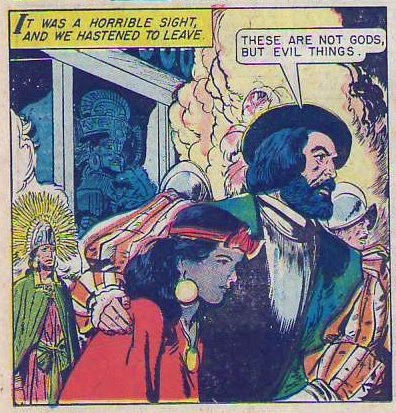
(The illustrations above are frames from the Classics Illustrated comic-book version of "The Conquest of Mexico." That's Aztec emperor Moctecuzoma lamenting the bad attitude toward his religion expressed by the Spanish conquistadores.)

Wednesday, April 09, 2008

Om Mani Padme Hum?


Shangri-La is under attack! The holy spiritual people of Shangri-La are being oppressed! The Oympic torch must be stopped!

Well I must point out with all the hullaballoo about the Beijing Olympic torch and the unrest in Tibet, that in American liberal fascination with Tibet, the Dalai Lama, Buddhist spirituality, and the certainty of its self-righteousness opposition to oppression in foreign countries, not everything is what it seems.

Tibetan Buddhism surely is a wonderful spiritual path, and while I have heard that the Dalai Lama has some unfortunate views on homosexuality, as a religious person outside the mainstream of Abrahamic tradition I throw no stones at its belief system or adherents.

However, I would point out that his supporters in the west seem to be endorsing a medieval theocracy with a documented and unglorious history of slavery and feudalism. I say to these supporters of Tibet the same thing I would say to supporters of Israel: if you believe separation of church and state is a defining principle of modern democracy in the United States, you need to believe the same thing about separation of church and state in other countries, no matter how like Shangri-La you imagine them.

It may be that the Chinese are oppressive to the Tibetan people, and Tibetan autonomy and self-determination is no doubt a laudatory goal. I don't excuse the subjugation of peoples. But the smashing of a brutal and backwards feudal theocracy? Go Chinese People's Liberation Army!

To the Americans caught up in protests of the Olympics, I say, your main enemy is at home. You want to help the people of Darfur? You want to help the Tibetans? End US imperialism and international corporate rape. Dismantle the CIA. Remove American troops from Korea. Remove American troops from the middle east.

Here's an interesting perspective on Tibet.

Thursday, March 20, 2008

Presidential Candidate Embarassed by Association to Bigoted Institution

"I have always had a deep personal faith that was rooted in the Methodist church in large measure because I was christened into it, I grew up in it. But, it also very much reflected how I thought about faith as I matured. You know, if you look at the Methodist book of discipline it talks about the four contributing streams of faith -- scripture, tradition, experience and reason. I always resonated to the fact that it was both revelatory and scripture-based but that you were invited to use your power of reason to think through your faith and to work through what it meant to you and how you would live it in your daily life."
--Hillary Clinton

"While persons set apart by the Church for ordained ministry are subject to all the frailties of the human condition and the pressures of society, they are required to maintain the highest standards of holy living in the world. The practice of homosexuality is incompatible with Christian teaching. Therefore self-avowed practicing homosexuals are not to be certified as candidates, ordained as ministers, or appointed to serve in The United Methodist Church.....The General Council on Finance and Administration of The United Methodist Church] shall be responsible for ensuring that no board, agency, committee, commission, or council shall give United Methodist funds to any gay caucus or group, or otherwise use such funds to promote the acceptance of homosexuality. The council shall have the right to stop such expenditures. "
--From the Book of Discipline of the Methodist Church.

And now some fresh air:
“I refuse to limit my God, to lock God into my cultural understandings because culture is fickle,” Wright said. “And culture is often wrong. Culture was wrong about slavery. Culture was wrong about women. Culture was wrong about Africans and Indians, and culture was wrong about Christ,” he said. “I have been the pariah among many of my clergy colleagues who somehow see me as defective or not quite saved because I won’t join them in their homophobic gay bashing and misquoting of scripture.” (Rev. Jeremiah Wright)

Friday, March 07, 2008

of seminaries, yeshivas, and madrassas

So just to get it out of the way, a massacre of students in a school is a pretty awful thing, even if that school was a training ground for the racist ultra-zionist Israeli settler movement. It's despressing to think that the soul-deadening mathematical response is necessary, but I point out that Israel just killed a hundred people in Gaza, certainly no less an awful thing, the disgusting display of official Israeli "regret" at civilian casualty notwithstanding. (I always learned that regretting something meant you intended not to do it again. The Israeli "regret" is complete and utter racist bullshit.)

All of that said I find it fascinating that the attack on the school was immediately reported as an attack on a seminary. One could argue that seminary is a fair translation for yeshiva. But then isn't it a fair translation for madrassa as well?

A seminary is full of earnest young spiritual seekers, learning the details of faith so that they might commit their lives to prayer and betterment of mankind. A yeshiva is a walled-off temple of mystery, where weirdly-dressed quaint, if somewhat distasteful strangers go to engage in weird mumbling, seeking ancient knowledge to preserve their alien presence in the world of normal people. A madrassa is a nest of terrorist vipers, where they keep their machine guns and scimitars (the ones for cutting off human heads), where crazed and delusional fanatics rouse themselves into an anti-human frenzy before going off and murdering innocents.

The problem here is that seminaries, yeshivas, and madrassas are all the same thing, just as all blood is red. It's really the problem, isn't it, with discussions of the middle east, that the mathematics of this tragedy and its translation are in the hands of manipulators, liars, and killers, and the ones who love them.

Thursday, February 07, 2008

(rant on islamophobia)

I love blogs. Everybody's got one. I know the person who read mine the most is me!

So I'm saving my latest rant from the comments of Joe.My.God. cause it took me a while to write and for once I feel reasonably articulate.

Apologies if--for shock--anybody has actually followed a link from JMG expecting to read something new here. Gasp!

---

(the subject was an anglican predicting sharia in england)

OK. I'll be the one.

I am so fucking sick of this islamo-phobia. I enjoy JMG, but if you get your knowledge of islam or world-events from this ZOMG!!1! React-to-this-immediately medium, you're doing yourself a disservice.

I live in Brooklyn, in a very mixed but mostly latin neighborhood. About ten blocks away is a super-super orthodox jewish neighborhood. The men wear slippers, long beards, weird hats, long coats. The women wear the jewish equivalent of the burka: wigs, long skirts. The kids are well-behaved. The shops close early on Friday and stay closed on Saturday. There are strings high up on poles around the blocks to mark off the eruv. There are jewish schools and jewish doctors and jewish everything else....and jewish social custom ruling the way the entire community acts. And you know what? These people are happy. They're not hurting anybody. They're not threatening anybody.

Now their beliefs are not my beliefs. You can argue that an ultra-orthodox man who wakes up and realizes he's gay faces awkward choices of removing himself from his community or enduring the closet or disapproval. And eventually I believe enough ultra-orthodox gay jews will get around to building a community where no one is forced to make that choice. But the problem is NOT that jews want to live in a world of cultural comfort. There are ultra-orthodox jews who would like to dictate NY city law, like Noach Dear and his opposition to gay marriage, and that's wrong. But screwing things up for the rest of us is NOT what MOST jews in this very self-contained community spend their time doing.

This is all that's fucking happening in England with the muslims except it's new. Nobody's talking about cutting the hands off thieves in muslim Liverpool, or stoning pakistani gay boys to death in London. Joe, give me a break. You're really baiting controversy here.

You wanna go out and learn something about islam, do so (I recommend a book by a guy named Reza Aslan I'm pretty sure is a gay muslim called "No god but God".) It's not my religion. I understand many of you don't like any religion, and I can't argue with that. Although I do have a religion, I understand religion has mostly treated us like trash. I'm not apologizing for that.

But this hysteria is just ridiculous. Islam is just the new "other" in the next neighborhood over. Let's welcome them and convince them some of western secularism is good, without threatening their religion.

And let's stop this stupid fucking ignorant racist ridiculousness. The world is changing. Help make it better.