Showing posts with label statues. Show all posts

Wednesday, November 28, 2012

Anti-Americana: Burn, Baby, Burn


Two more stamps from the Democratic People's Republic of Korea (North Korea), from 1971 and apparently produced but withdrawn or not officially issued. These are some kind of rarities; I copped the graphics from ebay. I don't know the theme or circumstances of this issue, but the top value clearly shows the Statue of Liberty and the US Capitol engulfed in flames so it's not hard to guess what these stamps are about. The foreground figure is breaking chains of oppression, and is probably a South Korean revolutionary. The bottom stamp shows a militiaman slamming a US soldier whose helmet has gone flying; in the foreground is an industrial worker. These are all common archetypes in North Korean iconography. World anti-imperialist sentiment was at its height in 1971; the American war against Vietnam having taken a particularly ugly and genocidal turn.

Anti-American art is an irregular feature here at the Cahokian: for more click here.


Tuesday, August 23, 2011

Anti-American Art: Bab al-Azizya


I figured I better feature this rather iconic statue before it's gone. Earlier in my series of Anti-American art images I featured a Libyan stamp showing a similar illustration, but here's the real thing, the statue erected by the Libyan dictator Qaddafi at the site of the American assassination attempt/bombing raid back in 1986 that took the life of his adopted daughter. Showing a hand crushing an American jet, it's located in his expansive Bab al-Azizya compound in Tripoli, and was, as seen below, just overrun by the NATO-backed rebels of the Libyan Transitional National Council.


A particularly noxious NY Times video already makes the not completely off-base comparison between this statue and the ones of Saddam Hussein pulled down by American invaders, so it seems likely that these NATO revolutionaries will shortly pull this iconic symbol of defiance down so as not to offend their new overlords.

It seems likely that Qaddafi's quixotic faux egalitarian faux anti-imperialist regime is now a thing of the past, though the TNC is rife with his former allies. It's also far from clear in any case that the war is at all over or that Libya's future is resolved.

Although before the US/NATO intervention I was all in favor of a real Libyan people's revolution, I have my doubts that this now beholden-to-NATO hitchup of former bureaucrats will bring anything resembling actual democracy to the Libyan people. Beware of NATO bombers bearing gifts. It ought to give all freedom-loving people pause to think that the rebels are now in effect celebrating the high-tech rain of death from the skies that this statue challenges. No doubt the world's future hindsight will be 20-20.

(PS: That earthquake today! Unnerving and momentarily terrifying...but no damage done here in the home of The Cahokian. We now return to our regularly scheduled programming.)

Sunday, September 26, 2010

Anti-American Art: The Forgotten War, part 2


Still on the subject of the forgotten war, this statue is in Vieng Xay, Lao People's Democratic Republic. It's a monument to the Pathet Lao resistance to the American "Secret War" that dropped huge quantities of bombs on Laos. The statue shows a peasant, a worker, and a soldier standing on a bomb labelled "USA" and looking resolutely forward. It's a little stiff for socialist realism, but certainly doesn't let the US off the hook for its role in trying to return Laos to the stone age. Here's another photo with a different perspective:


(Top photo snagged from "T Lao" blog documenting an Australian's year-long stay in Laos. Second photo snagged from alands763's flickr. Click on the photos to see the statue larger.)

Thursday, June 24, 2010

More Heroic Statuary


Here's two more of my favorite heroic socialist realist statues. Above, and in detail below, is the monument "Bohaterom Warszawy," "To the Heroes of Warsaw, 1939-1945" in Warsaw, Poland. The statue shows a bare-chested woman crushed down on one knee but rising up to defend herself with a sword. It harkens back both to ancient statues of Nike, goddess of victory, but also to the 19th-century armed mermaid statue ("Sirenka") that guards Warsaw from its old city square. It was erected in 1964 at the height of the Polish People's Republic; I took these photos in 1976.


Warsaw was pretty much destroyed during the Second World War. It suffered bombardment during the Nazi invasion of 1939, but then during the Warsaw Ghetto Uprising of 1942-43 and the general Warsaw Uprising of 1944 it became a battlefield as first the dwindling Jewish population and later the Polish Home Army rebelled. Huge portions of the city were flattened and thousands and thousands of civilians were killed.

The monument really captures the heroism and desperation of the times.


This is the monument to the True Heroes of the Revolution in Managua, Nicaragua. The inscription at the base of the monument reads, "Solo los Obreros y Campesinos Iran Hasta el Fin," "Only the Workers and Peasants Will See It Through To The End" I'm not sure when after the 1979 revolution it was erected but I photographed it in 1986. It shows a young bare-chested male guerrilla with a pickaxe in one hand and a rifle in the other. The statue has a rough quality about it, and a tremendous amount of motion is captured in the lines of the figure; even his hair is wild and free.

All photos by me. Click on them to see them larger.

Thursday, June 10, 2010

An Unlikely Renaissance of Socialist Realism


Shown above is the new bronze "African Renaissance" statue in Dakar, Senegal, built by a North Korean company at the commission of the Senegalese government (pic snagged from the NYT). It shows the perfect heterosexual couple posed dramatically with their child pointing the way forward to the future. It's taller than the Statue of Liberty in New York. I understand all the criticism that has been made of this sculpture: the expense, the culturally tone-deaf depiction for a mostly Muslim country, the indulgence of North Korea's outdated socialist-realist aesthetic, and more importantly to me its somewhat sexist and heterosexist implication (as if); but I have to say this statue really works for me. Works of art like this are meant to be a sort of inspirational cartoon, and I find the sweeping heroic tableau visually exciting and dramatic. Check out the Renaissance Africaine website for a flash montage of close-ups and a beautifully-filmed propaganda video in French.

This is a model of the centerpiece statue for the Martin Luther King National Memorial being built in Washington DC. It was designed by Chinese sculptor Lei Yixin, and has predictably attracted its share of criticism. Like the African Renaissance statue, its socialist realist pedigree is clear, and, like the African Renaissance statue, I love it.

Maya Lin's Vietnam War Memorial was revolutionary; it's beautiful and impactful. But I think it has engendered a whole new generation of cliches as memorials embrace abstraction and endless lists of sacred names. Frankly what I love about socialist realist statuary is its almost religious manipulation of symbol and motion. The metaphors slap you in the face, sure, but they generate the requisite awe, reverence and uplift.

It's surprising to see such a widely reviled aesthetic being resurrected in two such unlikely locations, but it sure makes me want to add both of the statues to my must-see list.

(see my previous post on the huge Ernst Thaelmann statue in Berlin)

Wednesday, June 02, 2010

The Massacre Monument


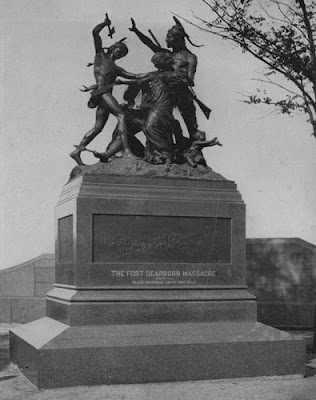
When I was a boy in the 1960s, I used to linger at this statue in front of the Chicago Historical Society. It's huge--certainly in my memory--these figures are larger than life. It shows the Potawatomi Chief Black Partridge rescuing the white settler woman Margaret Helm from being killed during what is remembered as the Fort Dearborn Massacre, when Indian tribes allied with the British during the war of 1812 successfully destroyed the Chicago-area settlement of Fort Dearborn. It's an evocative statue in a sort of heroic realist style. The "hostile" warrior raises his tomahawk to strike, the "friendly" chief's hand raised to stop him; the lithe Ms. Helm writhes dramatically, indeed erotically, between them. A white baby raises his teeny hand out for aid at their feet. I don't remember the other side clearly, though I remember further mayhem: I think another Indian crouches over his fallen victim. There's a visceral quality to it all: the rippling muscles, the violent instant eternalized in bronze.

Sometime after my departure from Chicago in the 1970s this statue was removed to a warehouse, a victim of changing sensibilities, and protests from Native Americans have prevented its planned re-installation in a memorial park for Fort Dearborn. Indeed the term "Fort Dearborn Massacre" seems to be falling out of favor, replaced by the Battle of Fort Dearborn.

I'm sure the railroad robber baron who commissioned this statue in 1893--interestingly enough a few short years after the final defeat of the Sioux nation at Wounded Knee--intended it to strike fear into the hearts of little white boys and virginal white maidens. It's surely some kind of triumphant monument to the final defeat of the fearsome savages, and proof that the industrious white race deserved its victory, so recently having proved its mastery of the continent. It's a justification for everything that happened between 1812 and 1893 as the United States moved west, pushing the indigenous residents onto smaller and smaller patches of land at bayonet point.

Oh it's clear that in the battle/massacre of Fort Dearborn, the Indians killed about half of those hapless settlers, soldiers and civilian alike, about 45 of them, and the half who survived were sold to the British allies. But in the ocean of blood spilt by the new republic as it pushed into Indian lands, this massacre was but a drop.

I don't remember feeling fear when I looked at this statue as a little boy. What I remember feeling was a kind of admiration. I wanted to meet those fearsome Indians, and it didn't matter whether it was the "bad" one about to deprive Ms. Helm of her scalp, or the "good" one nobly intervening. Those weren't savages, those were people; mysterious and compelling people, but people nevertheless. When me and my little friends played settlers and Indians I knew from this statue I always wanted to be the Indian. In my own play fantasies with my little toy figures I remember that the Indians always won the battle of the bedroom floor. My poor little cowboy and pioneer figures; half the time I was content to leave them in the toybox and just play with plastic Indians. Is this the way the world works among children? Do we choose sides so early?

Today America's bugaboo is no longer wild Indians, it's Muslims and terrorists, though in the popular imagination those two words mean the same thing anyway. A community board in New York City has just given permission for the construction of an Islamic mosque and community center, Cordoba House, near the "ground zero" site of the 9/11 World Trade Center attack, and predictably there's no end to the outrage. The imam of this center, Feisal Abdul Rauf, has plainly condemned terrorism; numerous victims of the 911 attacks were Muslims, and yet somehow, in typically bigoted American fashion, because the 911 hijackers were Muslim extremists this mosque is being called an insensitive insult to the memory of the fallen. Well, to the memory of the fallen non-Muslims apparently, since they're the only ones who count. Somehow the presence of an Islamic center near the eventual 911 memorial is just too much for these people to bear.

Even on the gay blog I read frequently, Joe.My.God., this mosque has engendered a fierce debate, with numerous gay men repeating ridiculous canards against Islam, basically suggesting that all Muslims want nothing more than to behead gay men on sight.

I am struck by how the tomahawking Indian savage of past American imagination has been replaced by the bomb-throwing, sword-bearing Muslim savage of present American imagination: both are charging fearlessly toward our heads, their goal expanded from just our scalps to our entire heads. This is rich with metaphor. Americans are nothing if not consistent. I suppose we are lucky that artistic sensibilities have changed: I'm trying to picture the bronze statue showing fiendish Muslims ravaging a modern Ms. Margaret Helm.

There's just something so arrogant about American intolerance. 911 was a terrible tragedy. I witnessed it. I lived with it. I walked home across the bridge with thousands of other frightened, saddened people. Every morning for weeks after the attack I saw the pillar of fire and smoke from my bathroom window. The nearly three thousand innocent people who died that day deserve to be honored and remembered. But we have no monopoly on tragedy. Our suffering as Americans doesn't make us superior beings. How many 911s has the United States inflicted on the people of Iraq, Afghanistan and Pakistan in its almost ten-year quest for vengeance? If you're a family in the rugged borderlands of Pakistan murdered by a predator drone that's mistaken you for a band of terrorists, is your death less tragic than an investment trader doomed at his or her desk? In the ocean of blood spilt during this misbegotten war between the US and "terror," what drops reflect the innocents of 911? Are those redder drops than all the people killed by "shock and awe" and its aftermath?

Whatever monument is built at the site of 911, I hope there are directions from there to Cordoba House. The monument to those lost that day needs to humanize people not demonize them. Oh I'm not saying it needs to rehabilitate the criminals who carried out the 911 attacks, nor am I offering sympathy for the perverse fundamentalists of Al-Qaeda. But as long as Americans fail to see themselves reflected in the faces of others, it will just be a matter of time before we have to build yet another monument to another massacre.

By way of humanizing the Potowatomi nation who won the Battle of Fort Dearborn--or committed the massacre of Fort Dearborn, your choice--check out The Pokagon Times for a video of the Pokagon band of Potawatomi performing at the rededication of a park at the site of Fort Dearbon in Chicago in 2009. A detailed history of the Potawatomi nations can be found at Tolatsga.org. Also recommended is the First Nations site index.

Top postcard photo from Chuckman's Chicago Nostalgia. Bottom image of the statue at its original location on the south side of Chicago from Wikipedia.
Friday, April 16, 2010

The lessons of Ernst Thaelmann


German communist leader Ernest Thaelmann (Thälmann) was born April 16, 1886. He was murdered by the Nazis in Buchenwald in 1944. These photos are of the massive graffiti-covered monument erected in Berlin on the centenary of his birth in 1986, just a few years before the fall of Communist East Germany; I took them in 1994.

Thaelmann is a problematic hero: the leader of Germany's Communist Party (KPD) he was arrested by the Nazis in 1933 and spent 11 years in solitary confinement in a concentration camp before being executed toward the end of the war. But despite his personal heroism, the years of his leadership saw the KPD make mistake after mistake. While the KPD had mass support in Germany, it constantly minimized the threat of the nascent National Socialists, the Nazi fascists, and directed most of its ire against the social democrats. Thaelmann was not considered a theoretical heavyweight, and his adventurist tendencies did not serve the KPD well. Thaelmann himself was known to swagger around in a sort of militaristic uniform to compete with the Nazi brownshirts.

At the risk of invoking the dreaded Godwin's law, Thaelmann's story should be something of a cautionary tale for today. While the teabaggers are not exactly Nazis (yet?), I think the left makes a serious error in discounting teabagger discontent. Progressives are faced with similar challenges as they were in Germany in the early 1930s: how to press our own agenda, critique the failings of the inadequately progressive administration of Obama without subverting the parts of our agenda that are, in fact symbolized by his election; and in defending progressive ideas against resurgent far-right Republicanism without taking responsibility for Obama's failings. This is immensely complicated by the fact that the right-wing is vastly more self-aware and organized than the left in the US. I continue to believe that saying it doesn't matter whether Obama or the Republicans win is short-sighted.

The KPD missed the key dividing line in the battle between left and right, and many historians accuse them of facilitating the rise of the Nazis. Let us not forget that battle continues today.


This monument is huge; it still stands. It's classic monumental socialist realism. It's centered in a fairly dreary modern housing project in Prenzlauer Berg in Berlin.