Welcome to The Cahokian... A thousand years ago Cahokia — across the Mississippi from what is now St. Louis — was one of the biggest cities in the world. Now it's an empty green spot next to the highway. I'm a middle-aged gay man living in New York City, center of the world, future footnote on somebody's future map. Welcome to the new world.
Showing posts with label Egypt. Show all posts
Friday, August 23, 2013
Anti-Americana: Unwelcome Visitor
I'm not entirely sure of the provenance of this image. It started appearing on my Facebook feed after the massacre of Ikhwan supporters in Egypt after the military coup. It shows a deadly spectre leaving a trail of blood as it moves along a hallway with doors marked "Pakistan," "Iraq," "Libya," "Syria" and "Egypt." The spectre is decked out in the stars and stripes, and its scythe is wrapped in the colors of the Israeli flag.
It is remarkable to me that the U.S. has, at least among its own citizens, preserved the laughable notion of being a benevolent, pacific world power gently using its influence for the greater good of the world's people. President Obama has displayed a remarkable clumsiness in foreign policy, as his speeches full of moral platitudes and lofty sentiment collide with American realpolitik, self-interest and remarkably self-evident hypocrisy. Sooner or later, all empires fall.
Anti-Americana is an ongoing series of anti-American propaganda art and caricature.
Saturday, August 17, 2013
Egypt: Sometimes Revolutions Fail
![]() |
| The aftermath of the army's crackdown on the Ikhwan: A grief-stricken man among the bodies in a makeshift morgue. |
‘[I]f the state is the product of the irreconcilability of class antagonisms, if it is a power standing above society and “alienating itself more and more from it,” it is clear that the liberation of the oppressed class is impossible not only without a violent revolution, but also without the destruction of the apparatus of state power which was created by the ruling class and which is the embodiment of this “alienation”.’ —V.I. Lenin, The State and Revolution, 1917
It has been two and a half years of hope, cycled with fear and disappointment. In the winter of 2011, millions of Egyptians took to the streets. In Cairo, Tahrir Square was turned into a carnival of revolution, an encampment where hundreds of thousands shook off the quiet of decades of political and military repression. In a model for the Occupy movement which followed later in the U.S. (which, it must be said, never quite reached the critical mass of the Egyptian — or Greek— squares movements), people camped out in public spaces, talking and celebrating and building a new reality 24 hours a day, defying the rules and laws of established order. There were waves of repression and violence, sectarian tension, and massive social ferment. Egyptians watched as the military, key to Egyptian state power in the most obvious ways, stood down and then consented to the overthrow of the Egyptian dictator Hosni Mubarak in February of 2011.
It's worth calling out the role of the United States during the Egyptian revolution: while cops used American-supplied teargas against protesters, the Obama government made equivocating noises until the die was cast that Mubarak would fall. As the U.S. has loudly shouted "Democracy!" it's clear what they've really meant was "Order!" It's also clear their primary concern is for the protection of Israel: Egyptian revolutionaries have over and over again called into question the peace treaty signed by Anwar Sadat, even as successive governments including Morsi's have done their part to enforce the Israeli blockade of Gaza. Jumping ahead a moment, the new military regime has been coordinating military attacks against Islamist rebels in northern Sinai with Israel and Israeli drones.
An interim government — again with the backing of the military — organized elections. After a long period of confusing debate a run-off election seemed to exclude both liberal democrats and leftists, forcing Egyptians to choose their new leadership either from a candidate tainted by association with the previous machine, or Mohammed Morsi, the candidate of the long-banned Ikhwan, or Muslim Brotherhood, an Islamist political party and social movement that sought to establish an Islamic State in a multi-sectarian nation. The Ikhwan promised to be more moderate than the far-right Salafist Islamist parties. Morsi won the election, and proceeded to use his new government to undermine democracy and give the Islamist movement permanent advantage. Leftists, liberals and Egypt's significant Coptic Christian population began to get nervous.
Fast forward to this summer, a new movement called "tamarod" ("rebellion") mobilized millions of people back into the streets. Some claimed that the ensuing demonstrations were the largest gathering of human beings ever. The military moved into action quickly, delivering an ultimatum not to the protesters, but to the Morsi government. In July, the military acted, and it deposed Morsi in a quick show of force. Millions celebrated the coup d'etat in the streets, though not the Ikhwan, who recognized that it had been backed into a corner.
![]() |
| A woman protester challenges a cop breaking up an Ikhwan protest encampment |
The Brotherhood soon set up its own protest camps in different districts of Cairo. Demonstrations turned violent, and a confrontation seemed imminent. This week, the military acted and attacked those camps. Over just a few days, hundreds maybe thousands of people have been killed, significantly including dozens of members of security forces. A heartbreaking post from an eyewitness on Facebook conveys some of the horror of the military crackdown on the Ikhwan:
"For the first time in my life I thought I wasn't going to make it home. This is a nightmare. After Friday prayer we had the Day of Rage march spilling out of the mosque into the streets. We prayed upon the deceased, wrapped in shrouds at the front of the minbar, their loved ones crying out in pain and raising their hands to the sky. We drove to Ramses, where all of the protests around the country were funneling into a massive one. As soon as I started walking, I saw reporters scurrying here and there with their cameras trying to get into the mobs. Smoke was everywhere...for the first time I experienced tear gas. That stuff hurts. Your eyes water, your throat cracks, you can't see, and the only way to relieve it is to pour pepsi into your eyes or water with yeast and breathe into a cloth. I was walking with my family into the crowd when we saw people running back, warning us not to go, they are firing live ammunition, people are dying. Helicopters are everywhere, dropping tear gas canisters. You can distinguish the crisp shots of live ammunition as opposed to the muffled blunts of the cartouche. I look up and I can see snipers atop the buildings. All of a sudden it is chaos. Everyone is running, everyone is pushing you or pulling you along; on one side there are thugs advancing upon you with sticks, on the other side are snipers and helicopters. The only thing you can do is flatten yourself against the walls of the buildings. One man lost his temper and started screaming in the middle of the streets, almost ripping his clothes off, telling us "WHY ARE YOU SCARED. THEY ARE TEN. WE ARE TEN THOUSAND. STAND YOUR GROUND." None of the protestors were armed. No one. As we advanced ahead, more gunshots, more people with cartouche wounds in their face. Small motorcycles were operating as makeshift ambulances as they urgently puttered back and forth, each time with a different man or woman on it covered in blood, some lifeless, some screaming in pain. There aren't enough motorcycles; some people are holding others like babies and running in the streets to the mosque which is housing injured folk. Dead bodies are being transported atop floor mats. There are mini fires on every corner of the street so as to make smoke so the helicopters don't see clearly. As we turned to head home, we found the street we were on was blocked with thugs. We took a side alleyway, hoping it was safer. As I was walking in the quiet alley, passing by a guy making bean sandwiches, I heard a sharp rat-a-tat-tat and turned to my right. A man not one meter in front of me, RIGHT IN FRONT OF MY FACE, got shot in the head and plopped to the floor, lifeless. His brother was holding him when this happened and started shaking the man's bloody face. He gave one last futile kick...I swear I saw his soul go out of him...and sunk like jello. His brother screamed in anguish...the deepest anguish I've ever seen, and threw himself at my feet. Sobbing uncontrollably, pounding at the floor like an infant, wiping his face and smearing blood everywhere. People picked him up, hugged him, kissed him, consoling him for something that couldn't be consoled. The dead man was carried away, pools of viscous ruby red pouring out of his head on the floor. When I walked home I saw a tank with soldiers sitting on it, stoic expressions on their faces. One woman in hysterics asked them if they were content in their hearts, to which the soldier replied yes, yes I am very content. I don't even know anymore. You can sit behind your computer screen talking politics, talking about churches or mosques or brotherhood or the STUPID word 'islamists' all you want...go ahead. This stuff can't be unseen." —Eman Haggag (August 16)
Not clear from this account is the massive division taking place in Egyptian society. It seems the military government has the support of massive numbers of Egyptians. And it's true, even as the Ikhwan is being violently repressed (again, U.S.-supplied teargas and weapons), its supporters have been attacking Christian churches as they retreat.
A statement from Tahrir-ICN, an anarchist network, nails the danger faced by the Egyptian people:
"The events of the past couple of days are the latest step in a sequence of events by which the military can consolidate its hold on power, aim towards the death of the revolution and a return to a military/police state.
The authoritarian regime of the Muslim Brotherhood had to go. But what has replaced it is the true face of the military in Egypt — no less authoritarian, no less fascist and for sure more difficult to depose.
The massacre carried out by the army against pro-Morsi supporters in Nadha Square and Raba’a has left around 500 killed and up to 3000 injured (Ministry of Health figures — the reality is likely much higher). It was a pre-orchestrated act of state terrorism. Its aim is to divide the people and push the Muslim Brotherhood to create more militia’s to revenge and protect themselves. This in turn will enable the army to label all Islamists as terrorists and produce an “internal enemy” in the country which will allow the army to keep the military regime in an ongoing state of emergency.
They go after the Muslim Brotherhood today, but they will come after anyone who dares to criticize them tomorrow. Already the army has declared a state of emergency for one month, giving the police and military exceptional powers, and a curfew has been declared in many provinces for the same amount of time from 7pm to 6am. This gives the army a free hand to crack down on dissent..." (August 15)
![]() |
| A cumpled poster for overthrown President Morsi |
So what has happened here? How is it that a revolutionary process that seems to have birthed so much hope all over the world seemingly come to such a terrible, bloody end, with an entrenched military dictatorship stronger than ever?
Let's go back again to Lenin:
"A state arises, a special power is created, special bodies of armed men, and every revolution, by destroying the state apparatus, shows us the naked class struggle, clearly shows us how the ruling class strives to restore the special bodies of armed men which serve it, and how the oppressed class strives to create a new organization of this kind, capable of serving the exploited instead of the exploiters."
It seems this crucial bit of revolutionary understanding has been lost. Even the Ikhwan, which rightfully saw seizing the government as key to its social agenda, seems to have forgotten that the state is nothing without the naked power of the military. The working-class communist left was destroyed by the radical nationalist Nasser in the 1950s. As happened across the Middle East, repression by rightward drifting nationalist forces drove a Leninist understanding of the state underground. While Egypt has a new generation of left organizations, none of these seems to have a strong mass base. The Trotskyist Revolutionary Socialists, for instance, seems to have bravely taken part in these two years of revolution, even losing martyrs to the repression. But in the end the Revolutionary Socialists supported the election of Morsi that has led to this predictable conclusion.
In my opinion, what the tragic unfolding of events in Egypt teaches us are some of the limits of horizontalism. Who could fail to be inspired by millions of people going out in the streets? Who could fail to be inspired by the new reality created in the mass democracy of the squares? In the early days of the revolution in 2011 there was some discussion of popular and factory committees, suggesting some will toward parallel horizontal self-reorganization of society; I can't tell how widespread or continued this movement was. But it's clear that this inspiring movement of people into the streets never challenged the real source of power of the Egyptian state. Indeed, Egyptian popular reverence for the military is repeated in news accounts ad nauseum. The whole world crossed its fingers and hoped that the Egyptian people would win, would win a new reality. How could millions of people in the streets, a scale unimaginable in the United States, lose? And yet, here we are.
What seems misunderstood to me in a horizontalist, or anarchist, critique of Leninist tradition, is the notion of how revolutionaries should organize. Horizontalists deride "vanguardists" for substituting themselves for the people, for being the seed of a future organized class of self-privileged dictatorship. I agree with anarchists that this is a danger, documented by certain historical failures. But what if the role of revolutionary leadership is to preserve the memory of theoretical and historical lessons? The capitalist state seems to well understand where its power comes from. In today's world it's true that not a lot of people are listening to communists, and there are lots of reasons why this is true, many of them excellent. But communist — Leninist — theory is rich with an understanding of the power of the state, and I think that it is incumbent on communists to offer up a bit of leadership by telling the truths it has learned about how revolutions unfold.
Egypt proves that none of this is an abstraction:
“According to the Marxist theory of the state, the army is the chief component of state power. Whoever wants to seize and retain state power must have a strong army. Some people ridicule us as advocates of the "omnipotence of war". Yes, we are advocates of the omnipotence of revolutionary war; that is good, not bad, it is Marxist. The guns of the Russian Communist Party created socialism. We shall create a democratic republic. Experience in the class struggle in the era of imperialism teaches us that it is only by the power of the gun that the working class and the laboring masses can defeat the armed bourgeoisie and landlords; in this sense we may say that only with guns can the whole world be transformed.” —Mao Zedong (1938)
The Egyptian revolution should remain an inspiration to all of us. It was a brilliant display of popular power, faults and all. Lenin talks about Marx's attitude toward the heroic Paris Commune, which was crushed in 1871:
"It is well known that in the autumn of 1870, a few months before the Commune, Marx warned the Paris workers that any attempt to overthrow the government would be the folly of despair. But when, in March 1871, a decisive battle was forced upon the workers and they accepted it, when the uprising had become a fact, Marx greeted the proletarian revolution with the greatest enthusiasm, in spite of unfavorable auguries.... Marx, however, was not only enthusiastic about the heroism of the Communards, who, as he expressed it, "stormed heaven". Although the mass revolutionary movement did not achieve its aim, he regarded it as a historic experience of enormous importance, as a certain advance of the world proletarian revolution, as a practical step that was more important than hundreds of programmes and arguments. Marx endeavored to analyze this experiment, to draw tactical lessons from it and re-examine his theory in the light of it."
So many popular movements have been successful in the past few decades, even though they may have not been socially transformative or socialist revolutions, it's hard to see this one apparently collapse. And sadly it probably won't be the last time the people are defeated as blood runs in the streets. We remember the 1960s as the decade when the Vietnamese were waging their ultimately victorious struggle against US imperialism, but we forget that was also the decade when half a million Indonesian communists were killed in a counterrevolution. So this is an opportunity to learn, and prepare ourselves for the next time.
What if the Occupy movement had been stronger? We saw how much the state felt threatened, how repression, albeit non-lethal repression, was quickly (and ultimately successfully) wielded to crush occupations across the country. What were the limits of our own radically rebellious horizontalism? While I think it would have been silly to suggest getting guns and running off to the woods to practice armed struggle, for equal reasons I think it would also be wrong, as some leftists are suggesting to the post-Occupy milieu, to channel all that rebellious energy to fielding electoral candidates. We must create and build popular power, but never forget the enemy we are up against. When there are millions and millions of Americans out in the street— and I believe this will happen one day — we will need to be there to share the lessons of history, and "The people united will never be defeated" is inspirational but incomplete.
(Crossposted to the Kasama Project).
Saturday, September 10, 2011
Hopefully Just the Beginning

That's a photo from Al Jazeera of one of the Egyptian protesters who last night attacked the Israeli embassy in Cairo. Protesters demolished a wall built by the Egyptian police to protect the embassy; some protesters gained access to the embassy itself and this one has ripped down the hated Zionist banner. Others threw confidential papers and files out the windows. The protesters waged a battle with Egyptian police, and today Israel announced it was pulling its staff out of Cairo. Good riddance. This comes a week after an insulting UN report on last year's Israeli pirate attack on the Gaza peace flotilla and Israel's repeated failure to apologize for assassinating eight unarmed Turkish civilians caused Turkey to expel the Israeli ambassador. Again, good riddance. Turkey and Egypt need to abrogate their treaties with Israel and stop enabling the repression of the Palestinians who they both claim to support.
Palestinian authorities have reaffirmed their intention to bring their case to the United Nations this month, hoping to get the UN general assembly to recognize a Palestinian State. The Obama administration, clinging to its obscene lie that it supports the rights of Palestinians, has continued to threaten to veto any Palestinian moves. Fortunately, the U.S. has no veto power in the general assembly. Obama and the U.S. government support only a Palestinian state that is a powerless, defenseless Apartheid-style bantustan on a tiny speck of historical Palestine. Since the last failure of farcical peace talks, the Zionist regime has gone full-steam ahead with its theft and seizures of Palestinian lands: so-called settlement activity — actually the illegal colonialization of Arab land and property — is at an all-time high and the U.S. is doing absolutely nothing but encouraging it.
It's clear that U.N. recognition of a Palestinian state on the rump territory Israel conquered in 1967 will not solve the fundamental problem of injustice in the region, but perhaps it will give the Palestinians some legal recourse to prevent further erosion of their rights and land. Since they seem to have few real international allies willing to actually use leverage against the State of Israel, they will have to keep doing what they're doing. The Angry Arab printed a photo of a sign at a democracy protest in neighboring Syria that reads: "We shall not forget you, O Palestine but we have been occupied with our blood."
And this is why the U.S. and Europe are so desperate to seize control of the wave of unrest that has been sweeping the Arab world: sooner or later the despots and corrupt leaders who speak out of both sides of their mouths will be gone, and nothing will stand between the obscenity that is the Zionist State of Israel and the people of the region who yearn for freedom and justice and peace.
Yesterday's protest at the Cairo den of spies was a good start.
Update: More great pictures of this historic event at the Occupied Palestine blog.
Saturday, February 12, 2011
Meanwhile....

That's the boardwalk at Atlantic City where I spent an evening and crisp winter day unintentionally gathering material for a new blogpost. There's nothing quite like watching a bit of the now at least partially successful Egyptian revolution on a hotel TV set. More on what I learned in Atlantic City later, but meanwhile here's a brief paragraph from the Lenin's Tomb blog about Obama's latest speech on the events unfolding in Egypt:
"Obama is speechifying in his classically elevated, sonorous fashion. He should shut up. He has nothing to say. He spent weeks first backing Mubarak, then the torturer Suleiman. He thought his man, Suleiman, had been put in charge last night. It never once crossed his mind that he would stop aid to the regime, even stop sending the bullets and tear gas that have been used against protesters. The US has been handed its arse by the Egyptian people, the vanguard of global democracy, and should at this point be feigning humility." As much as I can enjoy a good Obama speech, I think Lenin's Tomb's Richard Seymour has, sadly, nailed this one.
Thursday, February 10, 2011
Egyptian Revolution on the Brink

"All previous historical movements were movements of minorities, or in the interest of minorities. The proletarian movement is the self-conscious, independent movement of the immense majority, in the interest of the immense majority. The proletariat, the lowest stratum of our present society, cannot stir, cannot raise itself up, without the whole superincumbent strata of official society being sprung into the air." -- Karl Marx, The Communist Manifesto, 1848
Millions of people have been out in the streets of Egypt for over two weeks. Despite the daily predictions of the western media that the revolution is about to run out of steam, each day brings demonstrations bigger than the day before. According to eyewitnesses, the streets have become a huge festival of mass democracy. And yet the American-backed dictator Mubarak clings intransigently to power.
American diplomats are trying desperately to straddle both sides of the fence. On the one hand Obama claims to support democracy. On the other hand his diplomat sent to negotiate with Mubarak, Frank Wisner, turns out to work for companies with contracts with the Egyptian military and secret police: he's virtually an employee of Mubarak. After negotiations Wisner said, "Mubarak must stay in office in order to steer those changes through... This is an ideal moment for him to show the way forward." Obama proceeded to distance Wisner's position, and has been lining up behind new Vice President Omar Suleiman, head of the notorious Egyptian secret police. While Obama postures about the will of the Egyptian people, clearly he's concerned about letting things get out of control...of the American government and its Israeli allies.
So on the one side Mubarak and his massive security operation and control of the state. On the other the masses of Egyptian people of many classes and religions. In the middle is the Egyptian Army. The west seems to be desperate to find a leader it can impose on the revolution to make things nice.
And now the game has changed. Enter the Egyptian working class. I think it is no accident that today's dramatic events -- the rumor that Mubarak was stepping down, the rumor of a military seizure of power, and ultimately Mubarak's renewed intransigence -- are a direct response to the waking giant which has announced a series of political strikes. Because it is the Egyptian working class, with its hands on the gears of the Egyptian economy that has the power to push this revolution through to its righteous end. More than the rule of the Islamist Muslim Brotherhood the rulers of Egypt and their sponsors in Washington and elsewhere fear the power of the conscious and self-aware majority of the Egyptian people, unbeholden to the corrupt arrangements that perpertuate the rule of the dictator and his henchmen. They are terrified by what the unchecked success of the Egyptian revolution might mean for the other despotic rulers in the region. And they are freaking out about what this might mean for the struggle of the Palestinian people held in check by sellouts and betrayals. And the working people of Egypt have the power to break the stalemate; to split the army; to prevent the revolution being derailed by a new, replacement dictator at the helm of the same old same old.
The contrasts are now starker than ever. It's all out in the open. The U.S. must cut the strings to its puppet. The Egyptian people can see that the Americans are trying to attach those puppet strings to someone else and are rightly outraged. What the U.S. can do to help is pull its support from the Egyptian security apparatus and military.
The working class is about to speak. They can bring victory to the revolution. The days ahead are more dangerous than ever, but the prize is there waiting. The following statement was issued by a group of Egyptian revolutionary socialists a fes short days before the current strikes were announced:
"Call to Egyptian workers to join the ranks of the revolution
The demonstrations and protests have played a key role in igniting and continuing our revolution. Now we need the workers. They can seal the fate of the regime. Not only by participating in the demonstrations, but by organising a general strike in all the vital industries and large corporations.
The regime can afford to wait out the sit-ins and demonstrations for days and weeks, but it cannot last beyond a few hours if workers use strikes as a weapon. Strike on the railways, on public transport, the airports and large industrial companies! Egyptian Workers! On behalf of the rebellious youth, and on behalf of the blood of our martyrs, join the ranks of the revolution, use your power and victory will be ours!" -- Revolutionary Socialism Egypt (English translation from Lenin's Tomb.)
Many analysts predict that a massacre is brewing. There is certainly a real confrontation on the way. Who knows what's going to happen: I sure don't. But I'm inspired, and hopeful.
(According to the Angry Arab news service, the Arabic sign above reads "Down with Omar Suleiman, the Man of Israel.")
Monday, February 07, 2011
U.S. Trying to Derail Egyptian Revolution

According to the New York Times, "Vice President Omar Suleiman of Egypt says he does not think it is time to lift the 30-year-old emergency law that has been used to suppress and imprison opposition leaders. He does not think President Hosni Mubarak needs to resign before his term ends in September. And he does not think his country is yet ready for democracy."
Guest who the U.S. is lining up behind!
All of a sudden Hillary Clinton's State Department is all concerned with order more than democracy. American diplomats are huddling with Mubarak and his government. What's wrong with this picture?
(I first saw the above cartoon on Brother Peacemaker blog, though obviously it's from the Buffalo News)
Sunday, February 06, 2011
Foreign Policy Expert Sarah Palin Will Decide Who Can Rule Egypt

In a creepy interview with David Brody at the Christian Broadcasting Network, right-wing quitter and publicity whore Sarah Palin has offered her bizarre views on the situation in Egypt: "We want to be able to trust those who are screaming for democracy there in Egypt, that it is a true sincere desire for freedoms and the challenge that we have though, is how do we verify what it is that we are being told, what it is that the American public are being fed via media, via the protestors, via the government there in Egypt in order for us to really have some sound information to make wise decisions on what our position is. Trust but verify, and try to understand is what I would hope our leaders are engaged in right now. Who’s going to fill the void? Mubarak, he’s gone, one way or the other you know, he is not going to be the leader of Egypt, that that’s a given, so now the information needs to be gathered and understood as to who it will be that fills now the void in the government. Is it going to be the Muslim Brotherhood? We should not stand for that, or with that or by that. Any radical Islamists, no that is not who we should be supporting and standing by, so we need to find out who was behind all of the turmoil and the revolt and the protests so that good decisions can be made in terms of who we will stand by and support."
And she's miffed that Obama hasn't told her who's going to be the next president of Egypt: "It’s a difficult situation, this is that 3am White House phone call and it seems for many of us trying to get that information from our leader in the White House it it seems that that call went right to um the answering machine. And nobody yet has, no body yet has explained to the American public what they know, and surely they know more than the rest of us know who it is who will be taking the place of Mubarak."
Read the whole interview. It's a remarkable exercise in paranoia, arrogant presumption and pretending to know what she's talking about. She also brags about being a journalist. (!) And it's clear she has no idea that leading American politicians are not actually supposed to be saying they have the right to determine who will rule other countries.
Sadly, it is true that, lest things get out of control, President Obama and his diplomats seems to be settling on pushing out Mubarak in favor of the head of the secret police, Omar Suleiman, now appointed Vice President. (The AngryArab is priceless on the subject: "So basically, if you take Mubarak and his head of the secret police, `Umar Sulayman, the US would have been satisfied if only Hitler had appointed Himmler as his deputy."
Note to world: It is the Egyptian revolution and that means the Egyptian people get to decide what happens next.
Tuesday, February 01, 2011
Egypt's Mubarak Clinging to Power ... and American Lifeline

Today besieged Egyptian dictator Hosni Mubarak returned to the airwaves and said he would step down....after serving out the remainder of his "term" until new elections are held in September. This closely matches a "suggestion" made to Mubarak by a diplomat sent by Secretary Clinton and President Obama.
But what is really happening? I noticed something fascinating about the coverage of this turn of events. Note the New York Times page above, "Mubarak Won't Seek New Term" with the almost after-thought subhead of "Opposition Demands He Leave Sooner." Now compare this to the front page of the Al Jazeera English webpage, the Qatar-based newspaper that helped ignite the wave of unrest sweeping the Middle East:

"Defiant Mubarak vows to finish term." What a difference of emphasis! So who's right? Is the NYT insinuating that diplomacy is successful -- or are they expressing the ambivalence of a historically pro-Israel newspaper which is fearful of an Egypt breaking free into uncharted territory? And Al Jazeera -- sensationalist? Or are they being more truthful, calling Mubarak's maneuver a last-ditch attempt to cling to keep his own ruling clique in power?
President Obama spoke today after Mubarak: "Third, we have spoken out on behalf of the need for change. After his speech tonight, I spoke directly to President Mubarak. He recognizes that the status quo is not sustainable and that a change must take place. Indeed, all of us who are privileged to serve in positions of political power do so at the will of our people....Now, it is not the role of any other country to determine Egypt’s leaders. Only the Egyptian people can do that. What is clear -- and what I indicated tonight to President Mubarak -- is my belief that an orderly transition must be meaningful, it must be peaceful, and it must begin now."
As'ad abu Khalil of the Angry Arab News Service is having none of this: "As soon as I saw the defiant tone and substance of Mubarak's speech, I realized that he is not speaking for himself but for the US/Israeli sponsors. Israel erred before the Arab people by exposing her intense panic and fear from the prospect of an Arab democracy next door. Of course, Obama would take note and he consulted with his key adviser on the Middle East, Netanyahu. I just read the speech by Obama: it confirmed my suspicion, that basically Mubarak was permitted by the US to do with the Egyptian people as he would like... The speech by Obama was a not-so-coded language that let Mubarak do what he wish: the talk about transition means that he was basically told to stay in power, because Israel really freaked out at the prospect of Egypt without Mubarak."
So Obama says he abhors violence, and that the upcoming elections should be free and fair. But does this mean anything at all if Mubarak is allowed to remain at the helm for the next seven months? What does it mean that American aid will continue to flow to the military machines of the region: to Egypt, to Israel, to Jordan, to Saudi Arabia, to Yemen. The trail of money and weapons is visible to all: it's certainly visible to the protesters in Egypt. Isn't it hollow of Obama to say he abhors violence if he continued to fuel the threat of violent repression against the region's protesters?
According to AP, Mubarak's "speech was immediately derided by protesters in Cairo's Tahrir Square. Watching on a giant TV, protesters booed and waved their shoes over their heads at his image in a sign of contempt. "Go, go, go! We are not leaving until he leaves," they chanted. So maybe there's the answer.
[By the way I have alluded to the role of Israel in all this. From an article by Reuters about the reaction of the Israeli media to the Egyptian events: "One comment by Aviad Pohoryles in the daily Maariv was entitled "A Bullet in the Back from Uncle Sam." It accused Obama and his Secretary of State Hillary Clinton of pursuing a naive, smug, and insular diplomacy heedless of the risks. Who is advising them, he asked, "to fuel the mob raging in the streets of Egypt and to demand the head of the person who five minutes ago was the bold ally of the president ... an almost lone voice of sanity in a Middle East?" That's pretty clear!]
It might not be clear who will emerge out of the protests to challenge Mubarak for leadership -- but it's certainly clear that the tightrope being walked by the U.S. is getting thinner and thinner.
Monday, January 31, 2011
Anti-American Art: Revolutionary Appropriation

Hilarious application of graffiti to a Kentucky Fried Chicken in Tahrir ("Liberation") Square in revolutionary Cairo: The graffiti reads "No to Mubarak the US Client." Hah!
From 3arabawy's flickr, via the Angry Arab News service.
Sunday, January 30, 2011
Hope for Humans

I snagged this picture from an amazing collection of photos of Egyptian women in the current protests. It's on a facebook album compiled by Leil-Zahra Mortada.
Could it be any clearer? It's humanity vs. a faceless insectoid force. How inspiring moments like these are when fear is laid down and hope takes hold: hope that there is something better that can be grasped in the hands of people acting together. I hope the people of Egypt are not only able to stay resolute but able to win the hearts of these men dressed as insects, and have them shed their carapaces of repression and violence, and come over to the side of humanity.
Meanwhile on the side of the insects, Republican Weeper, er, Speaker of the House John Boehner said "What we don't want are radical ideologies to take control of a very large and important country in the Middle East."
Friday, January 28, 2011
People Choose Freedom, American Diplomacy Chooses Dictators

"'We are not taking sides' regarding the deadly clashes between protesters and government forces in Tunisia, US State Secretary Hillary Clinton said according to an English-language transcript of an interview with Al-Arabiya television, received by AFP on Wednesday." Reported on an Egyptian website (now offline due to state repression) and linked by the Angry Arab, January 12, 2011.
Two days later on January 14, a week of massive demonstrations sent the U.S. backed Tunisian dictator Zine Abedine Ben Ali packing to Saudi Arabia, legendary home of deposed tyrants. And so the U.S. backtracked and announced its support of the Tunisian revolution -- as though there was a choice -- to the point where President Obama even mentioned it in his State of the Union speech this week. But along the way the people of the Middle East noticed something: how easy it was to overthrow a tyrant.
In quick succession two more things happened stirring the political pot in the Arab world. First, the Lebanese national resistance movement Hezbollah, derided in the West as terrorists, but actually something much more complicated, flexed its muscles and caused the Lebanese government to fall. The pro-American prime minister was quickly replaced by one picked out by Hezbollah and its allies. Then, the Qatar-based Al Jazeera network released a wikileaks-like trove of documents that have come to be called "The Palestine Papers" documenting years of diplomacy between the Palestinian Authority, Israel, the U.S. and Egypt. The papers are dynamite: they show the PA cravenly giving in to Israel, and then show the Israelis turning away. They show plans for massive population transfers of Palestinian citizens of Israel to the West Bank and plans to give away huge swaths of Palestinian land in return for recognition of a PA microstate. They show massive collusion between Arab governments like Egypt and the Palestinian Authority with Israel during its brutal attack on Hamas-ruled Gaza two years ago. And they detail American betrayal after betrayal from the Bush era clear through to today's Obama administration. And they remind the world that when the Palestinians exercised free and fair elections and voted in a movement that the U.S., Israel and so-called moderate Arab regimes didn't approve of, these forces united against democracy and tried to crush that Palestinian will of the people.
Which brings us to this week.
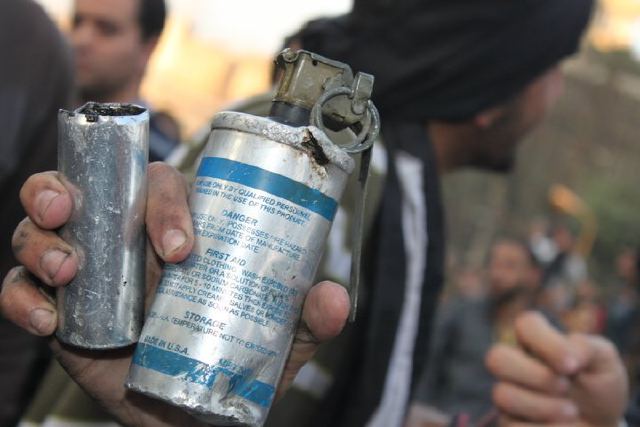
"O Mubarak. O Mubarak. Saudi Arabia is waiting for you!" -- chanted by demonstrators at the beginning of this week in Egypt. And so it began. Egypt is suddenly rocked by demonstrations, modest at first but soon massive. The Egyptian dictator Mubarak who has ruled Egypt since the assassination of Sadat thirty years ago is being put on notice by a mass pro-democracy movement. The Egyptian government sent out its forces of repression, at first sending the police and military into the streets, and then today shutting down telecommunications and the internet. The photo above shows where the teargas came from: here in the United States of America. (It's fitting to note that last month a middle-aged Palestinian woman was killed by American teargas wielded by Israelis in the town of Bilin.)
Last night Vice President Biden spoke on public television. Did he call for democracy? Hah! As reported by the Christian Science Monitor, reposted on Lenin's Tomb blog: "NewsHour host Jim Lehrer asked Biden if the time has "come for President Mubarak of Egypt to go?" Biden answered: "No. I think the time has come for President Mubarak to begin to move in the direction that – to be more responsive to some... of the needs of the people out there." Asked if he would characterize Mubarak as a dictator Biden responded: “Mubarak has been an ally of ours in a number of things. And he’s been very responsible on, relative to geopolitical interest in the region, the Middle East peace efforts; the actions Egypt has taken relative to normalizing relationship with – with Israel. … I would not refer to him as a dictator.”
Moderate Egyptian opposition figure Mohamed ElBaradei who has now joined the protests, reacted late this week to the American response in the New York Times: "He was stunned, he said, by the reaction of Secretary of State Hillary Rodham Clinton to the Egyptian protests. In a statement after Tuesday’s clashes, she urged restraint but described the Egyptian government as “stable” and “looking for ways to respond to the legitimate needs and interests of the Egyptian people.” “ ‘Stability’ is a very pernicious word,” he said. “Stability at the expense of 30 years of martial law, rigged elections?” He added, “If they come later and say, as they did in Tunis, ‘We respect the will of the Tunisian people,’ it will be a little late in the day.”

(Photo from today of a confrontation on a bridge over the Nile river from a Twitter feed.)
Today the demonstrations were more massive than ever, and military violence was unleashed. Demonstrators were bloodied and many were arrested; though there were some encouraging reports of demonstrators fraternizing with soldiers. Mubarak got on TV to say he would dismiss his government but would not give up power, and he threatened to unleash the full repressive power of the state. President Obama got on TV to call on Mubarak to respect the human rights of Egyptian citizens. But he also lectured the demonstrators against violence: "Violence and destruction will not lead to the reforms they seek." (Afghanistan, anyone? Anyway....) And he certainly failed to advocate Mubarak surrending to the democratic will of the people.
Meanwhile, demonstrations have been reported in Yemen.
Here's the sad truth, plain for all to see. While it's too soon to know what will ultimately happen, and too soon to know how any new governments in the region might orient to the United States and Israel, the first impulse of the United States has now been plainly and repeatedly shown to be backing dictatorships against mass popular democratic forces. All President Bush's trite claims of bringing democracy to the Arab world and President Obama's claims of new international relationships based on mutual respect are shown to be nothing more than empty tear-gas canisters.
The U.S. and its main ally Israel are shown to be more nervous about the threat of independent uncontrolled regimes than they are hopeful about an end to tyrants. No matter how in the end American diplomats might come to praise any revolutionary progress, their first choice was to defend the dictatorial status quo.
But these potential revolutions give me great hope. In them one might see a glimmer of hope that the collusion between corrupt gangs of thieves that prop up the Israeli apartheid state, that victimize the Palestinian people, that indeed dispossess regular people across the Middle East, might now finally be swept away. And no thank you, America.
Democracy FAIL.
(P.S. In addition to the blogs already mentioned check out Mondoweiss for great ongoing coverage of Egypt.)
Tuesday, January 25, 2011
The State of the... Middle East
Something amazing is happening in the Middle East. Revolution in Tunisia, directly threatening US (and Israeli) support of dictators; the resistance in Lebanon flexing its muscles; the amazing revelations from Al-Jazeera about the U.S., Israel and Fatah teaming up to sell out the Palestinian people; the Israeli government's whitewash about the Mavi Marmara. And now in Egypt. I'll compose my thoughts on all this in an upcoming post but meanwhile watch this incredible video just filmed in Egypt, as demonstrators stare down a police water cannon...shades of Tienanmen. Amazing and inspiring. First seen on Mondoweiss.
Thursday, January 21, 2010
Anti-American Art: Brawn vs. Naval Blockade

This Soviet poster dates back to 1956, to the blockade of Port Said, Egypt, during the 1956 Egypt-Israeli war. Here the enemy is the navy of the US and the UK; and the hero is a muscled rifle-bearing bedouin. My Russian is rusty but it says something like "Stop the Aggressors!" Interesting to me that this piece of propaganda from the height of the cold war is purely nationalist in its appeal: no workers or red banners this time.
Oh yeah, and you can get this one on a tee-shirt or mug!
Subscribe to:
Comments (Atom)