Showing posts with label technology. Show all posts

Friday, October 07, 2011

What Is the Steve Jobs Legacy?


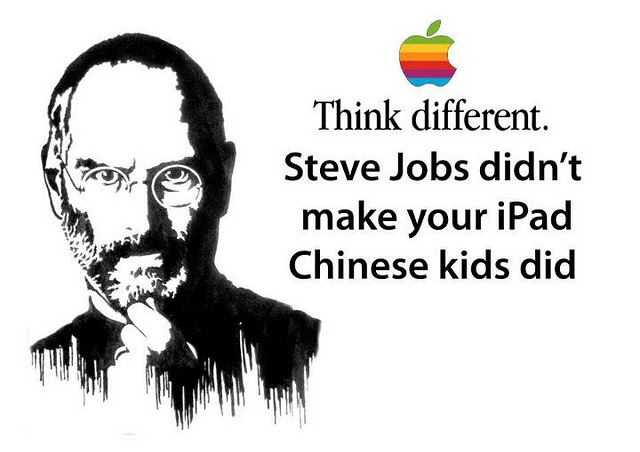
"Think different. Steve Jobs didn't make your iPad, Chinese kids did."

Since the products of Steve Job's Apple Corporation are by and large what has made the internet what it is today, it's not surprising that outpourings of grief for Mr. Jobs have been front and center on the internet since he died yesterday, far too young, of the dread pancreatic cancer. By all accounts he was a brilliant man who truly changed the world in ways that define our current era. I currently produce this blog on an iMac, and my professional career is currently based on working on Macs. I love my iPod, and the fact that I have no iPhone to love is a product of my deficient personal economy not aspiration. I post this graphic I found not to disrespect the memory of Mr. Jobs nor to demean his achievements. But I was immediately struck by how direct and important the message of this graphic is, and how superficial and partial are so many of the ubiquitous encomiums to the legacy of Steve Jobs. I certainly don't post this graphic to make anyone feel guilty about their Apple products since I'm guessing nobody but the Amish can claim a life free of the products plucked from the trees of universal corporate exploitation.

To my mind the statement of this graphic is less than a condemnation of Mr. Jobs — though a proprietary relationship with factories employing child or slave labor is highly problematic — but more a condemnation of us as consumers for not remembering that without the workers, children or adults, laboring to produce these miraculous little machines, Steve Jobs was nothing but a man with great ideas. I have my cool iMac and iPod not just because of his imagination, but because flesh and blood people put these things together with craftsmanship and know-how. And the fact that I was able to afford these things is probably thanks to the fact that other people made less money than I to do the hard work of making these things real.

Pondering all of this I did come to another realization: every time in the last twenty-some-odd years I've found myself out of work, I could blame Mr. Jobs and his creations. And here is something not often stated about our current economic condition.

In the 1980s I supported myself as a photo-typesetter. It was a valued craft. The development of desktop publishing via MacIntosh toward the end of that decade killed the typesetting business, and with it my skill-set. I transitioned first to pre-press, and then to the production and creative end of computer-based print graphics. But I wound up working in the music business, and soon iPods and iTunes killed the demand for CDs, and down went the music business starting in the mid-2000s and with it my replacement career and skill-set. Today I am slightly underemployed, working freelance in the print newspaper business at a much lower level than I was before. With the continued internet revolution and the development of the iPad, the grim reaper has his eye fixed firmly on the business model that supports me. I'm not sure at all what I will do when print design finally bites the dust or when the last newspaper goes all digital.

Don't get me wrong, I love the modern technology. I consume it. But talking about the economic crisis, if manufacturing is largely gone from the U.S., and soon fields like mine which once employed millions are obsolete memories, what indeed will we all be doing for work in the future? If computerization and automation combined with outsourcing so sharply reduce the number of people needed to keep the world functioning, it strikes me that all this nonsense the government is play-acting through about "job creation" is so much missing the point. With the one-two punch of technological improvement and the globalization of labor, there really is less and less for Americans to do. Of course, stupid Republicans, the government is going to be bigger, because that's getting to be one of the last places the jobs are. Along with serving bad, robotic food and working for banks or insurance companies to find ways of ripping people off of their money.

It seems inevitable that the much-lauded creative engine of capitalism would contain the seeds of its own obsolescence. Steve Jobs was very very smart: yes, visionary even. But not smart enough to avoid creating a world divided into soon-to-be-unemployed consumers with useless, outdated skills, and exploited, regimented child slaves working their tiny skilled fingers by the piece.

Graphic snagged from Lenin's Tomb.

Friday, May 13, 2011

Blogger Craziness

Skynet aka Google's Blogger platform has been erratic and/or down for at least a day. It seems, at least temporarily, to have eaten my ever so witty post on Newt Gingrich. I call conspiracy! Anyway, Blogger seems back up, and I will resume new posts tonight and this weekend. Hopefully the Gingrich post will reappear.

Update: Gingrich post has reappeared and is thus preserved for posterity!

Thursday, December 09, 2010

Digging in the Crates: Art Webb Reissued on CD!!


At various times in the history of digital music since CDs started to take over in the 1980s, reissues of pre-CD LPs have gone through many phases. When digital technology first took over, record companies rushed to put parts of their catalog back on the shelves. I remember furiously making the rounds of record stores every week, hoping against hope that some of my favorite wax albums had been upgraded and brought back to life by CD. Sometimes I scored, often via costly European and Japanese imports. As CD technology improved, record labels would go through another wave of back-catalog reissues, and sometimes in addition to re-reissuing remastered albums they'd dig a little deeper and broader and more forgotten vault treasures would spring back to life on the shelves. Falling for record-company hype over and over again, there are even a handful of albums I have bought three times on CD. It's a familiar pattern. The first digital reissue was welcome but didn't sound so good. Then the remastered version. WOW! And then the remastered deluxe edition in a nice digipak or mini LP-sleeve with bonus tracks. DOUBLE WOW! And the record company makes money over and over again from the same repertoire. But some albums just didn't seem to make it into the CD age, and I have on several occasions replaced favorite worn out-of-print vinyl LPs with slightly fresher less worn-out used copies.

A few years ago when digital downloads and iPods started to change how music was consumed, free (called by some, illegal) file-sharing became the rage. All of a sudden thousands of lost LPs were digitized by music lovers and shared for free over the internet. What fun! As both a consumer and sharer (through my music blog Ile Oxumare), I found this amazing. LPs I thought I had no hope of hearing again or for the first time even circulated freely among a community of music heads, real fans most of them, dedicated to the love of the groove.

And yet as the death of the CD is hourly reported, as music lovers have rediscovered crates and crates of great old LPs, it seems record companies have discovered that licensing old titles out to semi-independent labels has a little more money-making life left in it. Music blogs seem to have proved that crate diggers and seventies-grooves connoisseurs are still a loyal audience who buy enough CDs to make a new, even deeper, foray into the vaults worthwhile.

Which brings me to my discovery that two of my favorite 1970s discofied jazz-groove albums have finally made it to CD. Courtesy of the Wounded Bird reissue label, I am happy to welcome back flautist Art Webb's albums "Mr. Flute" and "Love Eyes," both, I believe, originally released back in 1977. (I bought both my copies from Dustygroove.com of course).


I bought both of these LPs back in the day. Having fallen in love with Blue Note jazz flautist Bobbi Humphrey's albums when I was in high school, I somehow assumed that all jazz flute must sound like her. Sorta funky, gurgling with danceable energy and complex, heady electric arrangements, and the occasional mellow if unvirtuosic background vocal, when I started consuming jazz LPs upon my arrival at college I kept running into disappointment in the pursuit of more jazz flute. Artists I now respect as awesome like Lloyd McNeill and James Newton disappointed the hell out of me at the time. Herbie Mann? Gees, guy pick a style and stay with it. And then I found Art Webb.

Art Webb turns out to have been a mainstay of the New York Latin music scene, and while these albums are not Latin music per se, his cred in that area comes shining through. "Mr. Flute" does conclude with an almost Santana-like Latin fusion tune cut with the group Raices, but I tended to skip that track in my hip-swinging youth. The real starmaker of "Mr. Flute" is producer Patrick Adams, who spent the late 1970s and early 1980s pioneering a gloriously glossy urban sound. And by urban I mean disco, baby. This album sounds like jazz funk dipped in a little Salsoul, with sweeping strings, a propulsive Latin beat, and the best background grooves studio singers and musicians could sell. Oh yeah and Art Webb plays the flute.

Which comes across as mean, I suppose, but what I realized from Bobbi Humphrey and Art Webb both is that the flute is a brilliant focus for a groove, riding along like foam on the crest of a wave, but I have no idea if their playing is particularly good. Oh the music is brilliant: it seduces each part of my body to the parallel lines of its groove. A little chunky guitar, the congas and cowbell, the cooing of female vocalists, the glorious bells, buried harmonies of golden horns, the sweep of those strings. Some of these songs have words, I suppose, but they're not lyrical ballads, these snatches of phrases and words whose beauty is momentary and whose meaning is nothing except the joy of getting lost in this beautiful sound. When that singer commands us to Smile in my favorite track of "Mr. Flute." that is exactly what I do. And if Herbie Mann's attempted forays into disco about the same time sounded crass and cliched, almost embarassingly forced, Art Webb via Patrick Adams gets it exactly right. While I don't think this music made it big on anybody's playlist -- it was still, after all, consigned to the deadly bins of Jazz -- the sound captures something about the spirit of the boogie, if you will, all in it together, no stars, no self, just groove.

I even featured a scratchy rip of one of these albums in the early days of Ile Oxumare. The new CD sounds terrific though, and my rip is now officially retired.

"Mr. Flute" was an album of mostly originals, and as much as it made an impression on me, it didn't really crack the charts. The follow up, "Love Eyes," tried to remedy that by including some covers, strangely all from the orbit of late Charles Stepney-era Earth Wind and Fire. There's "You Can't Hide Love" and "Devotion" which EWF both performed, and the amazing "Free" which made Deniece Williams a star under EWF's tutelage. Hubert Eaves is now in on electric piano and Patrick Adams is replaced by the eclectic John Lee and Gerry Brown, flown in from the continent on some starmaking errand, no doubt, from backing up for obscure-in-America European fusion musicians. The covers are more than serviceable -- God bless a world filled only with Earth Wind and Fire covers, I mean, really -- and even though the general formula is the same as "Mr. Flute," the album doesn't have quite the same brash freshness to my ear as the first. Not that I could live without either of these albums. These are wonderful things to have on pristine digital reissues, and whether or not the end of the CD is nigh--certainly the first thing I did when I got these is rip them to my iTunes--I'm thankful that somebody is still digging in those crates and bringing these tunes back into the light.

Thanks Art, for making this music!

Sunday, November 14, 2010

Proletariata Obsolescens: My Pocket Pal


I suppose it's a cliche to marvel at modern technology, but at least for somebody my age it's just hard not to. This is my copy of the Pocket Pal. As you can see from the scribbling on it I inherited it from Joe Cammilleri, one of a handful of old-timer graphic production people I worked with who made it to new technology. (He dropped dead at a family picnic in the late 1980s; he was in his sixties. Everybody at the type shop we worked at went to his wake.) Anyway the Pocket Pal was a treasured possession back in the day. Published by the International Paper Company, it was a pocket-sized book that was sort of a how-to bible of old-school graphic arts. It explained how everything worked, and had some basic charts and descriptions that were key to understanding any job or process somewhere along the graphic arts production chain. First published in 1934, mine is the snazzy 12th edition, hot off the presses in 1981.


I got my first job in graphic art in 1981, when I moved from Chicago to New York to be the Art Director of The Revolutionary Socialist League's newspaper, The Torch/La Antorcha. The guy who had put the paper together for years--he went by the name Lee but he was a veteran of the old S.D.S. named Morgan Spector--had learned a bit of the real newspaper craft as a youth working in California. He was tired and wanted to move on. Lee explained to me the basics of typography and layout. We could have used a Pocket Pal: even if our technology was pretty basic, we were only a few steps into post-mechanical production and there was stuff I wish we had known. The Pocket Pal details moveable type (above), linecasting and monotype even these were pretty much obsolete in the U.S. by 1981.

We had an early phototypesetting system, the CompuGraphic Comp One. It had a one- line memory, and a primitive one-line illuminated dot-matrix readout instead of any kind of video screen. It was very basic typesetting; there were a handful of codes you had to learn. Once you pressed the "return" key, there was no going back, the wheels inside the magic box spun and exposed photographic paper from a very bright bulb through a film strip. If you wanted to change the size of the type or the font, you had to open the machine and change the font film strip. When all of a manuscript had been re-typeset onto a galley, you had to remove the film cannister and put it in a special photographic processor. Out came a galley of type ready to be cut up and pasted up...and of course that's how the newspaper itself was actually laid out, with a razorblade, a waxer, a T-square, and a wonderful wooden easel. There was another similar machine called a headliner that generated display type. On special occasions we'd break out the presstype. In a couple years the technology improved to be more computerized: you entered the coded galleys of type onto a more standard computer screen and everything was recorded onto a giant floppy disk. The CompuGraphic Editwriter seemed like a miracle. An expensive miracle.


While the name is now dated, sounding like a bit of a medical issue, when VDT's hit typesetting it seemed like a miracle. That's Video Display Terminal. They displayed horrible bluish white or green letters against black, and they weren't even slightly WYSIWYG. You had to memorize a library of coding to generate a good paragraph of type. The Pocket Pal explains how all this works, with a precision of language and description that is admirable. It's all up to the ghost in the machine with today's digital publishing world, but not so back then. At my last typesetting job toward the end of the 1980s there was a person whose job it was to simply mark up the kerning between every single letter of type that we generated: she sat there with her schaedler rule measuring the number of points to be added or subtracted between every letter to make the type look "massaged."

Typesetting was a real old-fashioned trade. While it was unionized for big newspapers and the like, small nonunion type shops were all over the place. It was a great job for people who had other things going on in their lives. You could quit your job one day and choose from a page of them in the classified ads the next day to find more work immediately. You had to know what you were doing, though, so the hourly rate was pretty good. I learned and worked two different systems over the years, and even though the machines are completely obsolete, I think the old-school craft I learned from my coworkers has served me well in the digital world.

There's only a small bit of still relevant information in my Pocket Pal. Technology has steamrolled on. If you read between its lines, you realize a whole layer of working class craftspeople has been made obsolete and disappeared. As much as I love the miracle of graphic design on a Mac computer--InDesign and Adobe Photoshop are incredible tools--it's weird to think of how much skill and craft has been completely replaced by machines. And as much as I love the freedom of creative expression on the internet--like this blog--I wonder what we have traded up for when people's sense of class solidarity seems to have all but disappeared.

At least I'm certified as a punchtape telex operator for life!