

Yesterday the headlines and my friends' Facebook links were filled with reports of a Pew poll that suggested while Americans might be very religious, their knowledge of religions, even the ones they follow, isn't very deep. Since atheists scored highest on the poll, the New York Times asked the president of American Atheists why this is. He's quoted as smugly responding, “Atheism is an effect of that knowledge, not a lack of knowledge. I gave a Bible to my daughter. That’s how you make atheists.”
I came to religion late in life; well by late I mean while an adult not a child. I had been raised without religion. I knew that my mother had a certain attachment to Catholicism and its ideals, and especially to Jesus, but that she loathed the church establishment itself, and she chose to raise me without any formal religious indoctrination besides letting me play with the creche figurines on Christmas. When I eventually felt a spiritual pull, being an intellectual person I certainly did a lot of reading about religion and made a thorough investigation of the paths I found myself walking down.
I read a lot of books on Neo-Paganism and later, Santeria. I learned all sorts of arcane details, historical tidbits, and history buff that I am, I ate that all up with relish. But what I credit my actual spiritual awakening to was not what I read in books. It was not the intellectual knowledge I was absorbing but the act of having my eyes, my heart, my mind, my soul, if you will, opened up to religious experience. All the books were enlightening and entertaining and all, but they ultimately meant little without the transformational way I came to experience the presence of God, of a deity immanent in nature around us, of spirits, of natural spiritual energies, of powers and happenings outside the mundanity of life and the linear trail of the intellect. I gained knowledge of my faith not by reading about it but by practicing it.
I'm glad I undertook an intellectual investigation and glad I studied the details I did. But that stuff was not necessary to experience the blessings of religion that came to unfold in my life. The most transformational experiences I had--a few while a Neo-Pagan and then ultimately the week-long initiation ceremony into Santeria and the year in white as an Iyawo that followed--were emotional and spiritual experiences that words, that intellect, can't adequately describe. I mean, I could tell you what happened, but that wouldn't be the same thing as allowing you to experience it. I didn't choose a religion because of what I read about it, I choose a religion because of how its practices made me feel. One could have these experiences without reading about them or their origins first.
When I write about my religion I do so to attempt to share an experience, or to offer some information that makes the experience of, say, listening to Afro-Latin jazz more rewarding. But I'm not exactly trying to convince you, dear reader, that I'm right. My faith comes from a personal revelation that changed my worldview and colors every experience in my life. If you haven't had the same experience as me I can neither judge, criticize nor condemn you. And while knowledge of the kings of medieval Yorubaland (today's Nigeria) is an interesting cultural and historical footnote to Santeria it's knowledge that is ultimately irrelevant to practicing the religion and being lucky enough to receive the blessings of the Orishas.
So for once I'm going to defend that majority of religious Americans who don't know all these historical details of Joseph Smith, Martin Luther or Maimonides. These facts could sure enrich the lives of American Christians and Jews as all history enriches our lives and makes us smarter, but they're not details necessary to love God, or to live a good life. And contrary to what the quoted atheist says, a person who feels the spirit can love the blessings of the Bible's Psalms without embracing the admonitions of Leviticus...even I the non-Christian recognize this.
Which is likely to make non-Muslim Americans more tolerant of Muslims, American or not: a history lesson about Muhammad and seventh-century Arabia? Or some emotional understanding of the spiritual humility Muslim believers feel before God? What if people of different religions focused not on the historical record that has divided us into different armed camps but on the common shared drive to find spiritual reverence and meaning in everyday life?

As I see it religions are man-made creations: attempts by different cultures to come up with the best way to experience and love God and the mysteries of life. Between crusades, inquisitions, suicide bombings, ethnic cleansings, 100-year-wars, armadas, slaveocracies and serfdoms people have done some terrible things in the name of those religions: in my opinion misunderstanding those religions. Obviously learning about all those terrible things is an important part of building a better world: I heartily endorse learning.
But there's nothing wrong with knowing only that God is real; that the world around us is alive with spirit; and that each of us has a choice to live our lives righteously, respecting and loving each other as we love ourselves. And so if the Pew poll suggests atheists know more about religion than religious people, so what. It's left out the most important thing that atheists cannot know: what it feels like to believe in God.
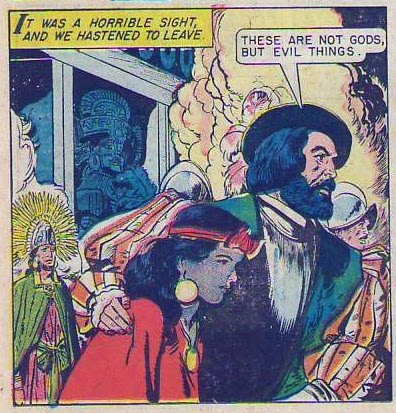
(The illustrations above are frames from the Classics Illustrated comic-book version of "The Conquest of Mexico." That's Aztec emperor Moctecuzoma lamenting the bad attitude toward his religion expressed by the Spanish conquistadores.)


